
Payment processor licensing in Canada is the set of registrations and provincial licences a provider must hold based on what it actually does, which legal entity performs that function, and where it operates. A checkout page can look polished while the infrastructure behind it is unregistered, unmeasured, or dependent on a single third party nobody has mapped. For merchants evaluating providers across Canada and the US, the questions that matter come after the demo: who is the contracting entity, what regulatory standing does it hold, what reliability targets does it measure, and how does its integration layer behave when a request fails mid-flight. What follows is a practical vetting frame built on Canadian supervisory guidance and published API and zero-trust standards to serve as your payment processor buyer’s guide.
TL;DR
- Bank of Canada RPAA requirements for risk-management and end-user-fund safeguarding frameworks came into force on September 8, 2025, so evaluate evidence of implemented controls, not stated future plans.
- A comprehensive payment processor buyer’s guide goes beyond uptime, focusing on entity licensing, incident response, and API resilience.
- ‘Applicant’ and ‘registered’ are not the same status. The Bank maintains separate public lists and publishes registration decisions, including refusals and revocations with reasons.
- For interconnected PSPs, the Bank recommends four reliability target types: system availability, recovery-time objectives, maximum tolerable downtime, and recovery-point objectives.
- OWASP names “Unsafe Consumption of APIs” a critical risk, and RFC 9110 idempotence is how a mature integration stops duplicate effects after a retry.
What does payment processor licensing in Canada actually require?
When it comes to payment processor licensing, Canada offers no single credential that covers every obligation. Under the Bank of Canada’s supervisory framework, payment service providers subject to the Retail Payment Activities Act must apply for registration to continue providing their services, which makes identifying the actual legal entity behind the product brand the first diligence step. The Bank keeps separate public lists for applicants and for registered PSPs, publishes registration decisions including refusals and revocations with reasons, and states that foreign PSPs subject to the RPAA must register even if they are not incorporated in Canada.
FINTRAC registration is a separate matter and carries no endorsement. FINTRAC’s MSB transaction guidance states plainly: “The registration does not indicate that FINTRAC endorses or licenses the business.” Money services businesses operating in Canada must register before operating, and FINTRAC’s MSB requirements describe core obligations covering a compliance program, recordkeeping, client identification in specified cases, and reporting. Quebec adds its own layer: an entity operating a money-services business for payment must hold a licence under the Money-Services Businesses Act where the activity falls within that regime, and Revenu Québec’s MSB licence application process ties the decision partly to security-clearance reports for the business and associated persons.
Yuzera is a tech-forward fintech and solutions provider serving merchants across Canada and the United States with proprietary POS software and hardware, payment orchestration, and value-added services for in-person, online, and mobile environments. Bank National Association and Elavon. This article is educational, not legal advice; obligations depend on each entity’s functions and jurisdiction.
What makes a reliable payment solution for online sellers?
A reliable payment solution is one that can show measured targets for availability and recovery, not just a marketing uptime figure. The Bank of Canada expects PSP risk-management and incident-response frameworks to preserve the integrity, confidentiality, and availability of payment activities and the related systems, data, and information. Its operational risk guideline puts it directly: “A PSP develops reliability targets and indicators to assess the achievement of its integrity, confidentiality and availability objectives.”
That gives online sellers a better question set than “what is your uptime” when seeking a reliable payment solution. For more ubiquitous or interconnected PSPs, the Bank recommends at least four types of reliability target: system availability, recovery-time objectives, maximum tolerable downtime, and recovery-point objectives. A recovery-time objective is the maximum time in which a disrupted system, service, process, or function should resume operations. A recovery-point objective is the maximum acceptable data loss, measured by time. Ask for all four, then ask how performance against them is monitored and reviewed.
Reliability is also an operating discipline rather than a platform feature. The Bank identifies business continuity and resilience, cybersecurity, fraud, data management, information technology, product design, change management, and third parties as operational-risk categories that can affect retail payment activities. Frameworks must be reviewed at least annually and before material changes, with the review evaluating effectiveness against those integrity, confidentiality, and availability objectives. For a high-volume seller, the practical translation is simple: a provider that reviews its own framework on a schedule is far more likely to catch vulnerabilities before your peak season does.
What makes a modern payment gateway modern?
A modern payment gateway is defined by identity-based security, governed dependencies, and current payment-page controls, not by how recently its dashboard was redesigned. NIST’s cloud-native zero trust guidance says granular application-level security policies require authentication and authorization based on application and service identities rather than network location, and names API gateways, sidecar proxies, and application-identity infrastructure as the components that enforce those policies across on-premises and multicloud environments. The same guidance notes that modern enterprise environments run distributed, loosely coupled microservices across several environments, so ask a provider to explain identity, access control, monitoring, and policy enforcement across its whole integration landscape.
Dependencies deserve equal scrutiny. Bank of Canada guidance treats cloud providers, backup-storage facilities, technology-management providers, cybersecurity and fraud-detection vendors, banking partners, and providers of safeguarding accounts, insurance, or guarantees as third parties relevant to a PSP’s risk framework. When assessing a third party, a PSP should understand that provider’s reliability targets and indicators, performance against them, internal controls, cybersecurity risk management, monitoring and testing arrangements, and breach and recovery plans. That is a ready-made question set a merchant can borrow directly. The Bank also flags concentration risk, where reliance on a particular third party, asset, system, or role can hinder a PSP’s ability to meet its objectives, so expect a credible answer on substitutability for material dependencies.
Finally, confirm the payment page itself is current. PCI SSC’s e-commerce security update notes that PCI DSS v4.0.1 requirements 6.4.3, 11.6.1, and 12.3.1 became effective on March 31, 2025. A well-governed REST API makes these controls easier to maintain.
What should you expect from a provider handling REST API payments?
A system managing REST API payments should be able to document how that API is authenticated, versioned, monitored, sandboxed, and protected against duplicate effects. API availability on its own proves nothing about maturity. The OWASP Foundation’s API security introduction describes the API Security Top 10 as an awareness resource for developers, designers, architects, managers, and organizations, which is a reminder that secure design and ongoing maintenance, not the mere existence of endpoints, are what distinguish secure platforms.
Start with the integration surface in both directions. OWASP identifies unsafe API consumption as a critical risk, warning that organizations often trust third-party API endpoints without adequately verifying transport security, authentication and authorization, input validation, and sanitization. A provider consumes other APIs too, so ask how it validates what comes back from fraud tools, tokenization services, and banking partners.
Then test failure behaviour, which is where REST API payments either hold up or create reconciliation work. The IETF’s HTTP semantics standard defines an idempotent method as one where multiple identical requests have the same intended effect as a single request, and notes idempotence matters precisely because requests can be repeated automatically after a communication failure. Ask how the provider prevents duplicate charges when a client retries an interrupted request, how idempotency keys are scoped and how long they persist, how webhook or event payloads are signed and replayed, and what audit logs a merchant can query directly. Yuzera builds its e-commerce gateway, virtual terminal, and POS stack to be integrated and observed, not treated as a black box.
What belongs in a payment processor buyer’s guide?
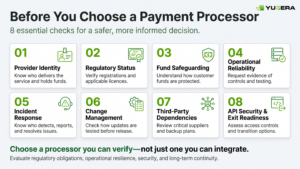
A payment processor buyer’s guide should move in a fixed order: entity, regulatory status, funds, reliability evidence, incident response, change management, third parties, API controls, and exit readiness. Identify the exact entity that provides the service, holds funds if applicable, and owns incident response, then check its status against the Bank of Canada’s applicant and registered PSP lists rather than accepting a general claim of being regulated. Confirm separately whether the business model triggers FINTRAC MSB requirements or a Quebec licence; Revenu Québec’s MSB public register can be searched by business name, licence number, address, or ATM number, though it cautions that an authorized MSB may not appear and advises contacting Revenu Québec if it is not listed.
If the provider holds end-user funds, ask how they are safeguarded and what happens on insolvency. RPAA registration applications cover ownership, key staff, payment functions, end-user funds held, safeguarding methods, and whether a risk-management and incident-response framework exists, and those requirements have been in force since September 8, 2025. Those same categories make excellent direct questions.
Close with operating discipline. Ask who detects incidents, who communicates with merchants, and who coordinates recovery. Ask how risk is identified before material product, system, or integration changes, what testing occurs, and whether vulnerabilities found in testing are fixed before release. Where a PSP has an internal or external auditor, a sufficiently skilled and independent individual must review the framework at least once every three years. Then map material third parties and ask whether transition and supplier-failure plans are documented and tested.
FAQ
Q1) How can merchants verify payment processor licensing in Canada?
Start with the legal entity, not the brand. Check the Bank of Canada’s public lists to see whether that entity appears as an applicant or as a registered PSP, and read any published registration decision. Separately, confirm whether FINTRAC MSB registration applies and whether a Quebec Money-Services Businesses Act licence is required for the activity in question. Obligations differ by function, entity, and province.
Q2) What should online sellers look for in a reliable payment solution?
Measurable targets and tested recovery. Ask for system availability targets, recovery-time objectives, maximum tolerable downtime, and recovery-point objectives, plus evidence of how actual performance is monitored. Confirm the provider reviews its risk-management and incident-response framework at least annually and before material changes. A single uptime percentage, offered without recovery objectives or incident-response detail, is not evidence of a reliable payment solution.
Q3) What technical features make a modern payment gateway secure?
A modern payment gateway enforces authentication and authorization based on application and service identities rather than network location, governs its cloud and vendor dependencies, and keeps payment-page controls current with PCI DSS v4.0.1. Expect clear answers on concentration risk and substitutability for material third parties, and on how identity, access control, and monitoring work across distributed microservices.
Q4) Should merchants specifically look for REST API payments?
Supporting REST API payments makes integration and automation easier, but it is not automatically a security or reliability credential. What matters is how the API is secured and governed: transport security, authentication and authorization, input validation, versioning, sandbox environments, signed webhooks, audit logs, and idempotent handling of retried requests. Ask how the provider validates the third-party APIs it consumes as well.
Q5) What should a payment processor buyer’s guide include?
Ten checks: the contracting entity, Bank of Canada status, other applicable regimes, fund-holding and safeguarding, measurable reliability targets, incident-response roles, change-management testing, a map of material third parties, API and integration controls, and tested exit and continuity plans. Run them in that order, because payment processor licensing and fund safeguarding shape every answer that follows.
Works Cited
- Bank of Canada. “Supervisory Framework.”
- Bank of Canada. “Operational Risk and Incident Response.”
- FINTRAC. “Conducting Transactions with a Money Services Business.” Financial Transactions and Reports Analysis Centre of Canada.
- FINTRAC. “Money Services Businesses.” Financial Transactions and Reports Analysis Centre of Canada.
- Revenu Québec. “Money-Services Business Licence Application.”
- Revenu Québec. “Register of Money-Services Businesses.”
- OWASP Foundation. “API Security Top 10 2023: Introduction.”
- OWASP Foundation. “API10:2023 Unsafe Consumption of APIs.”
- National Institute of Standards and Technology. “SP 800-207A: A Zero Trust Architecture Model for Access Control in Cloud-Native Applications in Multi-Location Environments.” NIST Computer Security Resource Center.
- Internet Engineering Task Force. “RFC 9110: HTTP Semantics.” IETF Datatracker.
- PCI Security Standards Council. “Important Updates Announced for Merchants Validating to Self-Assessment Questionnaire A.” PCI Perspectives.