Service businesses don’t sell from a shelf. A consultant bills a milestone, a clinic charges a monthly plan, an agency takes a deposit by phone, and none of that looks like a retail counter. Service business payments work best as three connected capabilities: invoicing that documents the work and its tax treatment, recurring billing that collects on a schedule with documented authorization, and a virtual terminal that lets staff key a card manually in a secure browser. Treated separately, they create gaps where money waits. Treated as one workflow, automated invoicing and recurring payments shorten the distance between delivering a service and being paid for it. This guide explains how each piece functions in Canada, what the rules actually say, and how to assemble them without chasing clients.
TL;DR
- Payments Canada found that 27% of Canadian SMEs named delays in incoming or outgoing payments as the payment challenge they experienced most over the previous six months, and 66% said they would use real-time payments to receive money if available.
- Atradius reported that 44% of the total value of Canadian B2B credit sales was overdue in its 2025 survey, with 7% written off as bad debts and 31% of respondents citing delays in the payment process as the top reason for late payment.
- Recurring credit-card charges are not pre-authorized debits and are not governed by Payments Canada Rule H1, so card-on-file billing and bank-account PADs need separate authorization practices.
- PCI SSC defines a virtual payment terminal as browser-based access to a hosted payment environment where card data is manually entered, never read from the card itself.
What should service business payments look like from a payment processor?
A payment processor for a service based business has to collect money across three different billing events: one-time or milestone invoices, scheduled collections for ongoing work, and staff-assisted payments taken over the phone. That means invoicing, recurring billing, and a reliable virtual terminal belong in one connected environment rather than three disconnected tools.
The operational case for streamlining service business payments is well documented. Payments Canada’s small business payment study reported that 27% of Canadian SMEs identified delays in incoming or outgoing payments as the payment challenge they experienced most over the previous six months. In the same study, 66% of SMEs said they would use real-time payments to receive payments if the option were available. The appetite for faster collection is not a marketing idea; it is what merchants say they want.
Yuzera is a technology-led POS and payment solutions provider serving North America, offering a virtual terminal built for Canadian businesses, along with billing and invoicing, recurring payments, fraud detection, and tokenization in one omni-solutions stack built for businesses operating in person, online, or on mobile. We build for the business owner rather than only the clerk, which matters more in service work, where the person sending the invoice is often the person who did the job.
Scale matters here too. As of December 2023, Canada had 1.10 million employer businesses, of which 1.07 million, or 98.1%, were small businesses, according to key small business statistics from Innovation, Science and Economic Development Canada. Those businesses do not all bill the same way, which is exactly why a single rigid collection method tends to fail somewhere.
What belongs in an invoice for a consulting business in Canada?
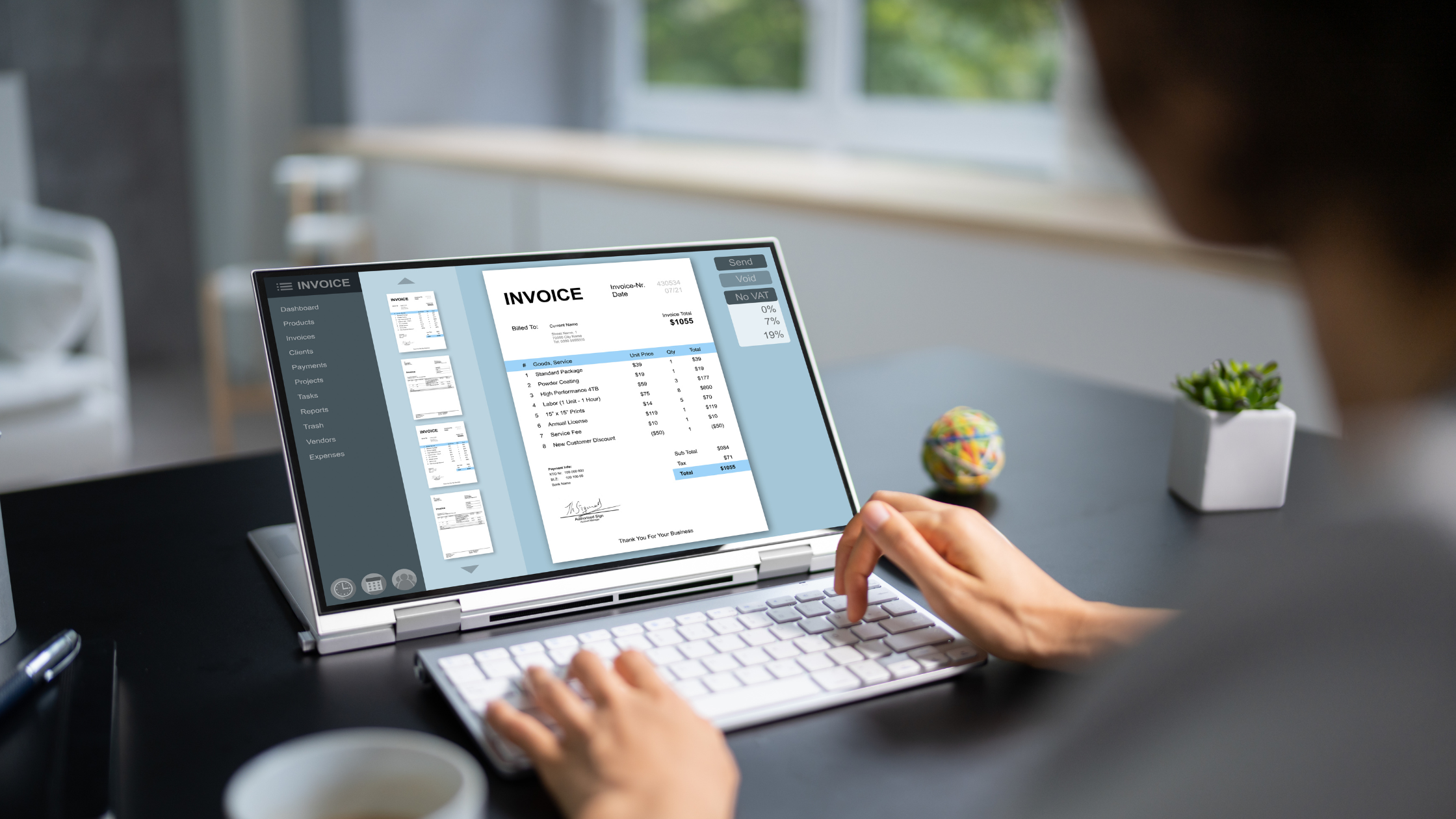
For a consulting business in Canada, the invoice record itself must establish what was sold, when, for how much, and how tax applies. The Canada Revenue Agency states that “Invoices are the primary trail for verifying tax paid or due on supplies of property and services,” which is the plainest summary of why invoice configuration is a recordkeeping discipline, not a formatting preference.
The CRA’s GST HST record guide says GST/HST records must describe related goods and services in enough detail to determine whether GST/HST applies. For a consultant, agency, contractor, or professional services firm, a reliable consulting payment solution must translate into a meaningful description of the engagement, the billing period, the amount due, and the due date.
Two further details shape the template. For taxable supplies, registrants must show either that the total includes GST/HST or show the amount payable and the GST/HST separately, and where tax or a tax rate is shown, the total GST/HST payable or the total applicable rate must also be indicated, per the CRA’s GST HST registrant guide. Separately, a supplier must include its GST/HST account number on receipts, invoices, contracts, or other business papers when supplying taxable goods or services of $100 or more, according to the CRA’s GST HST account guide.
Build those fields into the template once and every engagement inherits them. Requirements depend on transaction and recipient circumstances, so a registered firm should confirm its own obligations with a tax advisor.
How does invoice payment processing in Canada reduce late payment?
Invoice payment processing in Canada works best when the invoice carries a direct payment action, so the client can pay in the same moment they read the amount owed. The research points straight at the gap: Atradius’ North America payment report found that delays in the payment process were the most frequently cited reason customers paid invoices late in its 2025 Canada results, reported by 31% of respondents.
The cost of that gap shows up in the aging report. Atradius’s North America payment trends reported that 44% of the total value of B2B credit sales in Canada was overdue, while 7% was reported as bad debts. For a service business carrying payroll against unpaid work, that spread is working capital sitting in someone else’s account.
Reducing friction in service business payments is mostly about removing steps between “invoice sent” and “customer paid.” One document, one payment path, and one record that updates automatically when the payment clears through integrated invoice payment processing. Yuzera’s invoice payment processing keeps billing organized alongside transaction monitoring, so the status of a bill and the status of its payment live in the same view rather than in two systems that have to be reconciled by hand.
Retention is the other half. The CRA’s GST HST collection guide says businesses generally must keep records supporting GST/HST returns for six years from the end of the last year to which they relate, and the CRA may request that records be retained longer. A payment environment that stores invoices, service descriptions, and payment records together makes that six-year obligation an archive rather than a scramble.
What does recurring payment processing in Canada require?
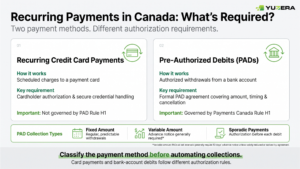
Recurring payment processing in Canada splits into two distinct arrangements that are often confused: recurring credit-card charges and pre-authorized debits drawn from a bank account. Payments Canada is explicit on the point, stating in its business PAD guide that “Recurring charges to credit cards are not considered PADs and aren’t covered by Rule H1.”
That distinction drives everything downstream. For PADs, Payments Canada says the agreement must include items such as authorization to withdraw from a specific account, the PAD category, the amount or a variable-amount disclosure, timing and frequency, cancellation instructions, and payee contact information. An informal email confirming a retainer does not meet that bar.
Variable amounts carry their own expectation. For variable-amount PADs at set intervals, the customer must receive at least 10 days’ notice of the amount before each payment, unless both parties agree to reduce or waive that pre-notification period in the PAD agreement. Sporadic PADs, meaning occasional, irregular, intermittent, or infrequent collections, require the payor’s authorization before each debit, such as through a password or secret code.
Practically, this means a service business should classify every ongoing arrangement before automating its recurring payments. A fixed monthly retainer behaves differently from a usage-based bill that changes every cycle, which behaves differently again from a plan billed only when the client books. The right consulting payment solution accommodates all these variations.
Yuzera’s recurring payments and tokenization support scheduled collections with stored credentials kept out of day-to-day systems. Any specific PAD agreement wording, waiver language, or programme eligibility should go through legal and compliance review before it reaches a customer.
How does a virtual terminal for Canadian businesses work?
This web-browser-based tool handles card-not-present payments, where staff manually enter the card details through a securely connected browser into a hosted payment environment. Regarding any virtual terminal, PCI SSC guidance makes the contrast clear: unlike a physical terminal, it does not read data directly from the card.
When adopting a virtual terminal, Canadian service businesses should know it works the same way everywhere: staff key the card details into a secure hosted page instead of swiping a physical reader, which is what lets a consultant take a payment by phone without shipping hardware to a client.
The environment around the browser matters as much as the browser. In the SAQ C-VT eligibility scenario described in the PCI SSC virtual terminal questionnaire FAQ, the terminal is hosted by a PCI DSS-validated third party and accessed from a computer isolated from other merchant systems, with no electronic storage of cardholder data and no attached capture devices. Merchants key one transaction at a time and must meet other eligibility conditions, so no virtual terminal automatically qualifies a business for that questionnaire. Confirm the right self-assessment path with your acquirer.
Security scope runs wider than the tool. PCI SSC’s PCI DSS overview states that “PCI DSS provides a baseline of technical and operational requirements designed to protect payment account data,” and it applies to entities that store, process, or transmit cardholder data or could affect the security of the cardholder data environment.
Phone payments are card-not-present, so layered controls help. Visa’s small business fraud guide advises authorizing every transaction, including the expiration date in every authorization request, and treating unusual transaction patterns as warning signs.
FAQ
Q1) What should I look for in a payment processor for a service based business?
Look for one environment that handles invoicing, scheduled collections, and staff-assisted card entry, because service businesses bill in all three ways. Whether you are using a standard processor or a specialized consulting payment solution, the invoice needs to carry enough service detail to support GST/HST recordkeeping, the scheduled arrangement needs documented authorization, and the manual-entry path needs a controlled workflow. Transaction monitoring across all three keeps reconciliation in one place rather than three.
Q2) What is the right payment solution for a consulting business in Canada?
A consulting payment solution in Canada should pair milestone and deposit invoicing with a virtual terminal for phone-taken payments and recurring payments for retainers. Consultants bill irregularly, so rigid subscription-only tools tend to break on project work. Invoice templates should include the service description, billing period, amount, due date, and tax presentation, plus the GST/HST account number where required for supplies of $100 or more.
Q3) How does invoice payment processing help reduce late payments in Canada?
Delays in the payment process were the most cited reason for late B2B payment in Atradius’s 2025 Canada results, reported by 31% of respondents. Efficient invoice payment processing attaches a direct payment action to the invoice, removing the back-and-forth between “invoice sent” and “customer paid.” Keeping invoices, service descriptions, and payment records together also supports the CRA’s general six-year GST/HST retention expectation.
Q4) Do recurring credit-card charges follow the same rules as pre-authorized debits?
No. Payments Canada states that recurring charges to credit cards are not considered PADs and are not covered by Rule H1. PAD agreements require specific elements including account authorization, amount or variable-amount disclosure, timing, cancellation instructions, and payee contact details, and variable set-interval PADs generally require at least 10 days’ notice of the amount. Treat the two as separate programmes with separate authorization records.
Q5) Is a virtual terminal secure enough for taking client card details by phone?
A virtual terminal keeps manual card entry inside a hosted payment environment instead of in email threads or chat tools, which is the main security gain. For Canadian merchants, compliance paths like the PCI SSC SAQ C-VT scenario assume a validated third-party host, an isolated workstation, and no electronic storage of cardholder data. It adds controls rather than guaranteeing against fraud, so pair it with Visa’s card-not-present precautions and verify changed payment instructions through a known, independently sourced contact channel, as the Canadian Centre for Cyber Security advises for business email compromise.
Where this leaves your billing workflow
Payment-card and banking details count as personal information, per the Office of the Privacy Commissioner of Canada, which is reason enough to limit who can see them and to keep them out of ordinary office channels. Quebec’s private-sector privacy law is deemed substantially similar to PIPEDA, with PIPEDA still applying to commercial personal-information flows across provincial or national borders, so businesses operating in more than one province should get jurisdiction-specific advice.
Backed by parent company Digitech’s track record in payments, Yuzera builds the technology side, offering a comprehensive consulting payment solution alongside POS software and hardware, payment orchestration, and value-added services for merchants in person, online, and on mobile. Start by mapping how your business actually gets paid, then match each billing event to the right collection method to optimize your service business payments.
Works Cited
- Atradius. “B2B Payment Practices Trends, USMCA 2025.”
- Atradius. “Payment Practices Barometer North America 2025.”
- Canada Revenue Agency. “Charge and Collect the Tax: Which Rate to Charge.”
- Canada Revenue Agency. “Confirming a GST/HST Account Number.”
- Canada Revenue Agency. “General Information for GST/HST Registrants (RC4022).”
- Canada Revenue Agency. “GST/HST and Payroll Records.”
- Canada Revenue Agency. “Invoices (GST 300-6-3).”
- Canadian Centre for Cyber Security. “Baseline Cyber Threat Assessment: Cybercrime.”
- Innovation, Science and Economic Development Canada. “Key Small Business Statistics 2024.”
- Office of the Privacy Commissioner of Canada. “Businesses and Your Personal Information.”
- Office of the Privacy Commissioner of Canada. “PIPEDA in Brief.”
- Payments Canada. “Pre-Authorized Debit: Business Guide.”
- Payments Canada. “Spotlight on Small Business Payments.”
- PCI Security Standards Council. “PCI DSS.”
- PCI Security Standards Council. “SAQ Instructions and Guidelines v3.2.1.”
- PCI Security Standards Council. “FAQ 1229: SAQ C-VT Eligibility.”
- Visa. “Fraud Protection for Small Business.”