
Most sellers in Canada do not look like the merchant that payment technology was originally designed for. They work from a vehicle, a client’s kitchen, a laptop, a market stall, or a spare room, and they move between platform income, direct invoices, and the occasional in-person sale in the same week. Gig worker payments are the payment acceptance, record-keeping, and account-security setup used by people who earn through short-term tasks or digital platforms rather than from a fixed commercial location. The same gap shows up for independent contractors, sole proprietors, and anyone seeking a reliable freelancer payment solution. This piece looks at what each of those sellers actually needs from a payment setup, what the data says about how they operate, and what changes the day the business grows past one person.
TL;DR
- In the 12 months ending December 2024, 665,000 Canadians aged 15 to 69 did paid work through a digital platform, which is 2.3% of that population, according to Statistics Canada.
- Among unincorporated self-employed workers with no employees, only 17.5% owned or leased a dedicated business space, which makes portable and online acceptance the default rather than the exception.
- Generally, a seller earning more than $30,000 over four calendar quarters must register for, collect, and remit GST/HST, the CRA says; commercial ridesharing providers must register regardless of earnings.
- Nearly 30% of self-employed Canadians planned to expand in the following 12 months, so payment technology chosen today has to survive staff, channels, and reporting demands tomorrow.
Gig Worker Payments: Core Features You Need
A payment solution for gig workers needs to accept payment away from a fixed location, produce a clear transaction record for every sale, and protect the account that controls the money. Those three things matter more than any feature list, because platform-managed payouts only cover part of what most gig workers earn.
Statistics Canada counted 665,000 Canadians aged 15 to 69 doing paid platform work in the 12 months ending December 2024, and 495,000 of them provided services. Delivery of food or other goods accounted for 263,000 people and personal transport for 151,000, per the same Statistics Canada digital platform employment release. The categories spread wider than driving, highlighting the growing diversity of gig worker payments: a detailed platform activity chart from Statistics Canada shows 138,100 people selling goods, 39,600 content creators, 29,300 professional-service providers, and 28,200 doing programming, data analysis, video editing, or design work, with caution advised on several smaller categories.
The definitional point matters for anyone building a setup. Statistics Canada writes that “gig work is a form of employment characterized by short-term jobs or tasks which does not guarantee steady work,” which is not the same thing as digital-platform employment, where a platform exercises control over the work process, and not the same as dependent self-employment. A courier who also takes private catering bookings is operating in two models at once. The platform handles one; nothing manages the worker’s independent gig worker payments unless they build the setup. That second stream is where portable card acceptance, a simple invoice, and a transaction history that reconciles to a bank deposit start earning their keep.
Finding a Payment Processor for Freelancers that Canada Trusts: Handling Invoices and In-Person Work
A freelancer payment solution in Canada should cover invoicing, online checkout, and occasional card-present sales in one place, so income from all three channels lands in one set of records. Most independent professionals mix channels rather than choosing one, and splitting them across disconnected tools is what breaks reconciliation at year-end.
Yuzera is a tech-forward fintech and solutions provider serving merchants across Canada and the United States, offering proprietary POS software and hardware, payment orchestration, and value-added services for both face-to-face and e-commerce selling. Our virtual terminal brings together billing and invoicing, recurring payments, tokenization, fraud detection, and call-to-action buttons, which map closely to what a modern freelancer payment solution must offer: a deposit by link, a recurring retainer, a final invoice, and a tap on the terminal when a client pays in person.
The record side is not administrative busywork. The Canada Revenue Agency tells platform-economy earners to “keep track of all of the income that you earned and the expenses that you incurred for business purposes.” Its broader business record guidance notes that complete, organized records identify income sources, support GST/HST decisions, surface deductible expenses and possible input tax credits, assist during an audit, and help an owner understand profit, loss, trends, budgets, and forecasts.
One more reason to stop treating freelance work as marginal: Statistics Canada reported that 19.0% of Canadian businesses that outsourced work in the first quarter of 2025 used third-party digital platforms to do it. Independent professionals are being engaged by real companies with real procurement expectations.
What Should a Payment Gateway for Independent Contractors Include?
A payment gateway for independent contractors should keep card data off the contractor’s own website, support invoice and link-based payment alongside a checkout page, and give one clear view of what has been paid. Independent contractor payments often arrive from business clients on net terms, which makes the gateway a billing instrument as much as a checkout.
Architecture decides how much security work lands on the contractor. The PCI Security Standards Council’s guidance on SAQ A eligibility states that all elements of the payment page delivered to the customer’s browser must originate only and directly from PCI DSS-compliant third-party service providers, and that no single payment-page element can originate from the merchant’s website. Where any element does originate from the merchant site, the implementation is not eligible for SAQ A; SAQ A-EP covers situations where elements may come from the merchant website or a compliant provider, subject to all eligibility criteria. Eligibility always depends on the full implementation, not on any single tool.
Storage rules are equally firm. On card verification guidance, PCI SSC says codes such as CVV2, CVC2, CID, and CAV2 are sensitive authentication data that may be requested for card-not-present transactions, and states that “PCI DSS Requirement 3.3.1.2 strictly prohibits storing them after authorization, even if encrypted.” For repeat clients, tokenization is the mechanism that supports a return charge without the contractor holding card details, streamlining independent contractor payments. We build e-commerce setups in phases across website, shopping cart, gateway, and payment workflow so the configuration can change as the client mix does.
Choosing a Sole Proprietor Payment Gateway for Multi-Channel Sales
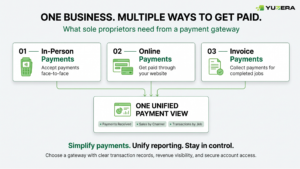
A sole proprietor payment gateway should handle in-person, online, and invoice payments through one account with one reporting view. In short, a payment gateway for sole proprietors needs to treat every channel as one business, because a sole proprietor is usually all three sales channels at once. The priority is visibility, not volume: knowing what came in, from where, and against which job.
The operating picture supports that. Statistics Canada found that 71.9% of self-employed workers had no employees in the fourth quarter of 2023, and that 46.2% of all self-employed workers were unincorporated with no employees. Among that unincorporated, no-employee group, the self-employed worker experiences report found that just 17.5% owned or leased a dedicated business space and 7.4% had partners or co-owners. Any sole proprietor payment gateway that assumes a storefront, a back office, and a bookkeeper is assuming facts not in evidence for most of this group.
Registration thresholds are the next consideration, and they attach to revenue rather than corporate form. The CRA’s guidance on platform tax obligations says that, generally, a seller providing goods or services who earns more than $30,000 over four calendar quarters must register for, collect, and remit GST/HST, with commercial ridesharing providers required to register regardless of how much they earn. Reaching that threshold is easier to see coming when every channel reports into one place.
Account security belongs in the same conversation. NIST describes multi-factor authentication as requiring two or more factors such as something known, possessed, or inherent to the user, and says it creates an additional barrier if a password is compromised. For a one-person business, the login to the payment account is the business.
Scaling a Payment Processor for Unincorporated Business Operations
Your payment setup needs room to add staff, locations, and sales channels without a rebuild, because a meaningful share of these sellers are planning exactly that. Unincorporated business payments start simple and get structurally more complex the moment someone else touches the system.
The expansion intent is measurable. Statistics Canada found that 29.8% of self-employed Canadians planned to expand their business in the following 12 months, with or without hiring. Among those without employees, 26.6% planned to expand their activities and 9.6% planned to expand and begin hiring, meaning unincorporated business payments must scale seamlessly. Growth infrastructure is not an enterprise-only category.
Hiring opens a distinct administrative stage. The CRA’s payroll remittance guidance says a new employer must register for a payroll program account before the first remittance due date, and its explanation of business program accounts notes that a business with an existing business number uses that same number to register payroll as a separate program account. Once employment status is established, the CRA’s payroll deduction guidance requires calculating CPP contributions, EI premiums, and income tax deductions, and treats amounts withheld as held in trust for the government until remitted. Filing diverges too: self-employment income goes on lines 13499 and 13500 using Form T2125, while incorporated businesses complete a T2 return and Schedule 125. Getting your unincorporated business payments organized early simplifies this transition.
Technology should move in step. NIST advises inventorying systems that offer MFA, enabling it on sensitive accounts, limiting access to people who need it for their jobs, removing access when employees leave, and restricting administrative privileges. Role-based access, reporting, and integrated POS and e-commerce workflows are what turn a solo setup into a team one. This is educational material, not tax, payroll, or legal advice; review your situation with a qualified advisor.
FAQ
Q1) How should I manage gig worker payments alongside platform income?
A platform handles the income it coordinates, not the direct work a gig worker takes on the side. For that, the practical setup is portable card acceptance, a clear transaction record for each sale, and strong account security. Statistics Canada distinguishes gig work, digital-platform employment, and dependent self-employment as separate concepts, and many workers sit in more than one at a time.
Q2) What features make up a complete freelancer payment solution?
A proper freelancer payment solution provides one account that supports invoicing, recurring billing, online checkout, and in-person acceptance, with reporting that ties all of them together. Yuzera’s virtual terminal includes billing and invoicing, recurring payments, tokenization, and fraud detection. Consolidated records also support the income and expense tracking the CRA expects from platform-economy earners.
Q3) What are the core requirements for independent contractor payments?
Invoice and link-based payment, a hosted checkout page, tokenization for repeat clients, and reporting that shows paid versus outstanding. PCI SSC guidance makes the architecture decision consequential: whether payment-page elements originate from your site or from a compliant service provider affects how you process independent contractor payments. CVV values may be requested for card-not-present sales but cannot be stored after authorization.
Q4) How do I choose the right sole proprietor payment gateway?
A reliable sole proprietor payment gateway handles in-person, online, and invoiced sales in one place with a single reporting view. Most sole proprietors have no dedicated business space, so portability and remote billing matter more than fixed-location features. Watch the GST/HST threshold as revenue builds: generally, more than $30,000 over four calendar quarters triggers registration, with commercial ridesharing registering regardless of earnings.
Q5) How should unincorporated business payments change before hiring?
Role-based access, audit-ready reporting, and POS and e-commerce workflows that connect, so adding a first employee does not mean replacing the system. Nearly 10% of self-employed Canadians without employees planned to expand and hire within a year. Registering a payroll program account before the first remittance due date is a CRA requirement, and access controls for unincorporated business payments should tighten as more people gain system access.
If you are mapping a setup that has to work today and still work after your next hire, our team can walk through POS, gateway, and orchestration options with you.
Works Cited
- Canada Revenue Agency. “Understanding Your Tax Obligations.”
- Canada Revenue Agency. “What Records to Keep and Who Should Keep Them.”
- Canada Revenue Agency. “Remitting Source Deductions.”
- Canada Revenue Agency. “Which Program Accounts Do You Need?”
- Canada Revenue Agency. “Making Deductions.”
- National Institute of Standards and Technology. “Multi-Factor Authentication.”
- PCI Security Standards Council. “SAQ A Eligibility.”
- PCI Security Standards Council. “Are Merchants Allowed to Request Card-Verification Codes/Values from Cardholders?”
- Statistics Canada. “Digital Platform Employment, 2024.”
- Statistics Canada. “Platform Activity Chart.”
- Statistics Canada. “Experiences of Self-Employed Workers.”
- Statistics Canada. “Defining and Measuring the Gig Economy Using Survey Data.”
- Statistics Canada. “Outsourcing Work Analysis.”