Badges are easy to print. Evidence is harder, and evidence is what you should be asking for.
A certified payment processor is a provider whose security and compliance claims are backed by dated, scoped documentation from a recognized body, not by a logo on a pricing page. That distinction matters because almost every assurance signal in payments is narrower than it sounds: a compliance attestation covers specific services, a product validation covers specific versions, and a regulatory registration confirms identity rather than quality. For merchants running both in-store and online channels, the gap between “we are secure” and “here is the scoped document that proves it” is where most procurement risk lives.
This guide walks through what to verify, in what order, and which questions surface real answers.
TL;DR
- Bank of Canada PSP registration confirms a provider’s legal identity and status, but the Bank states plainly that it does not endorse or license registered payment service providers.
- PCI Security Standards Council expects a provider with an Attestation of Compliance to hand it over on request, covering the exact gateway, POS, or hosted checkout you are buying.
- The FTC’s Consumer Reviews and Testimonials Rule took effect October 21, 2024, banning fake reviews, undisclosed insider testimonials from insiders, and false claims that a company-controlled review site is independent.
- NIST’s 2026 quick-start guide names five supplier due-diligence components: foreign ownership or influence, provenance, resilience, foundational cyber practices, and supply-chain tiers.
What does “certified payment processor” actually mean?
Evaluating a certified payment processor means checking if the provider can produce current, scoped validation documents from an issuing body for the specific services you intend to use. No single certificate covers everything a payment technology company sells, so the word “certified” is only meaningful when attached to a named standard, a defined scope, an assessment date, and the organization that issued it.
Start with scope, because that is where claims quietly collapse. The PCI Security Standards Council notes in its provider scope FAQ that PCI DSS applies not only to organizations that store, process, or transmit payment account data, but also to service providers that could affect the security of that data. A company might be in scope because it can influence a payment environment or supply security controls on your behalf, even without touching card numbers directly.
Product-level assurance is narrower still. PCI SSC’s product listings distinguish among validated secure software, approved PIN Transaction Security devices, point-to-point encryption solutions, and other acceptance technologies. A corporate claim does not prove that every terminal, POS application, integration, or e-commerce component sits inside a validation scope.
Two more signals are routinely misread. ISO/IEC 27001:2022, described by the International Organization for Standardization in its information security family overview, governs an information security management system, not payment-card security. And a SOC 2 report, per the SOC reporting guide from AICPA and CIMA, is an examination of controls, not a certification. Treat both as complementary governance evidence.
How do you verify a trusted payment gateway in Canada?
To verify a trusted payment gateway, search the Bank of Canada’s public PSP registry using both the brand name and the provider’s legal entity name, then confirm what that listing does and does not mean. The registry identifies registered providers by legal name, trade name, country, and a violations field, which makes it a reliable identity check and nothing more.
The Bank is unambiguous about the limits. In its PSP registry, the Bank of Canada states: “The Bank does not endorse, or license registered PSPs.” Registration supports verification. It does not say the regulator has vetted a provider’s technology, commercial practices, or fit for your business.
Registration itself is triggered by conditions rather than choice. The Bank of Canada’s registration criteria apply when an entity is a PSP, performs retail payment activities, falls within the Act’s geographic scope, and is not excluded. If a provider should be registered and is not listed, ask why before anything else.
Privacy posture deserves the same scrutiny. The Office of the Privacy Commissioner of Canada, setting out the PIPEDA principles, says: “Personal information must be protected by appropriate security relative to the sensitivity of the information.” The Commissioner’s safeguards guidance breaks protections into physical, organizational, and technological categories, including restricted access, need-to-know controls, passwords, and encryption. PIPEDA also interacts with provincial private-sector privacy laws, so it is not the only regime in play. Ask how access, encryption, retention, breach response, and personnel permissions are actually governed, rather than accepting a general claim of strong security.
Which product-level controls separate real security from marketing language?
The controls worth verifying are PCI-listed point-to-point encryption for in-person acceptance and EMVCo-approved 3-D Secure components for e-commerce, because both are listed publicly by product name and version. “Encrypted terminal” and “fraud protection” are descriptions; a listing entry is a record you can check.
P2PE protects account data from the merchant’s payment device to the secure point of decryption, rendering it unreadable before it reaches that environment. PCI SSC notes in its P2PE standard overview that merchants using PCI-listed solutions may have fewer applicable PCI DSS requirements, which simplifies validation effort without eliminating it. Solutions are assessed by a qualified P2PE assessor and documented in a Report on Validation, so ask for the solution name, version, listing status, validation date, and device-deployment instructions from the P2PE solutions listing.
Online, EMV 3-D Secure helps merchants and issuers authenticate customers and reduce card-not-present fraud. EMVCo’s 3-D Secure overview explains that the protocol exchanges transaction, payment-method, and device data so issuers can evaluate risk without adding unnecessary checkout friction. Ask whether the relevant 3DS Server or SDK appears on EMVCo’s approved products list, and check its protocol support and expiration date.
One caution on assessors. A Qualified Security Assessor is an independent organization qualified to validate adherence to PCI DSS, but PCI SSC’s QSA listings page is explicit that the Council does not endorse a QSA’s business practices or other services. QSA involvement validates the assessment, not every technology sold alongside it.
How should you read payment gateway reviews and ratings?
Read payment gateway reviews by separating provider-hosted testimonials from independent third-party feedback, then checking whether outcomes are attributable and whether criticism appears anywhere at all. Both independent feedback and curated payment gateway testimonials are useful, but they carry different weight and should never be presented as the same thing.
The regulatory floor here changed recently. The FTC’s Consumer Reviews and Testimonials Rule, detailed in the Commission’s reviews rule FAQ, took effect on October 21, 2024, and prohibits fake or false reviews, purchased sentiment-conditioned reviews, undisclosed insider testimonials, false claims of independence for company-controlled review sites, and certain review-suppression practices. Announcing the rule, then-FTC Chair Lina M. Khan said in the Commission’s fake reviews announcement: “Fake reviews not only waste people’s time and money, but also pollute the marketplace and divert business away from honest competitors.”
A provider that misrepresents a review site it controls as independent is squarely in scope under the reviews final rule. Meanwhile, the Consumer Review Fairness Act protects customers’ ability to share honest opinions, including negative ones, about products, services, and customer service, as the FTC’s review fairness guidance sets out. A ratings profile with no critical feedback and no visible responses to it is worth a second look.
Practically: confirm whether named customers gave permission, whether the account is current, and whether material relationships are disclosed. A review from four years ago may establish experience, but it is not evidence of a provider’s present technology, support model, or security posture.
What makes payment processor case studies and testimonials credible?
Credible payment processor case studies identify the merchant’s vertical, sales channels, operational problem, technology deployed, implementation period, and the observed result. Payment gateway testimonials are credible when they are attributable, permissioned, current, and clearly labelled as provider-hosted marketing content rather than independent review data.
The useful test is separating outcomes from opinions. “Helpful support” is a legitimate customer opinion. “Reduced reconciliation time” is an operational outcome, and it should name the measurement period and the process affected. Strong payment processor case studies also show a believable baseline by describing the prior workflow or system constraint, rather than dropping a result with no context behind it.
For complex deployments, ask for a live reference conversation. Multi-location rollouts, omnichannel builds, custom POS work, and orchestration projects all carry integration risk that a written summary cannot convey. Ask for references in your vertical, operating model, or deployment complexity, and ask whether those customers will verify the outcome directly.
Then verify the technical claim separately. Even the best payment processor case studies do not validate PCI scope, P2PE listing status, SOC reporting, ISO certification, or regulatory registration. Those are document checks, and they stay document checks no matter how good the reference call goes.
Yuzera is a technology-forward provider of POS software and hardware, payment orchestration, and value-added services for in-person, online, and mobile commerce across Canada and the United States. Yuzera operates as a distinct brand, separate from parent company Digitech, whose track record offers an additional credibility signal. Ask the same scoped questions you would ask any provider before choosing a trusted payment gateway.
Where should due diligence go after the certificates?
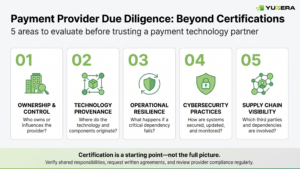
After the certificates, due diligence should cover resilience, provenance, and the full technology lifecycle, because a validated product can still sit on a fragile supply chain. NIST defines supplier due diligence as researching available, pertinent information about a supplier or product so an organization can make informed decisions.
NIST’s 2026 due diligence guide identifies five components for ICT suppliers: foreign ownership, control or influence; provenance; resilience; foundational cyber practices; and supply-chain tiers. Applied to a payment provider, that means asking who owns the entity, where components originate, and what happens to your checkout if a dependency fails.
NIST’s work on supply chain management frames cybersecurity supply-chain risk management as identifying, assessing, and mitigating risk across the lifecycle of technology products and services. For payments, that lifecycle extends past the terminal and the gateway into software development, update cadence, integrations, hosting, maintenance, support access, and decommissioning.
Two obligations stay with you regardless. Merchants remain responsible for their own PCI DSS obligations even when payment functions are outsourced, and the Council’s merchant outsourcing FAQ advises ensuring the provider is compliant for the services offered, keeping written agreements that acknowledge responsibilities, monitoring provider compliance at least annually, and understanding shared responsibilities. Request a written responsibility matrix.
Finally, do not assume that appearing on a generic directory automatically makes a vendor a certified payment processor. PCI SSC’s provider listings FAQ confirms the Council does not maintain a universal list of PCI DSS-compliant third-party service providers, directing organizations to their payment brands and acquirers instead.
FAQ
Q1) What defines a certified payment processor?
It means the provider can produce current validation documents from a named issuing body covering the specific service you are buying. PCI Security Standards Council states in its compliance evidence FAQ that “if the provider has a PCI DSS Attestation of Compliance (AOC), it is expected that the third-party service provider (TPSP) provides the AOC to customers upon request.” Ask for the AOC tied to your gateway, POS, or hosted checkout. A corporate-level claim is not the same as a service-level attestation.
Q2) How do I confirm a trusted payment gateway is legitimate in Canada?
Search the Bank of Canada’s PSP registry under both the trade name and the legal entity name, and review the violations field. Registration under the Retail Payment Activities Act applies to entities performing retail payment activities within the Act’s geographic scope. Remember that the Bank does not endorse or license registered PSPs. Pair that identity check with documented PIPEDA-aligned safeguards.
Q3) Can I rely on payment gateway reviews when comparing providers?
Use them as one input, not as proof. Since October 21, 2024, the FTC’s rule has prohibited fake reviews, undisclosed insider testimonials, and misrepresenting a company-controlled review site as independent. Check whether negative feedback appears and how the provider responded. Then verify security and compliance claims through documents, not sentiment.
Q4) What should payment processor case studies include to be useful?
Vertical, sales channels, the operational problem, the technology deployed, the implementation period, and a measurable result with its measurement window. Look for a baseline describing the prior workflow so the result has context. Confirm the account is still current. For multi-location or orchestration projects, request a live reference conversation.
Q5) Are payment gateway testimonials on a provider’s own site trustworthy?
They can be valuable, but FTC guidance treats testimonials a business places on its own website as promotional content, with liability if they are fake or false. Ask whether named customers gave permission and whether material connections are disclosed. Treat provider-hosted payment gateway testimonials as distinct from independent review platforms. Never let a testimonial stand in for PCI, P2PE, SOC, ISO, or registration evidence.
Works Cited
- AICPA & CIMA. SOC 2: Reporting on an Examination of Controls at a Service Organization.
- Bank of Canada. Criteria for Registering Payment Service Providers.
- Bank of Canada. Registry of Payment Service Providers.
- EMVCo. 3-D Secure.
- EMVCo. Approved Products: 3-D Secure.
- Federal Trade Commission. Consumer Review Fairness Act: What Businesses Need to Know.
- Federal Trade Commission. Consumer Reviews and Testimonials Rule: Questions and Answers.
- Federal Trade Commission. Federal Trade Commission Announces Final Rule Banning Fake Reviews and Testimonials.
- Federal Trade Commission. Trade Regulation Rule on the Use of Consumer Reviews and Testimonials.
- International Organization for Standardization. ISO/IEC 27000 Family: Information Security Management.
- National Institute of Standards and Technology. NIST SP 1326: Supplier Due Diligence Quick-Start Guide.
- National Institute of Standards and Technology. Cybersecurity Supply Chain Risk Management.
- Office of the Privacy Commissioner of Canada. PIPEDA Fair Information Principles.
- Office of the Privacy Commissioner of Canada. PIPEDA Self-Assessment Tool: Safeguards.
- PCI Security Standards Council. FAQ 1065: Compliance Evidence from Third-Party Service Providers.
- PCI Security Standards Council. FAQ 1092: Merchant Responsibilities When Outsourcing.
- PCI Security Standards Council. FAQ 1138: Listings of Compliant Service Providers.
- PCI Security Standards Council. FAQ 1579: Service Provider Scope.
- PCI Security Standards Council. Point-to-Point Encryption (P2PE).
- PCI Security Standards Council. Point-to-Point Encryption Solutions.
- PCI Security Standards Council. Product and Solution Listings Overview.
- PCI Security Standards Council. Qualified Security Assessors.