Payment processor support is the operational capability that lets a merchant report, escalate, diagnose, and recover from a payment technology problem, and it belongs in the same conversation as encryption, tokenization, and access control. Encryption protects data at rest and in motion. Support determines what happens in the twenty minutes after a terminal stops authorizing on a Saturday night, or when an e-commerce checkout starts behaving strangely. Nobody can tell whether it’s a caching issue or an unwanted script.
That distinction matters more than most payment processor support pages admit. The Canadian Centre for Cyber Security defines a cyber incident to include an unauthorized attempt to render a system resource unavailable, which means an availability event is not automatically a technical problem sitting outside the security domain. It might be. It might not be. Somebody has to determine which, quickly, with the right information.
This piece breaks down what 24/7 payment support should actually cover, why local payment support Canada merchants can reach in real time has operational value, how payment processor uptime ties directly to revenue continuity, and what to put in writing before you sign anything. Written for operators who already know the difference between an acquirer timeout and a gateway 500.
TL;DR
- PCI DSS requires designated personnel to be available 24/7 for suspected or confirmed security incidents, which makes 24/7 payment support a compliance-adjacent requirement, not just a convenience feature.
- Uptime Institute found that four in five respondents said their most recent serious outage was preventable through better management, processes, or configuration, pointing squarely at operational discipline.
- Roughly four out of five small firms faced customer-payment challenges in the Federal Reserve Banks’ 2024 report, and timely customer payments remain a key source of available cash.
- The Canadian Centre for Cyber Security warns against rebooting a potentially compromised system immediately, because volatile forensic evidence needed to size a compromise can be lost.
- PCI DSS v4.0.1 payment-page requirements 6.4.3, 11.6.1, and 12.3.1 became effective March 31, 2025, making script integrity and tamper detection an active support obligation.
Why is payment support a resilience issue and not just a help-desk issue?
Payment support is a resilience issue because the person answering the phone is often the first human who can tell you whether your business is experiencing a configuration fault, a network failure, or the early stage of a security incident. That triage decision shapes everything downstream: whether you preserve evidence, notify anyone, switch to a continuity procedure, and how long you stay offline.
The compliance framework already treats this as security work. PCI DSS v4.0 retired on December 31, 2024, and v4.0.1 became the only active version the PCI Security Standards Council supports, according to the PCI Security Standards Council’s PCI DSS revision notice. The revision clarified and corrected parts of v4.0 rather than adding or removing requirements, so the incident-response expectations carried forward intact.
Those expectations go well past technical remediation. The PCI DSS service provider assessment describes an incident-response plan that is ready to activate. That plan includes roles and responsibilities, communication and contact strategies, incident-specific containment and mitigation procedures, business recovery and continuity procedures, backup processes, legal-reporting analysis, and coverage for critical system components. Read that list again and notice how much of it is coordination, not code. Communication strategies. Contact strategies. Business recovery. These are support functions.
A cardholder-data incident also pulls in parties you don’t control. PCI SSC’s breach response guidance identifies stakeholders in a cardholder-data breach as merchants, acquiring banks, payment brands, third-party service providers, PCI SSC, and where required, PCI Forensic Investigators. It further notes that payment brands may require an independent forensic investigation after an actual or suspected breach. If your support relationship consists of a ticket queue and a business-hours email address, you are not positioned to coordinate across that many stakeholders under time pressure.
The plan also has to be exercised. PCI DSS requires you to review, update as needed, and test the incident-response plan, including all required elements, at least once every 12 months. A partner who has never walked through a scenario with you is an untested dependency. This is one of the clearest signals of how a business evaluates payment processor support before committing to a long-term relationship.
Why do outages belong in a security conversation at all?
Outages belong in a security conversation because availability loss is inside the formal definition of a cyber incident. The Canadian Centre for Cyber Security’s incident response plan guidance defines a cyber incident as an unauthorized attempt, successful or not, to access, modify, destroy, delete, or render unavailable a computer network or system resource. An outage might be a failed router. It might also be the visible symptom of something else. Treating every interruption as purely technical means you’ll occasionally be wrong in the most expensive direction.
The same guidance frames the purpose of an incident-response plan as preparing an organization to detect, respond to, and recover from an incident, with the goal of fast recovery and limited disruption to internal services, clients, and partners. That’s a business-continuity objective expressed in security language, which is exactly where this topic lives.
Detection quality drives everything. Insufficient monitoring may leave cyber incidents undetected for long periods, resulting in more complicated and costly recovery, and the Cyber Centre recommends considering solutions that detect, monitor, and respond to incidents, including SIEM capabilities. Applied to payments, that means alerting on authorization failure rates, terminal heartbeat loss, and unexpected changes to checkout assets, not just waiting for a staff member to report that the card reader is acting strangely.
The scale of preventable failure is documented. Uptime Institute’s outage analysis summary reported that four in five respondents to its 2023 data-centre survey believed their most recent serious outage could have been prevented through better management, processes, or configuration. Uptime Institute also estimates roughly 10 to 20 high-profile global IT outages or data-centre events in a typical year that cause serious financial loss, business and customer disruption, and reputational loss.
And not every disruption is an attack. The Cyber Centre’s incident response lifecycle guidance notes that cyber threats, natural disasters, and unplanned outages can all affect networks, systems, and devices, and that the same response approach assists with a range of incidents. Good business payment support doesn’t need to guess the cause before it starts helping. It needs a process that works either way, and that discipline is what separates business payment support that scales with a merchant from a channel that only handles the easy cases.
What should 24/7 payment support actually mean?
24/7 payment support should mean that a named, reachable party can receive and act on a report at any hour, including a suspected security incident, with defined severity levels and defined update cadence. Anything less specific is a marketing phrase, and merchants evaluating providers should treat it that way.
The anchor for this is explicit. The PCI DSS service provider assessment states that specific personnel must be designated as available 24/7 to respond to suspected or confirmed security incidents. So the useful question is not “do you offer 24/7 payment support” but “does your 24/7 coverage include security incident escalation, or only device and configuration troubleshooting?” Those are different capabilities staffed by different people.
Canadian procurement guidance gives you the rest of the interrogation. The Cyber Centre’s managed services guidance recommends asking what the provider’s incident-response roles and responsibilities are and what it expects from your organization. It also recommends asking what turnaround time it guarantees for the incident types you’ve identified, whether it can support a hotline to initiate incident response and when that hotline is available, and how and how quickly it notifies you when a security incident affects your data.
Notice the structure of those questions. Each one converts an assumption into a documented commitment. A vague promise of constant availability collapses under the first.
Service-level agreements should carry the same weight. The Cyber Centre’s enterprise information guidance says an SLA should establish service expectations and indicate the security measures used, while also defining auditing and incident-response roles and responsibilities. Availability percentages alone don’t describe who investigates, who documents, or who talks to your acquirer.
Regulatory thinking elsewhere reinforces the always-on premise. The Reserve Bank of Australia’s retail payment reliability bulletin observed that card payments, fast transfers, and online banking are available 24/7, meaning an outage at any time affects end users. It also noted that payment-service providers should be able to address outages swiftly, whether they occur inside or outside business hours. Different jurisdiction, transferable principle: your customers do not check your support hours before deciding to buy something.
How is routine technical help different from incident escalation?
Routine technical help resolves known problems with known fixes. Incident escalation handles situations where the cause is unknown, the blast radius is unclear, and the wrong first move destroys information you’ll need later. Merchants who blur the two end up routing a possible compromise through a password-reset workflow.
The clearest example is evidence handling. The Cyber Centre’s compromise response guidance advises organizations not to shut down or reboot a potentially compromised system immediately, because it may hold volatile forensic evidence needed to determine the source and scale of a compromise. The instinct to restart a device is correct for a frozen terminal and wrong for a suspected intrusion. A support function that can’t tell which conversation it’s in will default to the reboot.
Escalation also has a defined shape. Canadian incident-response controls describe an operational capability spanning preparation, monitoring, detection, analysis, containment, recovery, and response, with incidents monitored, documented, and reported to appropriate officials and authorities, per the incident response controls guidance. Routine business payment support rarely touches documentation and reporting. Incident work lives there.
External coordination separates them too. When payment brands may require an independent forensic investigation, and acquirers and service providers are all stakeholders, the escalation path has to produce a factual timeline, not a resolved ticket. That means capturing when the anomaly was first observed, what changed recently, which systems were touched, and who was notified.
Practical test for a prospective partner: describe a scenario where your terminals are authorizing intermittently, your e-commerce checkout is fine, and a staff member noticed an unfamiliar USB device attached to a lane. Ask who picks up, what the first three actions are, and when the conversation stops being troubleshooting. A payment processor customer support organization that answers crisply has thought about this. One that talks only about ticket priority levels has not.
Then ask whether they will participate in an incident-response simulation for the scenarios that matter to your business. The Cyber Centre’s managed-services due-diligence list includes exactly that request, and willingness to rehearse is one of the few pre-purchase signals that isn’t easy to fake.
Why does payment processor uptime protect revenue and customer experience?
Payment processor uptime protects revenue because a declined or unavailable checkout is a lost sale in the moment and a trust deduction afterward. This is measurable at both ends of the market.
On the merchant side, the Federal Reserve Banks’ small business payment report found that roughly four out of five small firms faced challenges related to customer payments. It also identifies timely customer payments as a key source of cash available to small businesses. Payment friction isn’t an IT inconvenience for those firms. It’s a cash-flow event.
On the consumer side, Applause’s digital payment survey reported that 41% of respondents had encountered an issue that prevented a recent purchase. That’s vendor-sponsored survey research, not a universal abandonment rate, and it should be read as directional. Even read conservatively, it reinforces something operators already know: checkout failures rarely produce a retry; they produce a departure.
The cost side of outages is documented, though it needs careful framing. Uptime Institute’s outage analysis summary found that 54% of respondents said their most recent significant, serious, or severe outage cost more than US$100,000, and 16% said it cost more than US$1 million. Those figures describe surveyed digital-infrastructure organizations, not merchants, so treat them as evidence of how expensive downtime can get rather than a forecast for your storefront.
Cause analysis points at a practical lever. Uptime Institute reported that power issues remained the most common cause of serious data-center outages. In contrast, network-related issues were the largest single cause of IT-service outages. For payment environments, that translates into connectivity design: redundant links, cellular failover on terminals where appropriate, network diagnostics your support partner can actually read, and a documented answer to what staff do when the line drops mid-transaction.
A reliable processor with good uptime is therefore not just one with a high number on a status page. It’s one whose support organization can explain its failure modes, show you its recovery objectives, and tell you what your side of the recovery looks like. Payment processor uptime is ultimately a shared responsibility between the provider’s infrastructure and the merchant’s own preparation.
What belongs in an outage-communication plan?
An outage-communication plan defines who learns what, through which channel, in what order, and how quickly, when payment acceptance degrades or stops. It is the difference between a controlled forty minutes and an uncontrolled afternoon of staff improvising answers to customers.
Start with the requirement itself. PCI DSS incident-response expectations include communication and contact strategies alongside containment, business recovery, and backup processes. Communication is not the soft edge of the plan. It’s a listed element.
Then build the contact layer so it survives the incident. The Cyber Centre’s baseline controls guidance recommends a written incident-response plan with responsibilities and relevant contact details for external parties, stakeholders, and regulators. It specifically recommends maintaining an up-to-date hard copy for situations where soft copies are unavailable. If your escalation numbers live only in the system that just went down, you don’t have an escalation path.
Recovery targets give the communication substance. Visa’s acceptance risk standards state that tested business-continuity and resilience plans are critical to payment operations and should address resumption timelines to minimize disruption. Visa recommends well-defined recovery point objectives and recovery time objectives. With an RTO agreed in advance, your first customer-facing message can say something useful instead of a vague assurance that the issue is being reviewed.
Notification timing from the provider side needs the same precision. Ask how the provider notifies you when a security incident affects your data, how long after detection that notification arrives, and what the first update will contain. These come directly from Canadian managed-services due-diligence guidance, and they separate a real communications commitment from a promise to be in touch.
Finally, plan the internal distribution. Define how employees, providers, leadership, and other stakeholders receive updates when regular email, portals, or internal systems are unavailable. A group text thread and a printed call tree are unglamorous, and they work. The Cyber Centre’s framing is that a good plan limits disruption to internal services, clients, and partners, which only happens if all three groups are actually reachable.
Why does local payment support for Canada merchants matter in real time?
Providing local payment support that Canadian merchants can access matters because time zones, shared operating hours, and escalation speed are documented factors in incident response quality, not preferences. A careful version of this argument avoids claiming local support is automatically better and instead identifies the specific conditions where proximity creates an operational advantage.
Canadian guidance on contracting with managed service providers identifies availability during off-hours or in other time zones as a potential challenge for timely incident detection and response, per the managed provider practices guidance. That’s the operational case in one sentence. When your peak trading window and your support partner’s staffed window overlap, escalation is faster and context is shared.
Data handling is another dimension. The Cyber Centre’s enterprise information guidance advises organizations using a cloud or managed-service provider outside Canada to review applicable laws and potential privacy impacts, then evaluate the sensitivity of the data being handled. For merchants with regulatory constraints on support locations or resource residency, the Cyber Centre’s procurement contract clauses guidance says to discuss and agree on support models with the service provider rather than assume.
Canadian breach obligations add urgency. The Office of the Privacy Commissioner of Canada explains in its privacy breach findings that under section 10.1 of PIPEDA, an organization must report a breach of security safeguards to the OPC when it is reasonable to believe the breach creates a real risk of significant harm. The organization must also notify affected individuals unless the law prohibits it. This is educational context, not legal advice, and Canadian privacy counsel should review how it applies to your situation.
Volume is not trivial. An OPC estimates issue sheets document reports 696 breach reports under PIPEDA in fiscal year 2025-26. Across PIPEDA and the federal Privacy Act combined, breaches affected roughly 20 million Canadian accounts in that year, with unauthorized access the largest listed cause by affected-account count. That combines private and public sector reporting, so it isn’t a merchant-only figure, but it establishes that the reporting apparatus is busy. Support that understands the Canadian reporting environment shortens the distance between detection and a defensible decision, and it’s one reason local payment support Canada merchants can reach directly carries real operational weight.
How is POS support also payment-security support?
POS support is payment-security support because the terminal and the software around it sit inside the cardholder-data environment, and their configuration directly determines how many controls you have to operate. This is the part merchants most often outsource mentally and shouldn’t.
PCI SSC’s terminal scope FAQ states that payment terminals are part of the cardholder-data environment because they directly store, process, or transmit account data. It adds that a more complex POS system with multiple applications and configuration options may require more PCI DSS controls than a simple, tightly controlled terminal. That is a design consequence with a support bill attached. Every additional application, integration, and configuration option on the lane expands what has to be maintained, patched, and monitored, and therefore what your support partner has to understand.
Encryption reduces exposure without removing responsibility. PCI SSC’s P2PE standard overview explains that point-to-point encryption cryptographically protects payment-account data from the point of capture in the merchant payment device to the secure point of decryption, making the data unreadable until it reaches the secure decryption environment. Strong control, correctly scoped.
But the caveat is explicit. The terminal assessment FAQ notes that merchants using PCI-listed P2PE solutions have fewer applicable PCI DSS requirements, which can simplify compliance efforts. It also states that PTS-approved terminals alone do not guarantee PCI DSS compliance or automatically reduce cardholder-data-environment scope. Approved hardware is not a compliance program. Merchants who read it that way discover the gap during an assessment rather than during procurement.
This means support evaluation is concrete. Ask your POS provider which device models, application versions, and configurations are in scope for support. Ask how firmware and application updates are delivered and verified. Ask what the tamper-response procedure is when a device shows signs of physical interference, and who can declare a lane out of service. Ask whether support can produce a current inventory of deployed devices on request, because you cannot protect a fleet you cannot enumerate.
A POS platform built for the business owner, not just the clerk, makes these answers visible in the admin layer, not buried in a support script. That principle applies broadly to how proprietary POS software and hardware should work alongside orchestration and value-added services, and it’s the standard any merchant should apply when evaluating a partner.
What does e-commerce payment-page support need to cover?
E-commerce payment-page support needs to cover script authorization, script integrity, security-impacting HTTP headers, and detection of tampering or unauthorized change, because those are now explicit PCI DSS obligations with a live effective date.
PCI SSC’s payment page guidance explains that PCI DSS v4.x payment-page protections address e-skimming risk by focusing on the authorization and integrity of payment-page scripts, managing security-impacting HTTP headers, and monitoring for tampering or unauthorized changes. E-skimming is quiet by design. Checkout keeps working, conversion looks normal, and data leaves through a script nobody authorized.
The timeline is settled. PCI SSC’s merchant questionnaire update stated that PCI DSS v4.0.1 Requirements 6.4.3, 11.6.1, and 12.3.1 became effective on March 31, 2025, covering payment-page scripts, change-and-tamper detection, and the targeted risk analysis that supports monitoring frequency. That last one deserves attention from experienced teams: the standard expects you to justify your monitoring cadence with analysis, not pick a number that feels reasonable.
The fraud backdrop explains why the requirements tightened. Merchant Risk Council’s global payment fraud report reported that merchants lost an average of 3.2% of total annual e-commerce revenue to payment fraud globally. It also found that 45% of respondents identified real-time payment fraud as the next biggest fraud attack overall. Real-time rails compress the window between a fraudulent authorization and irreversible settlement, raising the value of detection speed and a support partner who can act inside that window.
So the support questions for a payment gateway with 24/7 support get specific. Who maintains the script inventory for your checkout pages, you or the provider? How are third-party tags reviewed before they reach the payment page? What alerting exists for unexpected script changes, and where does that alert go overnight? If tampering is suspected, what’s the containment sequence, and does it include temporarily suspending online activity?
Tie it back to evidence discipline. Since restarting or rebuilding a potentially compromised system can destroy volatile forensic evidence, the correct e-commerce response often involves capture and isolation before remediation. Support that pushes straight to a fresh deployment may solve the symptom and erase the investigation.
Comparing three payment support models
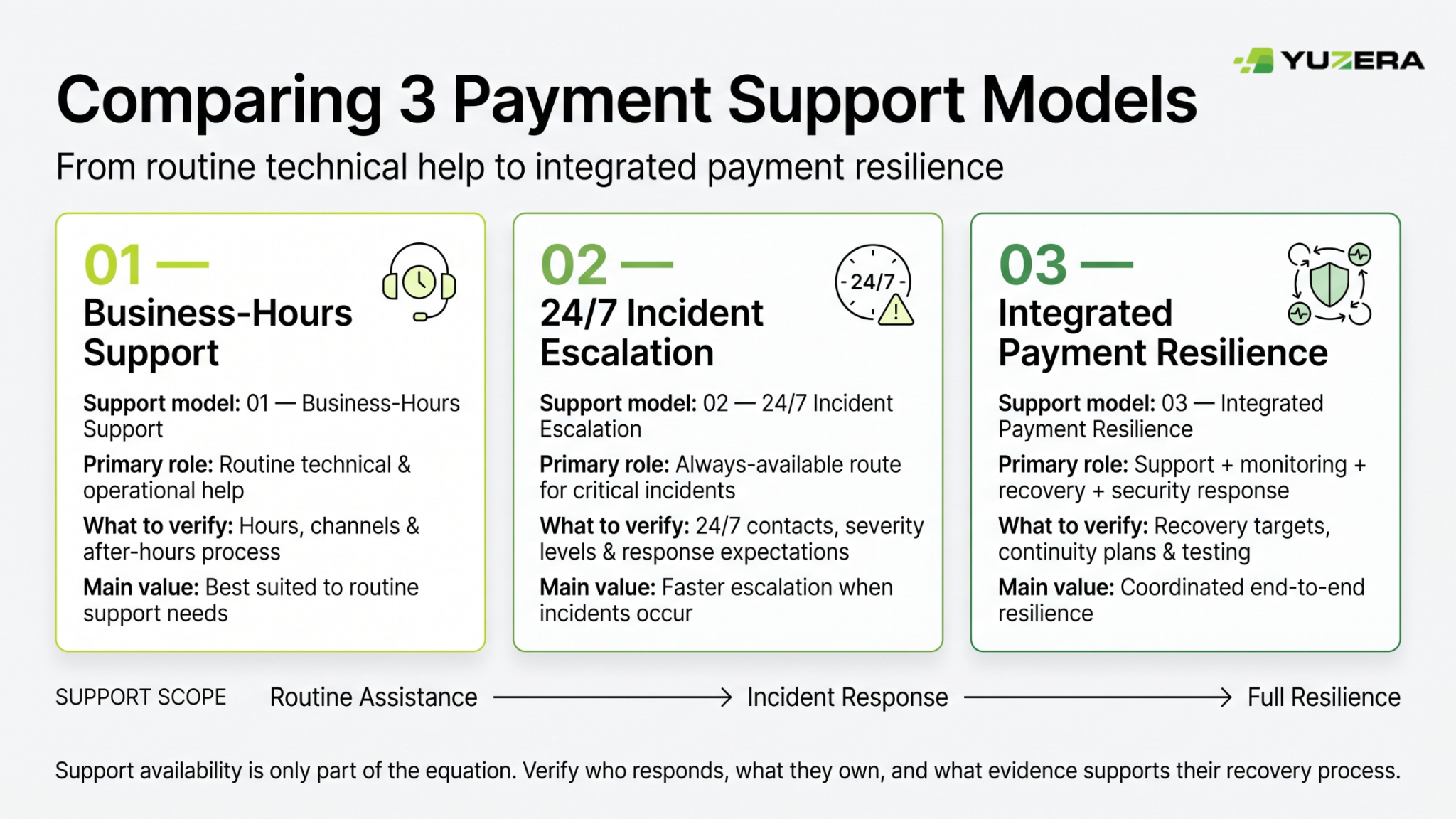
Most business payment support offerings sit somewhere on a spectrum, and the labels providers use rarely map cleanly onto what they actually staff. The framework below is an editorial comparison of three approaches, not a claim that every provider fits one column. Use it as an evaluation grid: for each row, ask a prospective partner to point to the documentation that proves which column they occupy.
The distinctions that matter most are coverage scope, named contacts, and evidence. Business-hours support can be entirely appropriate for a low-complexity single-location environment. It becomes a risk when nights, weekends, and peak trading periods carry meaningful revenue, and nobody has defined what happens then. The middle column addresses availability. The right column addresses whether availability, monitoring, recovery, and security response are run as one discipline or three disconnected ones. Each row draws on PCI DSS incident-response requirements, Canadian managed-services guidance, and Visa’s continuity recommendations.
| Dimension | Business-hours technical support | 24/7 incident escalation | Integrated payment-resilience support |
|---|---|---|---|
| Primary purpose | Resolves routine setup, user, device, or configuration questions during defined service hours | Provides a route to report and escalate suspected security incidents or severe availability incidents at any time | Connects POS and payment technology support, monitoring, incident handling, continuity, and post-incident improvement |
| What to ask for | Published support hours, channels, device and application scope, after-hours escalation process | Named 24/7 contacts, hotline availability, severity definitions, acknowledgment and update expectations | Documented RTO and RPO targets, outage communications plan, support ownership map, continuity playbooks, test evidence |
| Security value | Useful for operational issues; security role depends on escalation speed for a suspected compromise | Reduces delay between detection and the start of containment, investigation, and communications | Treats availability, monitoring, recovery, and security incident response as one operating discipline |
| Outage-resilience value | May suit non-critical questions but leaves ambiguity during nights, weekends, and peaks | Ensures a defined destination when an incident begins outside normal hours | Supports planned recovery, alternate communications, backup processes, recurring tests |
| Evidence to request | Written support-scope document and clear escalation instructions | Support matrix showing severity levels, channels, hours, primary contacts | Continuity documentation, recovery objectives, test cadence, response walkthroughs, communication plans |
A 14-step checklist for building payment processor support readiness
Work through these in order. Each step produces an artifact you can hand to a partner, an auditor, or a new operations lead.
-
Identify critical payment-dependent business functions. List in-store POS, payment terminals, e-commerce checkout, order management, connectivity, and staff access systems. Include anything that can prevent a sale or affect payment security, including systems you don’t think of as payment systems.
-
Map the systems, data, providers, and people involved. Document your POS provider, payment application provider, e-commerce platform, network provider, cloud provider, support contacts, and internal decision-makers. Include account numbers and contract references so nobody hunts for them during an incident.
-
Perform a threat and risk assessment. Identify high-value assets, sensitive-data touchpoints, the incidents most likely to hit your environment, the controls already in place, and the privacy implications of each data flow. Write down what you decided not to protect and why.
-
Define the incident scenarios that matter most. Canadian guidance supports scenarios including ransomware, denial-of-service events, cyber compromise, natural disasters, and unplanned outages. Add the payment-specific ones: terminal fleet failure, gateway unavailability, and suspected payment-page tampering.
-
Classify incidents by severity and business impact. Decide which events require immediate escalation, which need executive involvement, which justify temporarily suspending online activity, and which trigger a switch to a continuity procedure. Share severity definitions with your support partner; don’t invent them separately.
-
Assign internal response ownership before an incident occurs. Name the business lead, IT or security contact, operations lead, communications lead, and the person authorized to contact external providers. Name a backup for each. Ownership assigned during an incident is ownership assigned badly.
-
Document external support ownership and escalation paths. For every provider, record who responds, which incident types they cover, how to reach them, and what your team must do first. The Cyber Centre recommends asking providers what they expect from your organization, and that expectation belongs in writing.
-
Confirm 24/7 incident-response availability for security events. PCI DSS requires designated personnel to be available 24/7 for suspected or confirmed security incidents. Determine exactly who that is for your environment, on your side and your provider’s side, and validate the contact method works.
-
Set recovery objectives. Establish an acceptable recovery time objective and recovery point objective for critical payment technology and the business systems around it. Visa’s standards recommend well-defined RTOs and RPOs, and vague targets produce vague recoveries.
-
Create backup and restoration procedures. Build reliable backups for necessary systems and data, then test whether restoration actually completes inside your acceptable downtime window. An untested backup is a hypothesis, not a control.
-
Create a multi-channel communication plan. Define how employees, providers, leadership, and other stakeholders receive updates if email, portals, or internal systems are unavailable. Include customer-facing messaging templates so staff isn’t drafting under pressure at the counter.
-
Maintain an offline incident-contact list. Keep current phone numbers, escalation channels, account references, and provider contacts in hard copy. Canadian baseline guidance specifically recommends an up-to-date hard copy for situations where soft copies are unavailable.
-
Monitor for security and payment processor uptime indicators. Watch networks, systems, connected devices, and security alerts, plus payment-page tampering or unexpected script activity where applicable. Insufficient monitoring extends dwell time and makes recovery more complicated and costly.
-
Test, review, improve, and repeat. Exercise scenarios including a suspected compromise, a network outage, a major power outage, and an e-commerce payment-page incident. PCI DSS requires testing the plan at least once every 12 months, including all required elements.
FAQ
Q1) What should I look for in business payment support before signing?
Look for documented incident-response roles, guaranteed turnaround times for your priority incident types, a named primary contact, and a defined notification process for incidents affecting your data. Canadian managed-services guidance recommends asking each of these directly rather than assuming coverage. Also request evidence: a support-scope document, a severity matrix, and confirmation that the provider will participate in an incident-response simulation for your scenarios.
Q2) How do I evaluate a payment gateway with 24/7 support?
Ask what the 24/7 coverage includes. PCI DSS requires designated personnel available 24/7 for suspected or confirmed security incidents, so confirm whether round-the-clock availability extends to security escalation or stops at device troubleshooting. Then ask whether a hotline exists to initiate incident response and when it’s staffed. For e-commerce specifically, confirm who monitors payment-page scripts and where alerts route outside business hours.
Q3) Does local payment processor support in Canada actually make a difference?
It can, under specific conditions. Canadian guidance identifies off-hours or cross-time-zone availability as a challenge for timely incident detection and response, so shared operating hours improve escalation speed. Data location also matters: the Cyber Centre advises reviewing applicable laws and privacy impacts when using providers outside Canada. If you face regulatory constraints on support locations, agree the support model with your provider in advance.
Q4) What makes a payment solution with business support different from basic help desk access?
A payment solution with business support ties technical assistance to continuity planning, monitoring, and incident handling rather than treating them separately. Visa’s acceptance risk standards call for tested continuity plans with defined recovery time and recovery point objectives. Practically, that means documented RTO and RPO targets, an outage communications plan, a support ownership map, and evidence the plan has been exercised within the last twelve months.
Q5) How do I identify a payment processor with good uptime?
Go past the headline availability number. Uptime Institute found four in five respondents believed their most recent serious outage was preventable through better management, processes, or configuration, and that network issues were the largest single cause of IT-service outages. Ask about failure modes, connectivity redundancy, and network diagnostics. Then ask what your side of the recovery looks like, because uptime is a shared outcome, not a vendor statistic.
Where this leaves your evaluation
Good payment processor support is measurable, and the measurements already exist in public standards. PCI DSS tells you that 24/7 security incident availability is an expectation. Canadian guidance tells you which contractual questions to ask and why an offline contact list matters. Visa tells you that continuity plans need recovery objectives and resumption timelines. Uptime Institute tells you that most serious outages trace back to management, process, and configuration, which are exactly the things a strong support relationship improves.
Merchants evaluating a technology partner should apply that grid consistently across POS, orchestration, and e-commerce. Ask for documents, not assurances. Ask who picks up after hours and what they’re authorized to do. Ask to rehearse.
Yuzera is built around treating support as part of the architecture rather than an afterthought, informed by the operating track record of parent company Digitech. Start with the checklist above, and bring your answers to the conversation.
Works Cited
- Applause. “Limited Payment Options Survey.”
- Canadian Centre for Cyber Security. “Baseline Cyber Security Controls for Small and Medium Organizations.”
- Canadian Centre for Cyber Security. “Cyber Security Best Practices for Contracting Managed Service Providers.”
- Canadian Centre for Cyber Security. “Cyber Security Considerations for Consumers of Managed Services (ITSM.50.030).”
- Canadian Centre for Cyber Security. “Develop an Incident Response Plan.”
- Canadian Centre for Cyber Security. “Developing Your Incident Response Plan (ITSAP.40.003).”
- Canadian Centre for Cyber Security. “Incident Response (ITSP.10.033).”
- Canadian Centre for Cyber Security. “Protect Information at the Enterprise Level (ITSAP.10.097).”
- Canadian Centre for Cyber Security. “Recommended Contract Clauses for Security Operations Centre Procurement (ITSM.00.500).”
- Canadian Centre for Cyber Security. “What to Do When Your Organization Has Been Compromised by a Cyber Attack (ITSAP.00.009).”
- Federal Reserve Banks. “2024 Report on Payments.” Fed Small Business.
- Merchant Risk Council. “2024 Global Payments and Fraud Report.”
- Office of the Privacy Commissioner of Canada. “Estimates Issue Sheets.”
- Office of the Privacy Commissioner of Canada. “PIPEDA Findings 2025-001.”
- PCI Security Standards Council. “Important Updates Announced for Merchants Validating to Self-Assessment Questionnaire A.”
- PCI Security Standards Council. “Just Published: PCI DSS v4.0.1.”
- PCI Security Standards Council. “New Information Supplement: Payment Page Security and Preventing E-Skimming.”
- PCI Security Standards Council. “PCI DSS v4.0 SAQ D for Service Providers.”
- PCI Security Standards Council. “Point-to-Point Encryption (P2PE).”
- PCI Security Standards Council. “FAQ 1300.”
- PCI Security Standards Council. “FAQ 1301.”
- PCI Security Standards Council. “Updated Guidance: Responding to a Data Breach.”
- Reserve Bank of Australia. “The Reliability of Retail Payment Services.”
- Uptime Institute. “2024 Resiliency Survey Executive Summary.”
- Visa. “Visa Global Acquirer Risk Standards.”