A payment API integration is a documented HTTP interface that lets your own systems create orders, request payments, and receive transaction events, so the checkout your customer sees is built and controlled by you rather than handed off to a fixed template. For a growing merchant, that shift matters. The cart, the shipping step, the order review screen, and the post-purchase confirmation are all places where your business rules live, and an off-the-shelf flow eventually stops bending to them.
The good news is that custom checkout payments no longer mean building a card-entry form from scratch. Modern architecture separates the experience you own from the card-data component you deliberately contain. Baymard Institute’s cart abandonment research puts the average documented online cart-abandonment rate at 70.22 percent, which tells you checkout deserves engineering attention rather than a coat of paint. But it also warns against the opposite mistake: customizing for novelty and adding friction that no buyer asked for.
This guide walks through what a developer-friendly payment processor actually gives your team, how webhook payment support connects checkout to the rest of your operation, and where an embedded payment form fits between full outsourcing and full ownership. It is a technical decision, with security, accessibility, and privacy implications attached.
TL;DR
- Baymard Institute documents an average online cart-abandonment rate of 70.22 percent, and separately found 17 percent of U.S. shoppers abandoned an order in the prior quarter because checkout was too long or complicated.
- The average U.S. checkout displays 23.48 form elements by default, while Baymard’s research says an ideal flow can be reduced to 12, with many sites able to cut default elements by 20 to 60 percent.
- PCI SSC identifies three payment-page patterns: card data managed exclusively by the merchant, partially managed with third-party support, or wholly outsourced, which maps directly to redirect, embedded fields, and merchant-built forms.
- PCI DSS v4.0.1 published in June 2024, v4.0 retired December 31, 2024, and the e-commerce script-authorization and tamper-detection requirements 6.4.3 and 11.6.1 took effect March 31, 2025.
- Standard Webhooks recommends verifying the raw payload, checking timestamp freshness against a tolerance, and using the webhook ID as an idempotency key so a duplicate delivery never triggers duplicate fulfilment.
When does an off-the-shelf checkout become too limiting?
An off-the-shelf checkout becomes too limiting when the flow a business needs no longer fits inside the options the template exposes. The tell is not usually aesthetic. It is operational: a subscription that needs a mid-flow plan selection, a B2B order that needs a purchase-order field and an approval hold, a multi-location retailer that needs inventory checked against the correct store before payment is requested, or a post-purchase workflow that has to fire an invoice and a CRM update at the same moment.
Baymard’s checkout usability benchmark found that 65 percent of reviewed ecommerce sites had checkout UX rated mediocre or worse, only 2 percent rated good, and none reached perfect or state-of-the-art. That benchmark covers 344 top-grossing U.S. and European ecommerce sites, more than 110 checkout guidelines, and over 30,000 manually reviewed checkout elements. The distribution is instructive. If most large merchants are sitting in the mediocre band, the constraint is rarely budget. It is that the default flow was never designed for their specific catalog, customer type, or fulfilment model.
There is a second pressure point: form length. Baymard’s checkout abandonment causes research reports that the average U.S. checkout displays 23.48 form elements by default, while an ideal checkout can be reduced to 12. Its research suggests many sites can cut default form elements by 20 to 60 percent. A stock checkout usually cannot remove fields it considers standard. A custom one can, which is the most underrated argument for going custom. The work is subtraction, not addition.
The same research estimates the average large ecommerce site could potentially improve conversion by 35.26 percent through checkout-design improvements alone. Treat that as a research estimate, not a promise for any specific store. The point stands: the work is worth scoping properly, and it is exactly the kind of scoping that benefits from a payment API integration built around real order logic using a developer friendly payment processor rather than a generic template.
What can a payment API control that a standard checkout page cannot?
A payment API lets a server decide what a valid order is, when a payment is requested, what happens between steps, and how the result propagates through connected business systems. A standard checkout page decides those things for the merchant instead.
Start with the specification layer, because developer experience is a real evaluation criterion. The API specification standard from the OpenAPI Initiative defines a language-agnostic description for HTTP APIs so that people and software can discover and understand a service’s capabilities without access to source code, separate documentation, or network-traffic inspection. OpenAPI also states that a properly defined description lets a consumer understand and interact with a remote service using a minimal amount of implementation logic. That is the practical definition of a developer-friendly payment processor: the contract is legible before anyone writes code.
Ask what that description actually covers. An OpenAPI Description can include at least one of paths, components, or webhooks, and the top-level webhooks field exists specifically to describe event-driven interactions. So a single document can define both synchronous operations and asynchronous events. When evaluating a developer-friendly payment processor, request the description and check whether authentication, request fields, response objects, error states, versioning, sandbox behavior, and event payloads are all defined there. Gaps in that document become guesswork during a payment API integration, and guesswork during a payment integration becomes incidents.
What this unlocks in practice is control over sequence and authority. With API-driven custom checkout payments, a merchant can gate the payment request behind a real-time inventory check, apply promotion logic on trusted server data, insert an approval step for accounts that require one, and only then create the payment. A single order can draw from two fulfilment locations. A paid event can push into POS, billing, and support tooling in one pass. On the in-store side, Yuzera builds POS systems and terminals with the same design premise: the flow should match how the business actually runs, built for the business owner rather than only the clerk at the counter.
Redirect, embedded fields, or a fully custom form?
The choice comes down to how much of the card-entry experience a merchant wants to own, and PCI SSC gives a neutral framework for thinking about it. Its payment system guide says card-data handling on a payment page may be managed exclusively by the merchant, partially managed by the merchant with third-party support, or wholly outsourced to a third party. Those three patterns line up with merchant-built forms, embedded payment fields, and provider-hosted redirects.
The same guide draws a distinction that resolves a lot of confusion. It separates shopping pages, which should not request or capture payment-card data, from the payment page or form used to collect card data after the buyer decides to purchase. That means the cart, shipping selection, address collection, order review, and confirmation experiences can all be deeply customized even when the card-entry component itself is hosted or embedded. Most of what buyers experience as checkout is not the card field.
PCI SSC also defines an ecommerce payment system as the full process through which a buyer selects goods or services and a merchant accepts card payments, potentially including shopping pages, a payment page or form, connected devices or systems, and connections to the merchant bank or payment service provider. Scope a project against that full definition, not against the single screen.
How does the embedded pattern work technically? PCI SSC’s ecommerce security guidance illustrates a JavaScript-form flow: the merchant website creates the payment page, the buyer’s browser requests JavaScript from the payment-service provider, the provider’s JavaScript creates the payment form in the browser, card data is sent directly to the provider, and the merchant application receives the transaction result. This is the embedded payment form pattern in practice, and it is what lets a checkout stay on-brand while keeping card data contained.
One caution before treating any pattern as a shortcut. The OWASP Foundation’s payment functionality testing guidance advises avoiding storing, transmitting, or processing card details wherever possible and identifies a redirect or iframe to a payment gateway as a remediation approach, while noting the merchant still needs to review the gateway documentation and use relevant security features. PCI SSC is explicit that it does not determine whether a particular implementation is compliant. Compliance obligations should be confirmed with the organizations that manage a merchant’s compliance program.
Comparing the three checkout architectures
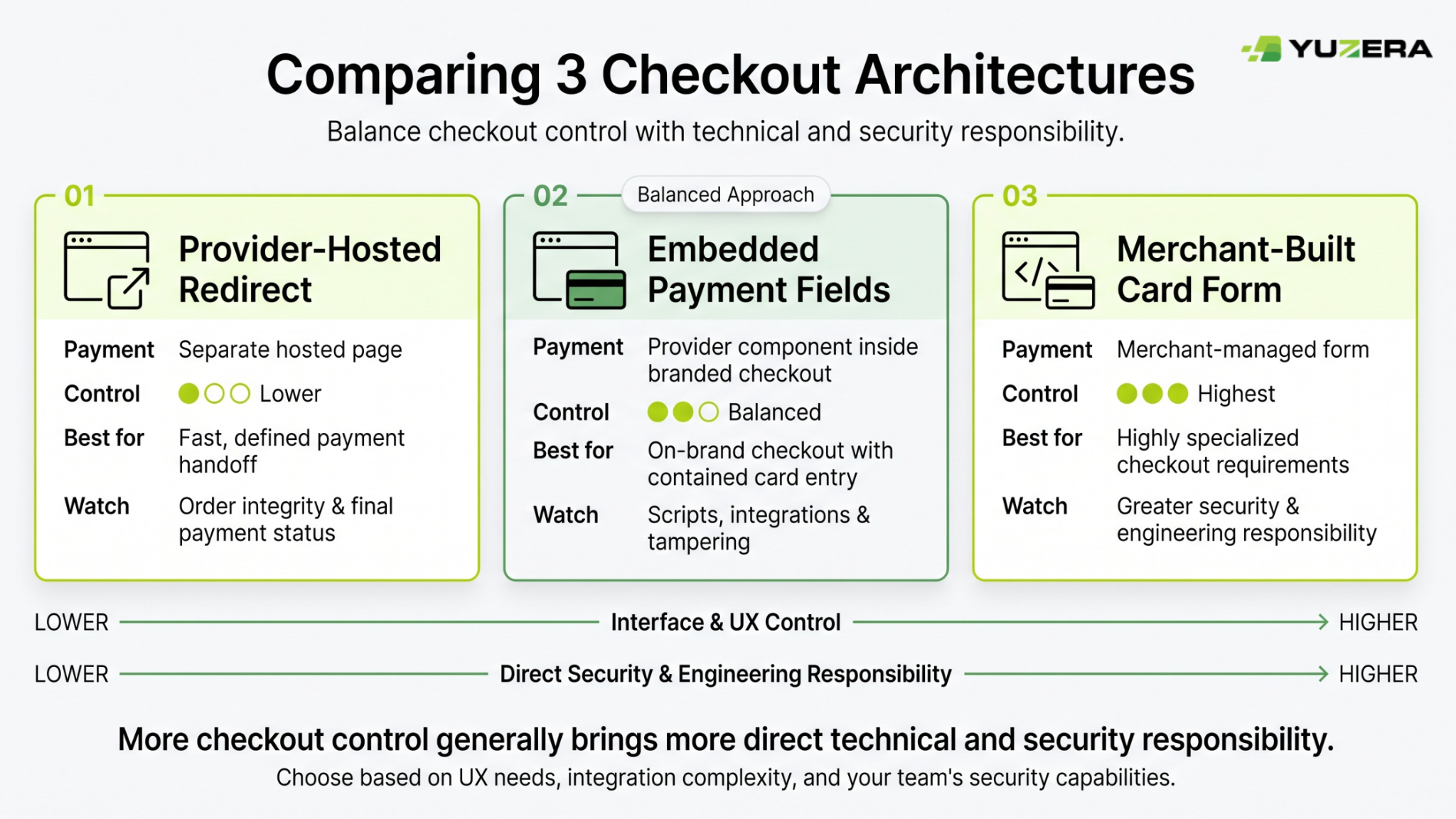
The table below is an editorial decision framework synthesized from PCI SSC and OWASP guidance. Read “more control” and “less control” as statements about application and user-experience control only. None of these rows establishes PCI scope, SAQ eligibility, or compliance status for any business, and that determination sits with the relevant compliance stakeholders.
Use it as a scoping conversation between product, engineering, and security teams rather than a scorecard. For many merchants, the honest answer lands in the middle column: an embedded payment form gives an on-brand checkout while keeping card-data handling contained in a provider-supplied component. The right answer depends on whether specialized order logic genuinely requires form-level control, and whether the team has the security engineering capacity to carry that responsibility. Score each row against your own catalog, verticals, and internal capabilities before committing.
| Dimension | Provider-hosted redirect | Embedded payment fields or iframe | Fully merchant-built card form |
|---|---|---|---|
| Where card entry occurs | On a separately hosted payment page | Inside a component displayed within your branded checkout | On a merchant-managed card-entry form |
| Brand and layout control | Generally lowest; buyer leaves your primary checkout interface | Middle to high; you control surrounding layout, branding, cart context, progression | Highest; you control the entire interface and form behavior |
| Responsibility for payment-page code | You still secure your site and integrations, with less direct control over the card-entry page | You must govern the parent page, embedded components, scripts, and security-impacting headers | You take the most direct responsibility for the card-entry experience and its security design |
| API and webhook integration depth | Suitable when speed and a defined handoff are the priority | Suitable for an on-brand checkout plus a contained card-entry component | Suitable only with a clear technical, security, compliance, and operational rationale |
| Best customizations | Cart handoff, confirmation page, brand messaging before and after payment | Layout, buyer flow, address collection, shipping logic, order review, payment-method placement, analytics events | Highly specialized workflow logic, interface behaviors, and data capture, subject to stringent review |
| Primary technical caution | Preserve order integrity across the handoff and reconcile final status safely | Control scripts, verify embedded integration behavior, monitor for tampering | Never rely on the client for prices or authorization; assess requirements before deployment |
What should the server validate before a payment request?
A server should validate every commercially meaningful value before it creates a payment request, and it should treat nothing from the browser as authoritative except item identifiers and quantities. OWASP’s payment functionality guidance warns that where a checkout hands off to a payment gateway, attackers may be able to tamper with prices between the application and the gateway. Its remediation guidance goes further: pricing-related information should be handled server-side, and client-side requests should include only item IDs and quantities.
In practice that means the checkout UI can display a total, but the server calculates and validates the authoritative total from trusted catalog, promotion, shipping, and tax logic.
Products and variants get re-resolved against the catalog. Quantities get checked against inventory rules. Discount codes get re-evaluated server-side for eligibility, stacking rules, and expiry rather than accepted as a submitted discount amount. Shipping method gets re-priced from the address and the fulfilment configuration. Tax gets computed from trusted logic. Only then does the server create the payment request with its own computed amount. This is the core discipline behind any solid payment API integration.
Sequence is the second half of the problem. OWASP notes that checkout flows with multiple steps, such as cart, discount code, shipping, billing, and payment, may produce unintended behavior if steps can be performed out of sequence, and its remediation guidance recommends robust payment flows that cannot be performed out of order. The fix is explicit state machines rather than implicit page order. Define valid states like cart created, checkout started, payment action required, authorized, paid, failed, cancelled, fulfilment-ready, refunded, and disputed.
Define legal transitions between them. Reject anything else at the API boundary.
Duplicate submission belongs in the same design pass. The Internet Engineering Task Force’s HTTP semantics standard defines an idempotent request as one where multiple identical requests have the same intended server effect as one request, and states that clients should not automatically retry a non-idempotent method such as a typical POST unless they can know the request is safe to retry or determine the original was never applied. A double-click, a mobile network timeout, or a client retry should never produce two orders. Build an idempotency key into order creation and payment intent creation from the start.
Why an order should never be completed on a browser redirect
An order should never be marked complete based only on a browser redirect or a front-end success message, because the browser is an untrusted and unreliable narrator. The customer may close the tab before the redirect resolves. The network may drop. A third-party authentication step may interrupt the return trip. The front end may report success on a request the provider later declines. Final order state belongs to server-confirmed events.
This is where webhook payment support stops being a nice-to-have and becomes the backbone of the integration. The OpenAPI Initiative’s webhook implementation guide explains that webhooks support out-of-band events that do not fit a standard REST request-response pattern: a receiver registers a URL in advance, the sender delivers an HTTP request containing event data to that URL when an event occurs, and the receiver acknowledges it. That mechanism is what connects checkout events to order management, inventory, CRM, invoicing, and customer support.
Be selective about what gets subscribed to. The same guidance notes that webhook implementations typically include a registration step, which can let consumers subscribe only to the events they want to receive. Subscribe intentionally to the operational events that actually drive logic: payment authorized, payment captured or paid, payment failed, refund issued, invoice paid, recurring charge succeeded or failed, dispute opened. A broad subscription looks thorough and behaves like noise, because every event received is an event someone has to reason about when it arrives out of order. Strong webhook payment support depends on this kind of intentional scoping.
Design for asynchrony rather than assuming it away. Events can arrive late, arrive twice, or arrive before the redirect that a customer is still waiting on. A robust pattern shows the buyer a provisional confirmation that reflects current known state, then updates order status, fulfilment triggers, and customer communication when the authoritative event lands.
Payment-action-required states need the same treatment, since an authentication challenge can pause a flow for minutes. For merchants running both storefront and back-office payment capture, Yuzera’s virtual terminals and ecommerce paths feed the same event model, which keeps reconciliation in one place instead of three.
How should developers verify webhooks and prevent duplicates?
Verify the signature on every webhook delivery before any business logic runs, then deduplicate by event identifier. GitHub Docs’ webhook delivery validation guidance states that recipients should validate a webhook signature before processing the delivery, to confirm it was sent by the expected source and was not tampered with. That documentation uses GitHub’s own implementation as its example, but the pattern of authenticated event delivery ahead of business processing applies directly to payment events, and it is a core expectation for reliable webhook payment support.
Secrets management is part of the control, not an afterthought. The same guidance advises creating a high-entropy webhook secret, storing it securely on the server, and never hardcoding it into an application or committing it to a repository. For a merchant engineering team, that means the webhook secret lives in a secret manager alongside API credentials, with rotation planned rather than improvised.
There is a specific implementation trap worth naming. The webhook signing specification from Standard Webhooks warns that cryptographic signatures are sensitive to very small changes, and identifies a common failure: parsing JSON and serializing it again before verification, which can change the representation of the payload. Verify the raw received body using the provider’s documented method, then parse. Many frameworks helpfully parse the body automatically, which is exactly why this bug is common in otherwise careful codebases.
Two more controls from the same specification close the loop. It recommends verifying that a webhook timestamp falls within an allowed tolerance of the current time to help prevent replay attacks. And it recommends using the webhook ID as an idempotency key so a receiver does not accidentally process the same delivery more than once. That second point has real operational weight. A duplicate paid event without deduplication can produce duplicate fulfilment, a second shipping label, a second confirmation email, a duplicated CRM record, and a support ticket that gets paid for twice.
Combine these into one intake handler: verify signature, check timestamp freshness, record the event ID in a durable store, exit early if already seen, then dispatch to business logic. Return a fast acknowledgement and do the heavy work asynchronously so a slow downstream system does not cause the sender to retry unnecessarily.
What API security controls does a custom checkout need?
A custom checkout needs object-level authorization on every endpoint that touches customer-owned data, plus deliberate protection for the business flows attackers want to automate. OWASP’s object authorization guidance identifies Broken Object Level Authorization as an API risk that occurs when attackers manipulate an object ID in a path, query parameter, header, or request payload. It states that every API endpoint receiving an object ID and acting on that object should implement object-level authorization checks that validate whether the logged-in user has permission for the requested action.
The stakes are specific. OWASP says failures in object-level authorization can lead to unauthorized data disclosure, modification, or destruction, and in some circumstances to full account takeover. Map that onto a custom checkout’s endpoint surface: saved payment methods, customer profiles, addresses, orders, invoices, subscriptions, and refund requests. Each one takes an identifier. Each one needs an ownership check that runs on the server, against the authenticated session, on every request, not just on the screens where the interface happens to hide the button.
Then there is flow abuse. OWASP’s sensitive flow guidance says an endpoint is vulnerable when it exposes a sensitive business flow without appropriately restricting access, and describes attackers identifying and automating flows that can harm the business, including situations where legitimate users could be prevented from purchasing. Anyone who has watched a limited-release product get consumed by scripted carts before real customers could load the page understands the category.
Rate limiting is one of the named mitigations. OWASP’s API security release notes state that the Unrestricted Access to Sensitive Business Flows category addresses emerging threats that can often be mitigated using rate limiting. Apply it where automation is profitable: coupon and gift-card validation, account creation, login, address lookup, order submission, and payment-method changes. Tune per flow rather than applying one global ceiling, because a single number that protects coupon endpoints will usually be too tight for legitimate browsing traffic.
For transaction-level risk, EMVCo’s three-domain secure overview explains that EMV 3-D Secure lets merchants integrate authentication into browser-based and app-based checkout, that issuers may require additional authentication for higher-risk transactions, and that device and browser information can be collected during checkout to enhance risk-based decisioning. Design the interruption into the checkout’s flow states rather than bolting it on later.
Script governance on payment pages is now a hard requirement
If browser code runs on or affects a payment page, it needs to be inventoried, authorized, integrity-checked, and monitored. This is no longer a best-practice suggestion on a roadmap. PCI SSC’s standard release update confirms that PCI DSS v4.0.1 was published in June 2024, that PCI DSS v4.0 was retired on December 31, 2024, and that the revision did not add or delete requirements.
The date that matters for checkout engineering is March 31, 2025. PCI SSC states that v4.0.1 did not change that effective date for the new requirements, and its ecommerce security update describes Requirements 6.4.3 and 11.6.1 as controls aimed at reducing e-skimming risk. PCI SSC explains that these e-commerce controls focus on ensuring payment-page scripts are authorized, checked for integrity, and monitored for tampering.
Read that against how a modern checkout page is usually assembled. Analytics, tag managers, session-replay tools, chat widgets, personalization scripts, A/B testing frameworks, consent managers, and affiliate pixels all tend to accumulate on high-value pages because that is where marketing wants measurement. A tag manager in particular can introduce new third-party code without a code deployment, which is convenient for campaigns and difficult for change control. A custom checkout should maintain a known inventory of scripts and stop treating third-party browser code as an ungoverned design convenience.
Embedding does not exempt a merchant from this. PCI SSC says its payment-page-security guidance is intended for entities conducting ecommerce card transactions and for webpages that can affect ecommerce payment security through embedded iframes. If an embedded payment form sits inside a page a merchant controls, that parent page is in the conversation. Script integrity, security-impacting response headers, and change monitoring all apply to the container, not just the component.
Tokenization deserves the same sober framing. PCI SSC’s tokenization guidance supplement defines tokenization as replacing a primary account number with a surrogate value called a token, and says tokenization may reduce the number of systems to which PCI DSS requirements apply depending on the implementation, but does not eliminate the need to maintain and validate PCI DSS compliance. Tokens are excellent for enabling saved payment methods, subscriptions, and repeat purchase without holding card data directly. They are not a compliance exit.
How do you keep a customized checkout accessible?
Keep a customized checkout accessible by using semantic native controls wherever possible, labeling input purpose programmatically, and testing embedded and heavily styled components against real keyboard and assistive-technology behavior. The World Wide Web Consortium published WCAG 2.2 as a Recommendation on October 5, 2023, and its accessibility standard update lists nine added success criteria including Focus Not Obscured, Target Size, Redundant Entry, and Accessible Authentication. Every one of those has a checkout analogue.
Focus Not Obscured maps to sticky order summaries and fixed footers that hide the field a keyboard user just tabbed into. Target Size maps to compact mobile quantity steppers and payment-method radio controls. Redundant Entry maps to asking for the same address twice in a multi-step flow. Accessible Authentication maps to step-up authentication and one-time-code entry, which is a common interruption point in a modern payment flow.
Field semantics do double duty. W3C’s input purpose guidance says the purpose of applicable input fields collecting information about a user should be programmatically determinable, and explains that the autocomplete taxonomy can help browsers and assistive technologies identify field purpose and may support appropriate autofill. That is an accessibility requirement that also reduces typing, which matters when the average U.S. checkout is carrying 23.48 form elements.
On component construction, W3C’s HTML control technique states that standard HTML form controls and links support keyboard operation and interoperability with assistive technologies.
The practical rule for custom checkout payments is to reach for native controls first and reserve custom widgets for cases where nothing native fits. When styling aggressively or dropping in an embedded payment form, test keyboard operation, visible focus, label association, focus management on step changes, and error messaging inside and around the embedded component.
Browser payment features need a fallback plan. MDN Web Docs’ payment request reference describes the Payment Request API as a browser API intended to give users a consistent way to select their preferred payment method, but marks it as Limited availability, says it is not Baseline because it does not work in some widely used browsers, and notes it is available only in secure HTTPS contexts. Treat it as an accelerator for the browsers that support it, never as the only path to payment.
Privacy-aware data collection in a custom checkout
A custom checkout is also a data-collection instrument, so a merchant should decide deliberately what it asks for and why. The Office of the Privacy Commissioner of Canada’s privacy requirements overview states that PIPEDA applies to private-sector organizations across Canada that collect, use, or disclose personal information in the course of commercial activity, subject to jurisdictional details, and identifies 10 fair information principles including accountability, identifying purposes, consent, limiting collection, safeguards, openness, access, and challenging compliance. Legal review is required before making a definitive statement about which privacy law applies to a given business, province, or data flow.
Two of those principles shape form design directly. The OPC’s purpose identification guidance says organizations should identify and document the purposes for collecting personal information and tell customers why the organization needs it before or at the time of collection. Applied to checkout, that means collecting only what the transaction requires, or clearly explaining any additional request. If a date of birth is needed for a loyalty program or a phone number for delivery coordination, say so at the field rather than burying it in a policy page.
Consent quality matters as much as consent presence. The OPC’s meaningful consent guidance says meaningful consent is an essential element of PIPEDA and is valid only when it is reasonable to expect that customers understand the nature, purpose, and consequences of collection, use, or disclosure. It advises making privacy information readily available and emphasizing what information is collected, who receives it, why it is used, and the associated risks of harm or consequences. A marketing opt-in bundled into an order-submission button does not meet that bar.
There is a pleasant alignment here. Data minimization is also conversion hygiene. Baymard’s research shows that 17 percent of U.S. shoppers abandoned an order in the prior quarter because checkout was too long or complicated, and its finding that many sites can reduce default form elements by 20 to 60 percent points the same direction as the limiting-collection principle. Fewer fields, each with a stated purpose, is the better checkout and the more defensible data practice. When that thinking extends across storefront, ecommerce gateways, and in-person capture, it helps to keep one documented answer for what each field is for.
A 12-step checklist for launching a custom checkout responsibly
-
Define the business problem before selecting an integration pattern for custom checkout payments. Document the specific limitations that need solving: brand continuity, multi-step purchase flow, account experience, subscriptions, POS or inventory connection, post-purchase automation, localization, or specialized order rules. Avoid writing custom code purely for visual novelty, since every customization adds a surface that must be maintained.
-
Map the complete purchase and payment system. Identify shopping pages, payment pages, APIs, browser scripts, embedded components, customer-data stores, inventory systems, invoicing tools, and internal order workflows. PCI SSC defines ecommerce payment systems as broader than the checkout screen itself, so scope the project and its reviews against that full definition.
-
Choose the architecture deliberately and write down why. Compare provider-hosted redirect checkout, embedded hosted fields or iframe, and merchant-built card-entry experiences against desired user experience, technical capacity, and security obligations. Record the decision and its rationale so future teams inherit reasoning rather than an unexplained implementation they are afraid to touch.
-
Minimize card-data exposure by design. Where appropriate, use hosted or embedded payment components instead of building systems that store, transmit, or directly handle card details. OWASP advises avoiding card-data handling wherever possible. Confirm the selected pattern with payment, security, and compliance stakeholders before development starts, not after.
-
Specify the API contract before development begins on your payment API integration. Require clear documentation for authentication, request fields, response objects, error states, versioning, test behavior, and webhook payloads. An OpenAPI description gives developers and tooling a consistent way to understand an HTTP API, and a gap in that document usually becomes an integration defect later.
-
Make the server authoritative for order data. Treat the browser as a presentation layer only. Validate products, quantities, inventory rules, promotions, delivery options, tax logic, and the final order total server-side. Never accept a client-submitted amount as authoritative, and keep client payloads limited to item identifiers and quantities.
-
Build explicit state transitions for checkout. Define valid states such as cart created, checkout started, payment action required, authorized, paid, failed, cancelled, fulfilment-ready, refunded, and disputed, then enforce legal transitions at the API boundary. This prevents users or attackers from invoking later checkout steps out of sequence.
-
Add idempotency controls to order creation and event handling. Design safeguards so a double-click, timeout, client retry, or duplicate event cannot create duplicate orders or duplicate downstream actions. HTTP guidance cautions against automatically retrying non-idempotent operations without a safe mechanism, so supply the key rather than hoping retries behave.
-
Treat webhooks as authenticated, asynchronous operational events. Subscribe only to events that drive logic, verify every delivery before business processing, check timestamp freshness where timestamps are provided, and deduplicate using the event identifier. Acknowledge quickly and process heavy downstream work asynchronously to avoid unnecessary sender retries.
-
Apply API authorization and abuse controls. Implement object-level authorization checks on customer, order, invoice, subscription, and saved-payment-method endpoints. Protect sensitive business flows such as coupon redemption, account creation, and order submission with access restrictions and per-flow rate limiting tuned to legitimate traffic patterns.
-
Govern payment-page scripts and security-impacting changes. Maintain an approved script inventory, establish integrity and change-management practices, and monitor for unauthorized changes or tampering. This applies to any page that can affect ecommerce payment security, including pages that render embedded iframes, and it includes code injected through tag managers.
-
Test usability, accessibility, failure paths, and recovery before launch. Exercise keyboard operation, visible focus, error messages, autofill behavior, mobile layout, authentication interruptions, payment failures, duplicate submission, out-of-order webhooks, delayed events, and browser fallbacks. Do not depend on browser-specific payment-request features without a dependable alternative path.
FAQ
Q1) What does payment processing with API integration actually let a merchant control?
It lets a server own the commercial logic and the order lifecycle while the payment platform handles the payment mechanics. A merchant decides when a payment is requested, what a valid order looks like, and which systems get notified. OWASP guidance supports keeping pricing server-side and sending only item IDs and quantities from the client, which is the practical boundary. The visible checkout becomes fully customizable, while card-data handling stays inside the pattern selected through the payment API integration.
Q2) How do I evaluate whether something is a developer-friendly payment processor?
Ask for the API description before anything else. The OpenAPI Specification exists so people and software can understand a service’s capabilities without source-code access, separate docs, or traffic inspection, and it states that a properly defined description lets a consumer integrate with minimal implementation logic. Check that authentication, request fields, response objects, error states, versioning, sandbox behavior, and webhook payloads are all documented. An OpenAPI Description can include a top-level webhooks field, so events should be defined there too, which is a strong signal of a genuinely developer-friendly payment processor.
Q3) What should I look for in a payment gateway with webhook support?
Look for signed deliveries, timestamps, stable event identifiers, selective event registration, and documented retry behavior. GitHub’s guidance says recipients should validate the signature before processing a delivery. Standard Webhooks recommends verifying the raw payload rather than a re-serialized version, checking the timestamp against a tolerance to resist replay, and using the webhook ID as an idempotency key. Registration matters too, since OpenAPI’s guidance notes it lets a system subscribe only to the events it actually needs, which is the foundation of dependable webhook payment support.
Q4) Can an embedded payment form stay fully on-brand without taking on card-data handling?
Largely, yes, which is why it is often the pragmatic middle path. PCI SSC separates shopping pages from the payment page or form that collects card data, so the cart, address collection, shipping logic, and order review can be fully customized around a contained card-entry component. Its guidance illustrates a JavaScript form where provider code creates the form in the browser and card data goes directly to the provider. Note that PCI SSC’s payment-page security guidance still covers pages affecting payment security through embedded iframes, so an embedded payment form still requires governance of its surrounding page.
Q5) What does a payment solution with checkout customization need beyond visual styling?
Server-authoritative totals, enforced step sequencing, idempotent order creation, verified webhook intake, object-level authorization, script governance, and accessibility testing. PCI DSS requirements 6.4.3 and 11.6.1 took effect March 31, 2025 and focus on authorizing payment-page scripts, checking integrity, and monitoring for tampering. WCAG 2.2, a Recommendation since October 5, 2023, adds criteria like Focus Not Obscured and Accessible Authentication that apply directly to custom checkout payments and step-up authentication flows.
Works Cited
- Baymard Institute. “Cart Abandonment Rate Statistics.”
- Baymard Institute. “Ecommerce Checkout Usability Report and Benchmark.”
- Baymard Institute. “Checkout Usability Research.”
- EMVCo. “3-D Secure.”
- GitHub Docs. “Validating Webhook Deliveries.”
- Internet Engineering Task Force. “RFC 9110: HTTP Semantics.”
- MDN Web Docs. “Payment Request API.”
- Office of the Privacy Commissioner of Canada. “PIPEDA in Brief.”
- Office of the Privacy Commissioner of Canada. “Identifying Purposes.”
- Office of the Privacy Commissioner of Canada. “Consent.”
- OpenAPI Initiative. “OpenAPI Specification v3.1.1.”
- OpenAPI Initiative. “Webhooks.”
- OWASP Foundation. “Testing for Payment Functionality.”
- OWASP Foundation. “API1:2023 Broken Object Level Authorization.”
- OWASP Foundation. “API6:2023 Unrestricted Access to Sensitive Business Flows.”
- OWASP Foundation. “API Security Top 10 Release Notes.”
- PCI Security Standards Council. “Small Merchant Guide to Safe Payments.”
- PCI Security Standards Council. “Best Practices for Securing E-commerce.”
- PCI Security Standards Council. “Just Published: PCI DSS v4.0.1.”
- PCI Security Standards Council. “New Information Supplement: Payment Page Security and Preventing E-Skimming.”
- PCI Security Standards Council. “Tokenization Product Security Guidelines.”
- World Wide Web Consortium. “What’s New in WCAG 2.2.”
- World Wide Web Consortium. “Understanding Success Criterion 1.3.5: Identify Input Purpose.”
- World Wide Web Consortium. “Technique H91: Using HTML Form Controls and Links.”