
Multi-currency payments are a checkout capability that lets a store display prices and, in some configurations, complete transactions in more than one currency, so international buyers can shop in terms they recognize. For Canadian merchants, that capability sits at the intersection of technology, trust, and operations. It is rarely the hardest part of going international, but it is often the most visible one, because currency is the first signal a shopper reads about whether your store was built with them in mind.
The good news is that expanding beyond Canada and managing currency conversion payments is more of a sequencing exercise than a leap. In 2024, 53,448 establishments in Canada exported goods, and 86.6% of those exporters sold into the United States, according to Statistics Canada’s exporter characteristics release. That concentration tells you something practical: for most Canadian merchants, the first international market is close, familiar, and reachable through the channels you already run.
This guide covers currency conversion, multi-currency payment processing in Canada, checkout design, authentication, payment-page security, privacy, and customs and returns processes that must align with your checkout’s promises.
TL;DR
- In 2024, 53,448 Canadian establishments exported goods, and 86.6% sold to the United States, making U.S. expansion the logical first test market for most Canadian merchants planning cross-border payment processing.
- Bank of Canada exchange rates are indicative only, published by 16:30 Eastern Time, and may differ from actual transaction rates, so displayed conversions must be labeled as estimates rather than guarantees.
- Baymard Institute reports an average online cart abandonment rate of 70.19%, with 40% of surveyed U.S. shoppers leaving due to unexpected extra costs and 12% because the total cost was unclear before checkout.
- Visa’s cross-border guidance says merchants should disclose the transaction currency, allow shoppers to toggle currencies, and never perform currency conversion on the buyer’s behalf, since an incorrect currency is a recognized dispute condition.
- PCI DSS v4.0.1 e-commerce requirements 6.4.3 and 11.6.1 took effect on March 31, 2025, applying script management and integrity duties even to merchants using embedded third-party payment forms.
Why is international selling a natural next step for Canadian merchants?
International selling and optimizing global sellers’ payments are a natural next step for Canadian merchants because the largest export market is adjacent, the trade relationship is deep, and e-commerce removes most traditional barriers to entry. Global Affairs Canada reports that cross-border trade between Canada and the U.S. is valued at more than US$3.6 billion per day in its competitiveness key facts. That flow is not abstract. It reflects established logistics lanes, carrier networks, customs procedures, and buyer familiarity that a Canadian merchant can plug into rather than build.
The Trade Commissioner Service is direct on the point: e-commerce can help businesses sell globally, and offering multi-currency payments gives Canadian exporters an online path to international buyers. Its online exporting guide treats localization, online payments, customer support, and technical readiness as parts of the same export-preparation exercise. Notice what that framing does. It refuses to isolate payments as a separate project. Currency, checkout, support scripts, and site language are a single system, and the buyer experiences them as such.
For merchants who already run both face-to-face and online channels, this is familiar territory. A business has already solved the problem of making two very different environments feel like one brand. Cross-border selling is the same discipline applied across a border instead of across a channel. This is where a POS built for the business owner, not just the person behind the counter, starts to matter for cross-border payment processing in Canada: the same product, pricing, and order data need to hold together whether a sale happens in-store or through an international checkout.
Where merchants get into trouble is treating international expansion as a switch rather than a sequence. Turning on a currency selector without adjusting order records, refund logic, support documentation, or customs paperwork results in a store that looks international but operates domestically. In cross-border payment processing, the gap shows up later as disputes, confused customers, and reconciliation work nobody budgeted for.
A more useful mental model is to pick one market, build the full operating loop for it, then repeat. The 86.6% figure from Statistics Canada is a strong argument for making the United States that first loop, not because other markets are unattractive, but because the learning curve is shortest where the infrastructure is densest. Once the loop works once, adding a second market becomes a configuration exercise rather than a rebuild. This is also where payment orchestration earns its place: coordinating checkout, order data, and reporting so a second or third market does not mean a second or third disconnected system.
Why is currency more than a symbol beside a price?
Currency is more than a symbol because the Canadian dollar’s value fluctuates continuously in the open market, making international pricing an ongoing operational decision rather than a one-time setup task. The Bank of Canada explains in its exchange rate overview that the foreign-exchange market determines the Canadian dollar’s value and that the Bank does not generally set the exchange rate.
That has direct consequences for how a store is built. If product pages carry converted prices, those numbers age. How fast they age depends on the currency pair and market conditions, but they age. The Bank of Canada publishes daily average exchange rates for key trading-partner and global currencies by 16:30 Eastern Time on Bank business days, in accordance with its foreign exchange methodology. Those averages are built from indicative mid-market quotes collected every minute between 8:00 and 16:00 Eastern Time, which clearly indicates that a currency’s value can move meaningfully during a single business day.
There is a second detail that trips up finance and merchandising teams working from the same spreadsheet. On the Bank of Canada’s exchange-rate pages, rates are expressed as the number of Canadian dollars required to buy one unit of the foreign currency. Read the wrong direction and an international price list is inverted. It happens more often than anyone admits, usually when a pricing table is handed between teams without a note on convention.
The most important caveat is that the Bank of Canada’s published rates are indicative only, based on aggregated quotes, and may differ from rates available from financial institutions or other market sources. A merchant who treats a published reference rate as the rate a customer will receive has built a promise the checkout cannot keep. This is exactly why the distinction between a displayed conversion and a transaction currency matters so much, and why a well-designed international payment gateway keeps those two concepts visibly separate for the shopper.
Currency, in other words, is a data-governance question as much as a design question. Which rate source is used, how often it refreshes, who owns it, and what the customer sees when it changes mid-session are all decisions that belong in a technology roadmap, not an afterthought.
What is the difference between currency display, transaction currency, and conversion?
Currency display is what a shopper sees on a page, transaction currency is the currency in which the purchase is actually completed, and currency conversion is the translation of one amount into another using an exchange rate. Those three things are frequently conflated, and the conflation is the root of most cross-border checkout complaints.
A converted display for currency conversion payments is an estimate. It gives an international shopper price context without changing what happens at authorization. A buyer-currency transaction, by contrast, means the amount, the currency code, and the record all reflect the currency the shopper selected. Visa’s cross-border merchant practices guidance says merchants should disclose the country or region in which they operate and inform customers of the currency used for the purchase. It flags that this matters most for currency names shared by more than one country, such as “dollar.”
That “dollar” problem is not theoretical for Canadian merchants. A shopper in Michigan looking at a price marked with a dollar sign has no reason to assume it is Canadian. Currency codes solve this cheaply. Writing CAD or USD next to the numeral costs nothing and removes an entire class of support tickets.
Currency-conversion payments raise a third question: who decides? Visa’s currency conversion guide states that merchants and ATMs offering dynamic currency conversion must allow the cardholder to accept or decline conversion and must not automatically convert for the customer. The durable lesson generalizes well beyond that specific scenario: currency choices should be explicit and customer-controlled, never inferred and applied silently.
Getting this taxonomy right also affects the back office. If an order management system stores only a single amount without recording which currency was displayed, which was transacted, and what conversion context applied, support cannot answer a customer question three weeks later. Neither can finance during reconciliation. Payment orchestration matters here as the layer that coordinates checkout choices, authentication, order data, and reporting across channels, so those fields stay consistent whether the sale started online, in-store, or on a mobile device.
Define the three terms internally, write them into the data model, and use them consistently in customer-facing copy. It sounds pedantic. It prevents disputes.
What are the three ways to approach multi-currency checkout?
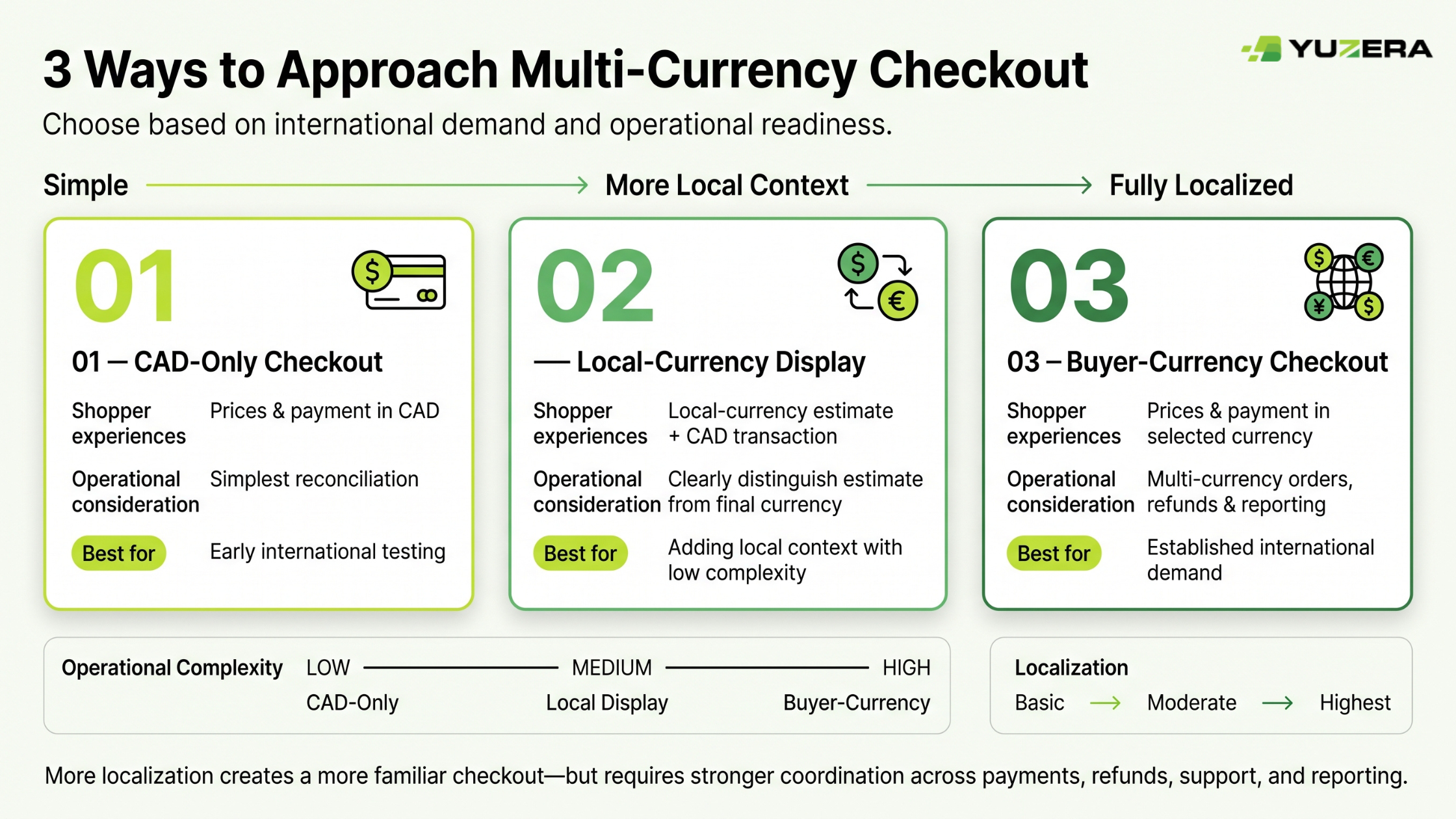
There are three practical approaches to multi-currency payments: CAD-only checkout, local-currency display estimates, and buyer-currency transaction checkout. Each is a legitimate choice. The right one depends on the level of international demand and the extent of operational coordination a team can sustain across checkout, order management, returns, support, and reporting.
CAD-only is the simplest configuration for global sellers’ payments and the easiest to reconcile, since every order settles in a single currency. Its weakness is familiarity. An international shopper may not recognize the currency, and their card issuer may apply a conversion outside the checkout entirely, meaning a party sets the final amount on their statement the merchant does not control. Local-currency display adds context without changing the transaction, which is a reasonable middle step. Still, it requires clearly labeling the estimate and stating the actual transaction currency before the order completes. Buyer-currency transaction checkout is the most localized and the most demanding, because every downstream system has to speak the same language.
Use the table below as a decision framework, not as a claim that every technology stack supports every option. Confirm capabilities with your technology partners before committing to a model.
| Dimension | CAD-only checkout | Local-currency display estimate | Buyer-currency transaction checkout |
|---|---|---|---|
| What shoppers see | Prices remain in Canadian dollars throughout the journey | An estimated equivalent in a selected currency, while the transaction may still complete in CAD | Prices and completion in the selected supported currency |
| Currency clarity requirement | State clearly that the purchase currency is CAD | Identify conversions as estimates and state the actual transaction currency before completion | Show selected currency, amount, and currency code in checkout, confirmation, and receipt |
| Exchange-rate exposure | The shopper’s card issuer may apply currency conversion payments outside the checkout | The estimate can differ from the final amount if the transaction completes in CAD | Requires a reliable mechanism for supported currencies, pricing updates, order records, and reporting |
| Checkout experience | Simplest to configure, may feel less familiar to international shoppers | Adds local context while keeping a single transaction currency | Most localized, requires the strongest operational coordination |
| Customer choice design | No selector needed, but currency must be obvious | If a selector is used, shoppers should be able to change it easily | Selection should be explicit, easy to change, and preserved in transaction records |
| Reconciliation and reporting | Most straightforward, all orders in CAD | Store both display context and transaction currency to avoid support confusion | Preserve transaction currency, order currency, refund currency, exchange context, and reporting fields |
| Best fit | Early-stage international testing | Adding price context for international traffic at low complexity | Meaningful international demand with the readiness to manage multiple currencies |
Most merchants move through these stages of global sellers payments rather than picking one permanently. Starting narrow and expanding is not a lack of ambition. It is how a business avoids discovering a refund-currency mismatch during its busiest week.
How does currency clarity strengthen buyer trust?
Currency clarity strengthens buyer trust by removing the single biggest source of post-purchase surprise in cross-border payment processing: a statement amount that does not match what the shopper thought they had agreed to. Visa’s cross-border merchant guidance makes it clear that complete, transparent currency disclosures can help cross-border e-commerce merchants avoid customer misunderstandings and unnecessary cardholder disputes. The mechanism is worth spelling out. Visa’s merchant dispute guidelines identify “incorrect currency” as a dispute condition, triggered where the transaction currency differs from the currency transmitted, or where a cardholder says they were not advised of, or did not agree to, a conversion. That is a disclosure failure being adjudicated as a transaction failure.
Documentation such as the transaction receipt and evidence of an active customer choice can be relevant in responding, which is a strong argument for recording currency selection as a deliberate event rather than an implied default.
Visa’s cross-border guidance also recommends that if a merchant offers multi-currency pricing, the shopper should be able to toggle between currencies or return to the merchant’s local currency. Reversibility is the point. A shopper who can undo a currency choice does not need to abandon the cart to correct a mistake.
Clarity is not only a checkout-page concern. It propagates. The currency and currency code should appear consistently on product pages, in the cart, at checkout, on the confirmation page, in the emailed receipt, in refund communications, and in the templates a support team uses. If a confirmation email drops the currency code while the checkout page displayed it, that ambiguity lands in the exact document a customer will forward to their bank.
There is a design temptation to hide currency details because they look like clutter. Resist it. A currency code beside a price is three characters that pre-empt a dispute. Currency disclosure is one of the few checkout elements where adding information reduces friction rather than increasing it, because the friction it removes is uncertainty. When optimizing global sellers’ payments, the uncertainty around checkout is precisely what stops a first-time international buyer from completing a purchase with a store they have never used before.
What does good checkout design look like for international buyers?
Good international checkout design shows total cost early, presents payment options clearly, and never asks a shopper to guess. Baymard Institute’s checkout usability research places the global average online cart-abandonment rate at 70.19%. Not all of that is checkout design, but the same research found that across a benchmark of 344 major U.S. and European e-commerce sites, 65% had checkout performance rated mediocre or worse, only 2% earned a “good” rating, and none reached “perfect” or “state-of-the-art.”
The upside is quantified. Baymard reports that the average large e-commerce site has 32 checkout improvements available and could achieve a 35% increase in conversion rate through better checkout UX. Treat that as directional research rather than a guarantee for any single merchant, but the direction is unambiguous: checkout is undermanaged relative to its influence.
Cost transparency is where cross-border stores lose the most ground. Baymard’s ecommerce UX statistics show that 40% of surveyed U.S. shoppers abandoned checkout because additional costs, such as shipping or tax, were too high, and 12% abandoned because they could not see the total order cost before beginning checkout. Multi-currency payments do not fix either of those on their own. A shopper who sees a familiar currency and still cannot tell what shipping and duties will cost is no better informed. Multi-currency checkout has to be paired with transparent landed-cost and delivery information to do its job.
Payment choice is the third pillar. Baymard reports that 9% of surveyed U.S. shoppers abandoned checkout because the site did not offer enough payment methods, and its research on payment UX standards found that 21% of sites have usability issues in how they present payment options. The recommendation is not to add everything. Baymard advises offering at least one third-party payment option as a fallback, showing the most likely method first, grouping similar options logically, and avoiding an overwhelming row of logos.
For a Canadian merchant entering a new market, this means an international payment gateway must validate local payment expectations rather than assuming a domestic configuration transfers. What converts in Toronto may not be the default in Texas or Berlin.
How should fraud prevention and authentication scale with international sales?
Fraud prevention should scale with international sales by shifting from a single blanket rule to risk-based decisioning that adds verification where risk warrants it and stays out of the way where it does not. The Canadian Anti-Fraud Centre received more than 112,000 fraud reports involving more than CAD 704 million in reported losses in 2025, according to its fraud prevention month materials. Those figures cover fraud broadly, not e-commerce alone. Still, they establish the baseline: fraud is a material trust issue in the Canadian market, and secure transaction design is a business fundamental, not a compliance afterthought.
The technical answer is EMV 3-D Secure. Visa’s secure merchant overview explains that EMV 3-D Secure enables data exchange among the merchant, the issuer, and, where necessary, the consumer to validate that the legitimate account holder initiates a transaction. Critically, Visa notes it supports risk-based authentication, so secure transactions can be handled with less friction when risk conditions permit while adding verification for higher-risk cases.
That last point is what makes authentication a design decision rather than a tax. EMVCo’s 2025 secure authentication whitepaper covers frictionless flow, out-of-band authentication, recurring and installment transactions, challenge flow, WebAuthn, Secure Payment Confirmation, and decoupled authentication. That is a configurable experience surface, not a single extra step bolted onto checkout.
Knowing which conditions should trigger a challenge matters when a merchant starts selling into unfamiliar markets. EMVCo’s online commerce resource identifies higher-risk online activity including purchases from a new device, unusually large transactions, and unexpected transaction types, and notes that authentication methods can include one-time passcodes, knowledge-based questions, and biometrics. Cross-border orders will frequently trip signals that a domestic-only rule set treats as anomalies, simply because the shipping address, device, and IP geography no longer match.
Tune for that before launch, not after approval patterns shift. An international payment gateway configured with domestic assumptions will either over-challenge legitimate buyers or under-challenge genuine risk. Neither outcome is acceptable when the goal is scalable commerce.
What are your payment-page security and privacy responsibilities?
Payment-page security responsibilities do not disappear when a merchant uses a third party’s embedded form, and privacy obligations follow customer data across borders. Both points are frequently underestimated by merchants expanding internationally, because both feel like someone else’s problem until they are not.
On the security side, the PCI Security Standards Council confirmed in its merchant validation updates that certain PCI DSS v4.0.1 requirements, including e-commerce requirements 6.4.3 and 11.6.1, became effective on March 31, 2025. Requirement 6.4.3 addresses the management of scripts that load and execute in the consumer’s browser, including confirming authorization, ensuring integrity, and maintaining an inventory with a business justification, as outlined in PCI SSC’s e-commerce threat trends material. International expansion tends to multiply exactly the scripts this requirement targets: localization tools, currency widgets, regional analytics, market-specific marketing tags.
Embedded forms do not exempt a merchant. PCI SSC’s e-commerce script FAQ states that merchants using a third-party provider’s embedded payment page or form must confirm that their site is not susceptible to script attacks that could affect their e-commerce system, either through appropriate techniques or by obtaining confirmation from the compliant third-party provider when implemented according to that provider’s instructions. The same FAQ advises merchants to consult the entity that accepts their PCI compliance validation, typically an acquirer or payment brand, to determine whether a self-assessment questionnaire is required and which one applies.
Privacy runs in parallel. The Office of the Privacy Commissioner of Canada explains in its PIPEDA requirements brief that PIPEDA sets ground rules for how private-sector organizations collect, use, and disclose personal information in commercial activities across Canada, structured around 10 fair information principles: accountability, identifying purposes, consent, limiting collection, limiting use, disclosure and retention, accuracy, safeguards, openness, individual access, and challenging compliance.
Those principles map cleanly onto checkout. The Commissioner’s PIPEDA safeguards guidance recommends security policies, technical and organizational safeguards, regular review, security testing, and staff training. Its authentication guidelines state that organizations need sufficient information to authorize legitimate transactions but should not collect, use, retain, or disclose unnecessary information. Fraud tooling is the usual pressure point: more signals feel safer, but data minimization is still the standard.
Who handles customs, tax, and returns when a Canadian store ships to U.S. customers?
Responsibility for customs, tax, and returns depends on the operating model, and for many direct-to-consumer Canadian sales into the United States, the Canadian exporter may also be the importer of record. The Trade Commissioner Service’s U.S. shipping guide says that when Canadian exporters ship directly to U.S. consumers, fulfillment networks, or certain U.S. warehouses, they may be required to act as importer of record, which carries legal responsibility to ensure goods meet U.S. import requirements.
That single fact reshapes checkout copy. If a merchant is the importer of record, the duties and import compliance story is theirs to explain, and it belongs in the same place shoppers look for shipping cost. Recall that 40% of surveyed U.S. shoppers abandon over unexpected additional costs. Import charges discovered at the door are the most expensive kind of surprise, because they generate a refund, a return, and a lost customer simultaneously.
Administratively, the same guide states that every Canadian exporter must obtain a Business Number account designated for export or import/export. Tax is less centralized. The guide notes that the United States has no federal sales tax, that state and local sales taxes vary by state, that economic nexus rules differ by state, and that exporters should obtain legal or tax advice to ensure compliance. On the Canadian side, the Canada Revenue Agency’s import/export GST guide states that goods and services normally subject to GST/HST may be zero-rated when exported from Canada, depending on the specific situation. Depending is the operative word, and this is territory for qualified advisors rather than a blog post.
Export reporting also applies to commercial goods. The Canada Border Services Agency’s commercial export guidance outlines exporters’ obligations for reporting goods exported from Canada, and its export reporting guide describes the Canadian Export Reporting System for electronic declarations and summary reports.
Returns deserve their own planning cycle. The Trade Commissioner Service warns that cross-border returns can be complex and that, for goods originally exported from Canada and then returned, the documentation must sufficiently describe them to verify they are the same goods coming back. It advises planning return policy and logistics before selling into the U.S., not after the first return request lands.
The 13-step cross-border payment processing readiness checklist
Work through these in order. Each step assumes the previous one is settled, which is what keeps a launch from stalling halfway.
- Choose one priority market first. Do not open five countries at once. For many Canadian goods exporters, the U.S. is the natural starting point, given that 86.6% of goods-exporting establishments sold to the U.S. in 2024. One market allows a complete operating loop to be built and then replicated elsewhere.
- Confirm product eligibility. Review whether a product faces destination-market restrictions, labeling requirements, permits, or category-specific rules. This check should come before any technology work, because an ineligible product renders every downstream decision moot, regardless of how good the checkout looks.
- Define the cross-border operating model. Decide explicitly whether the merchant, the customer, a distributor, a marketplace, or a logistics partner handles import responsibilities. Write it down. Ambiguity here surfaces later as a parcel held at the border, with no one named to resolve it.
- Confirm importer-of-record responsibilities. For direct-to-consumer U.S. shipments, determine whether the business will act as the importer of record and what that entails for classification, valuation, and compliance. Then make sure checkout language reflects that answer honestly.
- Map tax obligations by destination. Validate Canadian GST/HST treatment and destination-market tax responsibilities with qualified advisors. U.S. state and local sales taxes vary, and economic nexus rules differ by state, so a generic assumption about tax treatment is not a plan a business can rely on.
- Select the currency approach with your international payment processor. Choose CAD-only checkout, estimated local-currency display, or buyer-currency transaction checkout based on genuine operational readiness rather than ambition. The most localized option is only better if order management, refunds, support, and reporting can all sustain it.
- Write a currency-disclosure standard. Specify exactly how currency appears on product pages, in the cart, at checkout, on confirmation pages, in receipts, in refund communications, and in support templates. A one-page internal standard prevents the inconsistency that turns a clear checkout into an ambiguous receipt three emails later.
- Design customer-controlled currency selection. If more than one currency is offered, make the current selection easy to find and easy to change before order completion. Currency should never be chosen on the buyer’s behalf, and the selection should be recorded as an active choice in transaction data.
- Research local payment expectations. Validate which payment methods buyers in the target market actually expect, then present them clearly instead of stacking logos. Roughly 9% of surveyed U.S. shoppers abandon checkout when there aren’t enough payment methods, and 21% of sites mishandle the presentation of options.
- Configure fraud and authentication controls. Ensure checkout supports risk-based authentication so higher-risk activity gets verified without imposing friction on every buyer. Re-tune rules that assume domestic device, IP, and address patterns, because cross-border orders will legitimately break those assumptions.
- Audit payment-page scripts and integrations for your international payment gateway. Inventory every script on pages that affect payment, confirm authorization and integrity controls, and assess how localization, analytics, fraud, and marketing tags interact with payment-page security. International launches add scripts quickly, so make the inventory a recurring task.
- Set privacy governance and data-minimization rules. Document why checkout, fraud, support, and fulfillment data are collected, limit collection to what is necessary for the purpose, and define access, retention, and incident-response practices. Then review them on a schedule rather than only after an incident.
- Test the complete buyer journey before launch. Test from the target market’s perspective: storefront currency, cart, checkout, currency changes, payment methods, authentication, order confirmation, delivery updates, refunds, and returns. After launch, monitor outcomes by country and feed what is learned back into the experience.
FAQ
Q1) How does multi-currency payment processing differ from simply displaying converted prices?
Displaying a converted price is a presentation choice, while processing a transaction in another currency changes the amount, currency code, and record that flow through a merchant’s systems. A display estimate can differ from the final amount if the transaction completes in Canadian dollars, which is why Visa’s guidance asks merchants to state the actual transaction currency before completion. The Bank of Canada also confirms its published rates for currency conversion payments are indicative only and may differ from rates in real transactions. Label estimates as estimates, and explicitly confirm the transaction currency.
Q2) What should be confirmed before starting cross-border payment processing from Canada to the United States?
Confirm four things: product eligibility in the destination market, who acts as importer of record, tax obligations on both sides, and whether the business holds a Business Number account designated for export or import/export. The Trade Commissioner Service notes that Canadian exporters shipping directly to U.S. consumers may be required to act as importer of record, which carries legal responsibility for meeting U.S. import requirements. Sales tax varies by state, with differing economic nexus rules, so get qualified tax advice before publishing checkout tax logic.
Q3) What should a merchant look for in an international payment gateway or partner?
Look for a technology stack that treats currency, authentication, order data, and reporting as a single, connected system rather than as separate features. Practically, that means the ability to record transaction currency, order currency, and refund currency distinctly, support risk-based authentication under EMV 3-D Secure, and give a clear answer on payment-page script controls under PCI DSS requirement 6.4.3. Confirm capabilities directly with technology partners, since no framework guarantees every option is available in every configuration.
Q4) What makes a payment gateway for international transactions work well for buyers?
It shows total cost early, states the transaction currency plainly, offers the payment methods local buyers expect, and adds verification only where risk justifies it. Baymard research found that 12% of surveyed U.S. shoppers abandoned because they could not see the total order cost before checkout, and 40% left due to unexpected additional costs. Pair currency support with transparent shipping, tax, and duty information. Also make currency selection reversible, so a shopper can correct a choice without abandoning the cart.
Q5) Is there a single payment solution for global sellers, or does every market need its own setup?
There is no universal configuration, but there is a repeatable method. Build one complete operating loop for a single market, covering currency, checkout, authentication, privacy, customs, and returns, then treat additional markets as configuration rather than reconstruction. Payment methods and tax rules will differ by destination, so local expectations should be validated each time rather than assuming a domestic setup applies. The technology layer that coordinates checkout, order data, and reporting is what makes that repeatability practical.
Closing perspective: currency is infrastructure, not a feature
Multi-currency payments and global sellers’ payments work best when they are treated as a single layer within a coordinated stack that includes online checkout, POS, payment orchestration, fraud controls, privacy safeguards, order records, and returns workflows. A currency selector added on its own creates the appearance of international readiness without the substance. A currency approach chosen deliberately, disclosed clearly, recorded properly, and tested end-to-end creates a store that international buyers can trust on their first visit.
For Canadian merchants, the sequencing advantage is real. The nearest market is the largest, the trade lanes are established, and the research on what makes checkout convert is public and specific. What remains is the discipline to build the full loop once before scaling it. Yuzera is built as a forward-looking, education-first resource for merchants navigating exactly this kind of decision, backed by parent company Digitech’s track record in payment technology.
Works Cited
- Baymard Institute. “Checkout Usability Research.”
- Baymard Institute. “E-Commerce UX Statistics.”
- Baymard Institute. “Payment UX Standards.”
- Bank of Canada. “Background Information on Foreign Exchange Rates.”
- Bank of Canada. “Understanding Exchange Rates.”
- Canada Border Services Agency. “Canadian Export Reporting System Guide.”
- Canada Border Services Agency. “Exporting Commercial Goods from Canada.”
- Canada Revenue Agency. “GST/HST on Imports and Exports.“
- Canadian Anti-Fraud Centre. “Fraud Prevention Month.”
- EMVCo. “EMV 3-D Secure White Paper.”
- EMVCo. “How EMV Specifications Support Online Commerce.”
- Global Affairs Canada. “Key Facts on Canada’s Competitiveness.”
- Office of the Privacy Commissioner of Canada. “PIPEDA in Brief.”
- Office of the Privacy Commissioner of Canada. “PIPEDA Principle 7: Safeguards.”
- Office of the Privacy Commissioner of Canada. “Guidelines for Identification and Authentication.”
- PCI Security Standards Council. “E-Commerce Threat Trends and PCI DSS v4.0.” PCI Security Standards Council. “FAQ 1588: E-Commerce Script Requirements.”
- PCI Security Standards Council. “Important Updates Announced for Merchants Validating to SAQ A.“
- Statistics Canada. “Exporter Characteristics.”
- Trade Commissioner Service. “Selling B2C through E-Commerce Channels: A Guide to Shipping and Logistics.”
- Trade Commissioner Service. “Step 10: E-Commerce.”
- Visa. “Merchant Dispute Management Guidelines.”
- Visa. “Optimize Cross-Border E-Commerce.”
- Visa. “Dynamic Currency Conversion.”
- Visa. “Visa Secure.”