
Payment fraud prevention is a coordinated set of technology, checkout, and recordkeeping controls that helps an online seller identify risky orders before fulfillment, authenticate real customers with minimal friction, and document every transaction sufficiently to respond to a dispute later. It is not a single tool, and it is not a switch you flip after the first chargeback notice lands. The most recent Merchant Risk Council survey, fielded from November to December 2025 across 1,278 e-commerce payment and fraud professionals in 37 countries, found that 98% of merchants reported at least one form of fraud attack in the previous 12 months, according to the MRC 2026 Global eCommerce Payments and Fraud Report.
That near-universal exposure changes the question. The question is no longer whether your storefront will be targeted. It is whether your architecture surfaces the warning signs early, whether your checkout can tell a returning customer apart from a card tester, and whether your order records can withstand scrutiny months after the sale. This guide walks through the threat categories, the signals worth monitoring, the checkout and payment-page controls that hold up under real traffic, and the evidence trail that enables dispute response. Whether you rely on Yuzera’s payment orchestration or manage this internally, treat it as an engineering problem with an operations layer, because that is exactly what it is.
TL;DR
- 98% of merchants in the 2026 Merchant Risk Council survey reported at least one fraud incident in the past 12 months, and payment fraud accounts for 3.2% of total annual global e-commerce revenue lost.
- Refund and policy abuse topped the attack list at 41%, followed by first-party misuse at 36% and card testing at 33%, so controls must also cover post-purchase behavior.
- Merchants rejected 5.0% of orders for suspected fraud, while 3.0% of accepted orders turned out fraudulent, showing that both overblocking and underblocking are happening at the same time.
- The average merchant win rate for fraud-coded chargebacks was 17.4%, which is why evidence collection must start at order placement rather than at dispute notification as a foundational part of your fund freeze prevention strategy.
- Digital screening covered 52% of orders, up from 23% manually, and 72% of merchants now use at least one form of payment tokenization for secure e-commerce payments.
Why should fraud protection payments controls be built during scaling, not after the first loss?
Fraud protection payments controls belong in your architecture at launch because attack exposure is effectively guaranteed and the cost compounds quietly. The Merchant Risk Council reports that payment fraud accounts for 3.2% of total annual e-commerce revenue lost globally, the MRC Global Payments and Fraud Report. That is a survey benchmark rather than a forecast for any single merchant, but it provides context for the scale. For a business planning aggressive growth across multiple channels, a 3.2% structural leak is not a rounding error. It is a line item that grows in lockstep with volume.
There is a second reason timing matters, and it is architectural. Fraud protection payments controls depend on historical data. Risk scoring gets sharper as your order history deepens. Device and IP signals become meaningful once you have prior transactions to compare against. Dispute evidence requires records you either captured at the time or did not. Retrofitting a data model to support any of this after two years of trading is significantly harder than designing for it at the outset, and the gap shows up precisely when volume is highest and attention is scarcest.
The threat mix also refuses to stay simple. The Merchant Risk Council found that the average number of distinct fraud attack types a merchant faced fell from 4.2 in the prior survey to 3.8 in the 2026 survey. A decline, yes, but the number still means the typical merchant is defending against nearly four different attack patterns at once. A single rule set tuned for stolen-card use will not catch card testing, and neither will it catch refund abuse.
This pattern repeats across verticals: merchants who treat payment fraud prevention as a scaling requirement rather than a cleanup project spend far less time on remediation. The recommended framing is a five-stage loop. Detect risky activity, authenticate the customer where warranted, document the transaction thoroughly, fulfill with verifiable proof, and learn from every outcome to retune the controls. Each stage feeds the next. Skip documentation, and you cannot learn. Skip detection and authentication carries all the weight. Build all five and payment fraud prevention becomes a system rather than a scramble.
What is the difference between payment fraud, friendly fraud, and chargeback abuse?
Payment fraud, first-party misuse, and refund abuse are three distinct problems that require different controls, and conflating them is one of the most common mistakes in merchant risk programs. Unauthorized payment fraud involves the use of a card or credential by someone who is not the legitimate cardholder. First-party misuse, often informally called friendly fraud, refers to a dispute filed by the actual cardholder for a purchase they made. Refund and policy abuse involves exploiting return, refund, or promotional policies. The Merchant Risk Council treats first-party misuse, chargeback fraud, and refund and policy abuse as separate categories of post-purchase fraud and abuse in its MRC 2026 Global eCommerce Payments and Fraud Report.
The numbers explain why the distinction matters operationally. Refund and policy abuse affected 41% of surveyed fraud professionals in the 2026 report, making it the single most commonly reported attack category. First-party misuse followed at 36%. Card testing came in at 33%. If your entire chargeback protection budget is allocated at the authorization step, you are underinvesting in the two largest reported categories, both of which occur after a successful, legitimately authenticated payment.
First-party misuse is also growing. The Merchant Risk Council’s 2026 release reported that 64% of merchants saw increases in first-party misuse, with one-quarter reporting increases of 25% or more. Scale that against dispute volume and the exposure is substantial. Merchants in the 2025 survey estimated first-party misuse accounted for 20% of all fraudulent disputes, while Merchant Risk Council members put the figure at 30%.
One point of professional discipline: a filed dispute is not proof of dishonesty. Plenty of first-party disputes trace back to a customer who genuinely did not recognize a charge or misread a policy. Using neutral language such as “disputed transaction” or “suspected abuse” is not just legally prudent; it keeps a team’s analysis honest. Labeling every dispute as fraud stops the investigation of the customer-experience defects that caused it, and those defects are frequently fixable.
Card testing also deserves separate treatment. It looks like a run of declines, which is easy for a monitoring dashboard to ignore. Treated as its own attack pattern with its own velocity thresholds, it becomes visible early, often before any successful charge occurs.
How do you achieve chargeback protection without rejecting good customers?
Effective chargeback protection requires tuning for two failure modes simultaneously, as merchants are currently losing money to both. In the 2025 global survey of fraud professionals, merchants reported rejecting 5.0% of e-commerce orders because of suspected fraud in the previous 12 months, while 3.0% of accepted orders turned out to be fraudulent, according to the Visa Acceptance Solutions and MRC Global Fraud Report 2025. Both figures are non-trivial. A program tightened to drive the 3.0% down will push the 5.0% up unless the underlying signal quality improves.
The 2025 report labels false positives as “customer insults,” which is a useful framing for anyone presenting a risk program to a commercial team. A legitimate order that is rejected is not a neutral outcome. It is a customer who tried to buy from you, was told no, and now has a reason to shop elsewhere. For merchants operating at enterprise scale across multiple verticals, the lifetime-value cost of over-rejection can exceed the fraud loss it prevented.
This is where the win-rate data becomes sobering. Survey respondents reported an average merchant win rate of 17.4% on fraud-coded chargebacks and disputes. Roughly one in six. If your operating assumption is that you will simply contest and recover from fraudulent disputes after the fact, the data does not support that assumption. Prevention and pre-dispute clarity carry far more weight than post-dispute litigation, which is the core argument for chargeback protection built into checkout rather than added after the fact.
The practical resolution is not a single tighter threshold but better inputs and better routing. Visa’s acceptance risk standards identify address verification, card verification codes, authentication, machine learning, fraud scoring, geolocation, velocity checks, IP-address tracking, device fingerprinting, behavioral biometrics, and risk-based authentication as tools for identifying and preventing fraudulent transactions, and recommend using a mix of tools rather than relying on one. A mixed signal set lets you make graded decisions. Low-risk orders pass without interference. Ambiguous orders escalate. Only genuinely high-risk orders get blocked outright.
The corollary is measurement. You cannot tune what you do not track. Attempted fraud, approved fraud, suspected-fraud rejections, dispute volume by reason code, refund abuse, delivery exceptions, and false positives all belong on the same dashboard. Improving one at the silent expense of another is the most common way a fraud program appears successful while quietly destroying margin.
What early order patterns should trigger a review before you fulfill the order?
The most effective early warning signals are behavioral and historical rather than static, and they work best in combination. The Merchant Risk Council’s 2025 research found that monitoring transaction data for unusual activity or anomalies ranked among the five most effective tactics merchants reported for combating first-party misuse, alongside checking customer purchase and order histories, per the Global Fraud Report 2025. Neither of those is a checkout field. Both require your systems to compare the current order against a baseline.
In practice, that means watching for velocity anomalies first. A sudden burst of attempts from a single device, IP range, or card BIN is the clearest tell of card testing. So is a rapid sequence of small-value attempts with mismatched billing details, which is the classic pattern for validating a stolen card list before a larger purchase. Because card testing was reported by 33% of surveyed fraud professionals, it warrants its own rule set and alert threshold rather than being subsumed into a general decline metric.
Next, watch for inconsistency across signals that should agree. Geolocation that conflicts with the billing country. A device fingerprint that has previously been associated with disputed orders. A shipping address that has appeared on multiple accounts with different names. A new account placing an unusually high-value first order with expedited shipping. Individually, each of these has a legitimate explanation. Two or three together in the same order deserve a look before the parcel leaves the warehouse.
Order history is the counterweight that keeps this from becoming overblocking. A customer with a two-year record of undisputed purchases who suddenly orders from a new IP address poses a different risk than a first-time buyer with the same profile. Visa’s standards list purchase history alongside device fingerprinting and behavioral biometrics precisely because context reduces false positives.
Historical data also has downstream value. Mastercard’s merchant chargeback guide lists a registered device and IP address, prior undisputed purchases, purchase details, signed proof of delivery, delivery email addresses, registration records, and evidence of use among documentation that can support certain e-commerce dispute responses. The device and IP data you capture for real-time risk scoring is the same data that supports your case later. Capturing it once and using it twice is the sort of design decision that pays for itself, and it is a core reason to plan the data model before volume arrives, which is central to fraud protection payments planning.
Which checkout verification controls belong in secure e-commerce payments from day one?
Secure e-commerce payments start with verification controls at the point of card entry, and the two foundational ones are the card verification code and billing-address matching. The PCI Security Standards Council states in its card verification FAQ that card verification codes are commonly requested for card-not-present transactions to verify that the customer has the card in hand. Requiring the code was also among the five most effective tactics merchants reported for combating first-party misuse in the 2025 global fraud survey, which makes it unusually well-supported for a control this simple to implement.
The critical constraint is retention. PCI DSS prohibits storing card verification codes after authorization, even in encrypted form. The Council’s sensitive data FAQ confirms that sensitive authentication data must not be stored post-authorization, including verification codes and PIN-related data. This is where well-intentioned teams get into trouble. The code leaks into application logs, support ticket notes, screenshots attached to internal tickets, or a QA database populated from production. Any of those is a violation, and none of them show up in a standard code review unless someone is specifically looking for them. Audit your log configuration, your support tooling, and your data-retention jobs, not just your payments table.
Verification codes cannot carry a checkout on their own, and treating them as sufficient is a common gap. A code confirms possession of the physical card at that moment. It does not confirm authorization; it does not detect card testing across many attempts, and it says nothing about a first-party dispute filed six weeks after delivery. That is why Visa recommends layering a mix of tools rather than depending on any single control.
Tokenization is now the widely adopted complement. The Merchant Risk Council’s 2026 fraud report found that 72% of merchants use one or more forms of payment tokenization. Tokenization supports repeat purchases and subscription billing without retaining raw card data, reducing the sensitive footprint of your environment and strengthening overall secure e-commerce payments. It should not be presented as a fraud cure on its own, and it does not, by itself, resolve your PCI scope or validation obligations. Those depend on how your implementation actually works.
Build these controls to be configurable, not hardcoded. Risk conditions change, and a checkout you cannot retune will eventually be tuned for last year’s attack.
How does risk-based 3-D Secure authentication protect high-risk moments?
EMV 3-D Secure is an authentication protocol that enables an exchange of data among the merchant, the issuer, and, where required, the consumer before authorization, helping merchants authenticate customers and improve fraud and authorization decisions. Visa describes this data exchange in its secure authentication guide. The important word is “before.” Unlike a post-authorization control, authentication occurs before you have the option to decline, making it one of the few interventions positioned at the right moment in the flow.
The version that matters operationally is risk-based. Visa describes risk-based authentication as enabling frictionless authentication for low-risk payments and step-up verification for higher-risk payments. That is the whole design goal in one sentence. The vast majority of legitimate orders never see a challenge screen, while the subset that carries genuine risk indicators receives an additional verification step. Applied as a blanket requirement on every transaction, 3-D Secure becomes exactly the kind of blunt obstacle that drives the 5.0% suspected-fraud rejection problem in a different form: not a decline, but an abandonment.
Getting frictionless flows actually to work depends on data quality. The issuer’s risk decision is only as good as the transaction, device, and behavioral data you pass. Thin or malformed data pushes more sessions into challenge flows, which is why implementation quality, not just protocol adoption, determines the customer-experience outcome. This is a real engineering task, not a configuration checkbox.
On liability, precision is required. Visa states that authenticated or attempted-authentication transactions may receive liability-shift benefits, but eligibility depends on the applicable network rules, the transaction details, and the implementation. “May,” not “will.” Anyone claiming that 3-D Secure guarantees you will never lose a fraud dispute is overselling. What it can do is materially change the risk profile of qualifying transactions and give you an authentication outcome to record, which has value in its own right.
That record is the underrated benefit. Storing the authentication result against the order provides your risk team with a durable signal for future scoring and your dispute team with a data point for future evidence. It also feeds the learning loop: if authenticated orders in a particular segment still generate disputes at an elevated rate, that indicates something specific about that segment’s behavior rather than your authentication setup. Selective, well-instrumented authentication beats universal authentication on both fraud outcomes and conversion.
Why is payment-page security a fraud control and not just a compliance task?
Payment-page security is a fraud control because an unauthorized script on your checkout can capture card data before any of your risk logic ever sees the transaction. The PCI Security Standards Council explains in its ecommerce security practices guidance that scripts on a website can modify page elements, monitor keyboard input, and send payment form data elsewhere. It advises avoiding or tightly restricting third-party payment-form content. A compromised page defeats verification codes, risk scoring, and authentication simultaneously because the data is exfiltrated at the point of entry.
PCI DSS v4.0 responds with two specific requirements. Requirement 6.4.3 requires organizations to confirm that payment-page scripts are authorized, ensure script integrity, and maintain an inventory of scripts with written justification for each one.
Requirement 11.6.1 calls for a change- and tamper-detection mechanism that alerts personnel to unauthorized modifications to HTTP headers and payment-page content as received by the consumer browser, with checks occurring at least every seven days or according to a documented targeted risk analysis. Both are described in the Council’s ecommerce threat trends material.
Read those two requirements as an operating discipline rather than an audit artifact. A script inventory with written justification forces someone to answer why a marketing tag has any business loading on a page where card data is entered. Integrity assurance means you detect a modified dependency. Tamper detection means you find out about a change from your own alerting rather than from a card network inquiry weeks later. That is monitoring, and it belongs to security operations, not a compliance calendar.
A frequent misconception concerns embedded third-party forms. The Council’s 2025 guidance in its ecommerce script FAQ states that merchants using an embedded third-party payment page or form may need either to apply protections aligned with Requirements 6.4.3 and 11.6.1 or to obtain confirmation from the compliant provider that its implemented solution protects against script attacks. Dropping in an iframe does not automatically transfer the responsibility. You either implement the controls, or you get documented confirmation. Doing neither leaves an open gap.
Scope is broader than many teams assume. The Council’s service provider scope FAQ notes that PCI DSS applies not only to entities that store, process, or transmit payment account data, but also to service providers that can impact the security of that data. For merchants with a tag manager, a personalization vendor, and a chat widget all loading on the same page, that scope question deserves a concrete answer.
How do clear descriptors and fulfillment evidence prevent avoidable disputes?
Clear customer-facing communication prevents a measurable share of disputes, as a large portion of first-party misuse stems from confusion rather than intent. In the 2025 global survey, merchants identified attempts to obtain free goods or services at 48%, transaction-descriptor confusion at 40%, and transaction-amount confusion at 37% as leading reasons for first-party misuse, per the global fraud report. Two of the top three are communication defects you control directly.
Start with the billing descriptor. If 40% of merchants point to descriptor confusion as a driver, then a descriptor that shows your legal entity name rather than your trading name is generating disputes that you are then spending time contesting at an average win rate of 17.4%. Making the descriptor recognizable is a configuration change with a direct line to dispute volume. It is an evidence-based operational inference rather than a guarantee, but the cost of making the change is close to zero.
The 2025 report lists customer notifications before and after payment processing, order and delivery notifications, and clear cancellation and return policies among the tactics merchants use to reduce first-party misuse and improve chargeback protection. Each of these does the same job: it keeps the customer oriented so that a charge on a statement matches a memory of a purchase. Order confirmation, dispatch notice, tracking, delivery confirmation, refund timing, and return window rules should all be stated plainly and sent proactively.
Policy content becomes evidence. Mastercard’s merchant chargeback guide identifies unhonored terms and conditions, including guarantees, written promises, delivery commitments, and return policies, as potential grounds for a cardholder dispute. The same guide states that a merchant may support a second-presentment response in certain refund-related disputes when it can document that the refund policy was properly disclosed at the time of the transaction. Note the standard: disclosed at the time of the transaction. A policy page you can link to today does not prove what the customer saw at checkout six months ago. Capture the disclosure event with the order record.
Delivery evidence follows the same logic. Mastercard’s guide identifies a signed proof-of-delivery receipt as documentation that can support a response to certain goods-or-services-not-provided disputes. That has procurement implications for how you select carriers and service levels on higher-value orders. Signature capture costs more per parcel. On a high-risk order profile, it is the cheaper option.
Consumer-side guidance reinforces the mirror image of this. The U.S. Federal Trade Commission’s delivery dispute guidance advises shoppers to keep order confirmations, receipts, promised shipping dates, tracking numbers, and merchant communications. Whatever the customer is told to retain, you should be able to retrieve in seconds.
What does a dispute-ready evidence trail actually contain?
A dispute-ready evidence trail is a retrievable, per-order case file assembled at the time of the transaction, rather than reconstructed after a chargeback notice is received. Given the 17.4% average merchant win rate on fraud-coded disputes reported in the global fraud report, the difference between a complete file and a partial one often determines whether a response is worth filing.
The contents should mirror what the networks actually accept. Mastercard’s merchant chargeback guide lists a registered device and IP address, prior undisputed purchases, purchase details, signed proof of delivery, delivery email addresses, registration records, and evidence of use among documentation supporting certain e-commerce dispute responses. Map each of those to a system of record and confirm you can pull all of them for a single order without a manual data-joining exercise.
Visa’s compelling-evidence framework raises the bar on specificity. Its compelling evidence readiness guide states that qualifying evidence for a specified fraud dispute condition can require two prior transactions between 120 and 365 days old, with at least two matching core data elements from user ID, IP address, shipping address, or device ID and fingerprint, and one of the matches must be IP address or device ID and fingerprint. Read that as a data-retention specification. If your systems purge IP or device identifiers after 90 days, you have structurally disqualified yourself from a category of evidence you might otherwise have used.
Quality control matters as much as completeness. The same readiness guide states that incomplete or incorrect submissions may be declined and instructs merchants to carefully compile their responses before submitting. A rushed filing is not a free option. It consumes the opportunity.
There is also a broader operational payoff. Merchants sometimes ask about a payment processor that doesn’t freeze funds, reflecting real anxiety about account restrictions during periods of rapid growth or unusual volume. No provider can promise that outcome, and any that does should be viewed skeptically. What a mature control and documentation program can do is support fund freeze prevention efforts and help you be substantially better prepared if a payment partner requests information about a transaction pattern. Being able to produce authentication outcomes, risk decisions, fulfillment records, and delivery proof quickly is the practical form that fund freeze prevention takes in a real operation.
Design the file around retrieval, not storage. Documented, indexed, and exportable by order ID beats a technically complete archive nobody can query under time pressure.
How do orchestration and automation help you scale securely?
Payment orchestration and automated screening enable a growing merchant to apply consistent risk decisions at rising volume without adding proportional headcount, which is why they now rank near the top of merchant investment priorities. In the 2025 global survey, merchants screened an average of 52% of orders digitally and 23% manually, according to the global fraud report.
Digital screening covers more than twice the volume, and that ratio is the direction of travel.
Manual review still earns its place, but only as a targeted escalation. The same survey found that 19% of manually screened orders were subsequently declined. That is a meaningful hit rate, which tells you human review adds real value on genuinely ambiguous orders. It also tells you that 81% of manually reviewed orders were fine, so routing everything through a queue would burn analyst time and delay legitimate customers. Reserve human judgment for the cases your rules and models cannot resolve.
Fraud tooling is also moving later in the customer journey, which is a structural shift worth planning for. The share of merchants applying fraud tools when customers requested a refund or disputed a payment rose from 45% to 57% in the 2025 survey. Given that refund and policy abuse was the most commonly reported attack category at 41%, extending monitoring into the refund and dispute workflow is where a growing share of the remaining exposure sits. Your refund queue is a surface area of risk.
Investment intent aligns with this. The 2025 survey found that improving fraud AI and machine-learning accuracy, increasing prevention automation, and expanding data availability and access were top areas for improvement for between 40% and 50% of merchants globally, with fraud orchestration and payment and refund policy improvements also among the leading priorities. Note that three of those five priorities are data and orchestration problems rather than model problems. Better signals routed to the right decision point tend to outperform a better model fed thin data.
This is where an orchestration layer changes the economics for payment fraud prevention. Centralizing risk decisions, authentication routing, tokenization, and dispute data collection into a single configurable layer means rules are tuned once rather than across five disconnected systems. It also means the learning loop actually closes, because dispute outcomes flow back to the decisions that produced them. Yuzera’s proprietary POS software and hardware, payment orchestration, and value-added services are built around exactly that design principle, giving the business owner operational visibility rather than just a working terminal. More detail on how the pieces fit together is available at Yuzera.
Continuous tuning is the non-negotiable part. Revisit rules whenever attack patterns, decline rates, complaint volume, refund abuse, or dispute reason codes shift.
Comparing five protective layers: what each one actually does
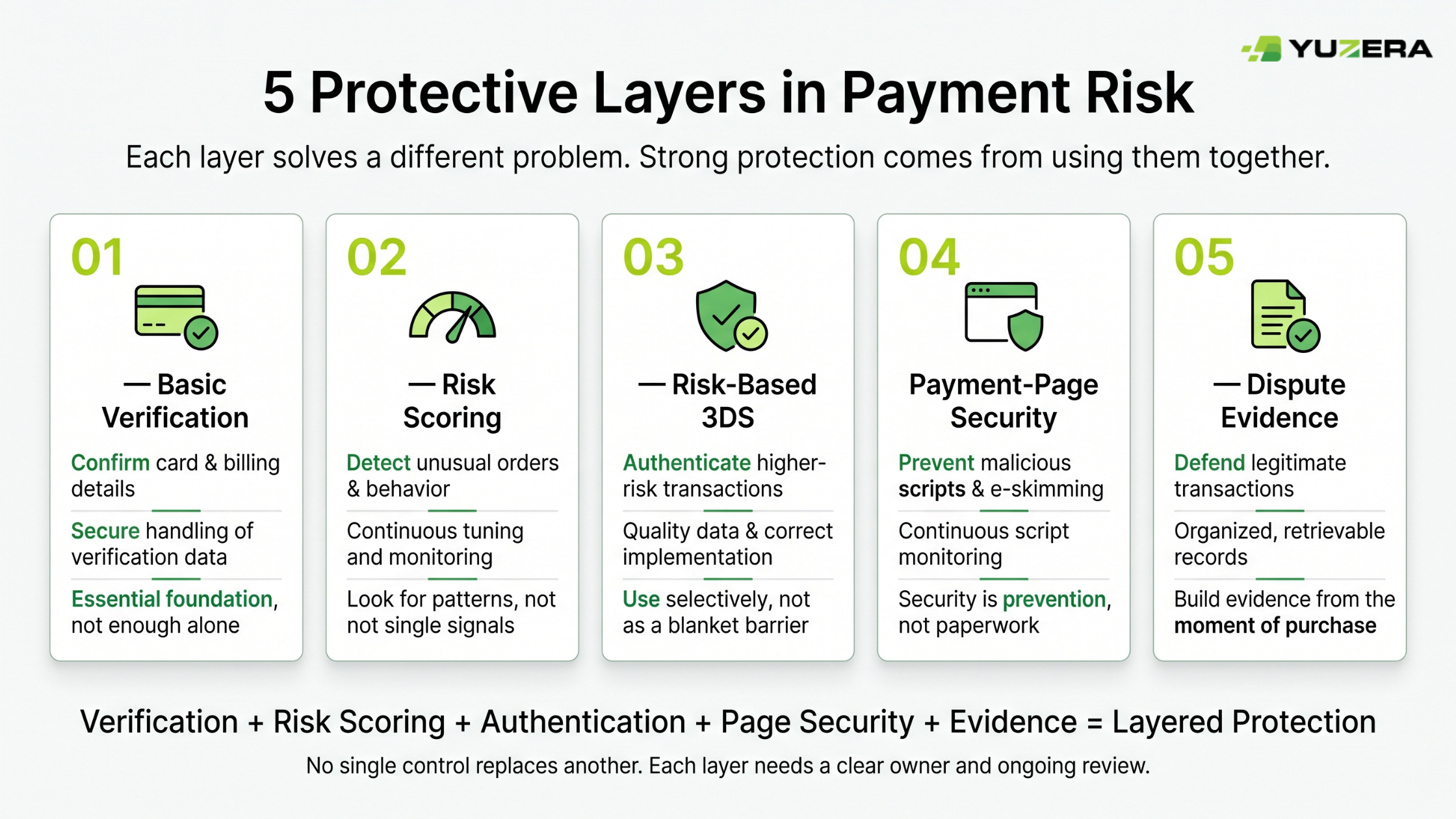
No single control on this list substitutes for another, and the practical failure mode in most merchant risk programs is overreliance on the layer implemented first. Basic verification controls are cheap and fast but shallow. Risk scoring is powerful but needs tuning and clean historical data. Risk-based authentication intervenes at the ideal moment but depends heavily on implementation quality. Payment-page security prevents a category of compromise that renders every other layer irrelevant. Post-purchase evidence does nothing to stop a bad order and everything to determine whether you can answer for a good one.
Read the table below as a coverage map rather than a shopping list. The column that matters most for planning is the operational requirement, because that is where programs quietly fail. A risk engine nobody tunes drifts toward either overblocking or underblocking within months. A script inventory nobody maintains is a document, not a control. Evidence you capture but cannot retrieve under deadline is not evidence. Match each layer to a named owner and a review cadence before you turn it on.
| Protective approach | Primary purpose | Inputs or evidence used | Checkout friction | Main operational requirement | Key takeaway |
|---|---|---|---|---|---|
| Basic verification controls | Confirm card and billing details at checkout | Card verification code, billing-address matching | Usually low | Verification codes must never be retained after authorization | Foundational, but only as part of a wider system |
| Risk scoring and behavioral signals | Flag unusual orders before fulfillment | Velocity, geolocation, IP address, device fingerprint, behavior, purchase history | Low when run behind the scenes | Ongoing monitoring, tuning, and a clear escalation path | Look for patterns, not one isolated bad signal |
| Risk-based 3-D Secure authentication | Enable issuer-led cardholder authentication | Transaction, device, and behavioral data shared with the issuer | Low for frictionless flows, higher on challenge | Correct implementation and high data-sharing quality | Deploy selectively and intelligently, never as a blunt obstacle |
| Payment-page security controls | Reduce exposure to e-skimming and unauthorized scripts | Script inventories, authorization records, integrity checks, tamper detection | None intended for buyers | Continuous script governance and security monitoring | Secure payment architecture is fraud prevention, not paperwork |
| Post-purchase evidence and dispute prevention | Resolve recognition and fulfillment issues early | Order details, billing descriptor, policies, customer messages, proof of delivery, device and IP data | None | Retrieval-ready records and a defined response process | The strongest dispute case begins at order placement |
A 13-step checklist for building your payment fraud prevention system
- Map the complete customer journey. Document every stage from account creation and checkout through fulfillment, returns, refunds, and disputes. Fraud monitoring should not stop at authorization, particularly given that the share of merchants applying fraud tools at the refund or dispute stage rose from 45% to 57%.
- Classify your core risk types separately. Define stolen-card use, card testing, account takeover, first-party misuse, refund abuse, and policy abuse as distinct categories with distinct controls. Merchants faced an average of 3.8 different attack types, so that a single undifferentiated rule set will leave gaps.
- Set a baseline measurement dashboard. Track attempted fraud, approved fraud, suspected-fraud order rejections, disputes by reason code, refund abuse, delivery exceptions, and false positives together. Without the false-positive metric alongside the fraud metric, you cannot tell improvement from overblocking.
- Require appropriate checkout verification controls. Implement card verification code entry where applicable and billing address verification for card-not-present orders. Requiring the verification code ranked among the five most effective merchant-reported tactics against first-party misuse in the 2025 global survey.
- Confirm you never retain verification codes after authorization. Audit application logs, support ticket notes, screenshots, QA datasets, and analytics pipelines, not just your primary database. PCI DSS prohibits storing sensitive authentication data after authorization, even when encrypted, and leakage usually occurs outside the payments table.
- Deploy a risk engine or rules layer for anomaly detection. Configure it to surface unusual velocity, device reuse, IP and location inconsistencies, suspicious ordering sequences, and abnormal purchase behavior. Anomaly monitoring and purchase-history checks both ranked among the top five most effective reported tactics.
- Reserve manual review for genuinely ambiguous orders. Route only escalated cases to human analysts, not every transaction. Merchants screened 52% of orders digitally versus 23% manually, and 19% of manually screened orders were subsequently declined, confirming review works best as a targeted step.
- Implement risk-based authentication. Configure EMV 3-D Secure so low-risk orders pass frictionlessly while higher-risk transactions receive step-up verification. Pass complete transaction, device, and behavioral data to the issuer, since thin data pushes more legitimate sessions into unnecessary challenge flows.
- Govern every script on your payment page. Maintain a script inventory with written business justification, authorization confirmation, integrity assurance, and tamper detection aligned to PCI DSS Requirements 6.4.3 and 11.6.1. Run tamper checks at least every seven days or per a documented targeted risk analysis.
- Confirm responsibility for embedded third-party forms. If you use an embedded payment page or form, either apply the script-protection controls yourself or obtain written confirmation from the compliant provider that its implemented solution protects against script attacks. Assumption is not a control.
- Make customer-facing information unmistakably clear. Configure a recognizable billing descriptor and proactively send order confirmations, fulfillment statuses, delivery notices, refund timing, and cancellation and return rules. Descriptor confusion was cited by 40% of merchants as a driver of first-party misuse.
- Capture dispute-ready records at every stage of the order. Store authentication outcomes, risk decisions, order details, IP and device data where appropriate, customer communications, fulfillment events, and proof of delivery. Retain identifiers long enough to support evidence requiring prior transactions 120 to 365 days old.
- Review outcomes and retune continuously. Revisit rules and thresholds whenever fraud patterns, decline rates, customer complaints, refund abuse, or dispute reason codes shift. Improving model accuracy, automation, and data access were top priorities for 40% to 50% of merchants globally.
FAQ
Q1) What should you look for in a payment processor with fraud protection built in?
Look for layered capability rather than a single feature. Visa’s acceptance risk standards recommend using a mix of tools including address verification, card verification codes, authentication, machine learning, fraud scoring, geolocation, velocity checks, IP tracking, device fingerprinting, and risk-based authentication. Beyond the tooling itself, ask how rules are tuned, who owns escalation, and whether risk decisions and dispute outcomes feed back into the same system. A solution that scores orders but cannot show you why is difficult to improve, which is why fraud protection payments programs need transparent, adjustable logic rather than a black box.
Q2) Is a payment solution with chargeback protection able to guarantee you win disputes?
No, and any claim otherwise should be treated cautiously. The 2025 global fraud survey reported an average merchant win rate of 17.4% on fraud-coded chargebacks and disputes, so post-dispute recovery is not a reliable safety net. What technology can do is reduce avoidable disputes through clear descriptors and notifications, improve detection before fulfillment, and support evidence collection, all of which are core parts of genuine chargeback protection. Visa also notes that incomplete or incorrect compelling-evidence submissions may be declined, so the quality of preparation matters as much as the filing.
Q3) Does a payment processor with no fund freezes exist, and how should merchants think about account holds?
No provider can responsibly promise that funds will never be held, since account reviews depend on network rules, risk conditions, and transaction patterns. The productive approach centers on fund freeze prevention through preparedness. A mature fraud-control and documentation program can help you reduce avoidable risk and be better positioned if a payment partner requests information. That means retrievable authentication outcomes, risk decisions, order records, and signed proof of delivery, which Mastercard’s chargeback guide identifies as supporting documentation for certain disputes.
Q4) What does secure payment processing for Canadian sellers require beyond standard controls?
The technical foundation is the same across North America: layered verification, risk scoring, risk-based authentication, governed payment-page scripts, and dispute-ready records, all of which support secure e-commerce payments regardless of geography. The context is the differentiator. The Canadian Anti-Fraud Centre received more than 112,000 fraud reports involving more than CAD 704 million in reported losses during 2025 involving more than CAD 704 million in reported losses during 2025, a national figure rather than an e-commerce-specific one. For cross-border sellers, geolocation and billing-country consistency checks need to be tuned to reflect legitimate cross-border ordering patterns.
Q5) If you are looking for a payment processor that doesn’t freeze funds in Canada, how should you evaluate provider claims and what should you ask instead?
Reframe the question toward operational transparency, because guarantees in this area are not credible. Ask how risk reviews are communicated, what documentation a partner would request, how quickly you can export order and fulfillment records, and whether tokenization is supported. The Merchant Risk Council reported that 72% of merchants use one or more forms of payment tokenization. Also confirm whether the provider will state in writing that its embedded checkout protects against script attacks, as PCI guidance contemplates, since that written confirmation is itself a meaningful signal of fund freeze prevention practice.
Works Cited
- Canadian Anti-Fraud Centre. “Fraud Prevention Month.”
- Federal Trade Commission. “What To Do If You’re Billed for Things You Never Got, or You Get Unordered Products.“
- Mastercard. Chargeback Guide.
- Merchant Risk Council. 2026 Global eCommerce Payments and Fraud Report.
- Merchant Risk Council. “Global Payments and Fraud Report.“
- Merchant Risk Council. “MRC Releases 2026 Global eCommerce Payments and Fraud Report.“
- PCI Security Standards Council. “Best Practices for Securing E-commerce.”
- PCI Security Standards Council. “E-commerce Threat Trends and PCI DSS v4.0.”
- PCI Security Standards Council. “FAQ 1319.”
- PCI Security Standards Council. “FAQ 1533.”
- PCI Security Standards Council. “FAQ 1579.”
- PCI Security Standards Council. “FAQ 1588.”
- Visa. Compelling Evidence 3.0 Merchant Readiness.
- Visa. “EMV 3-D Secure.“
- Visa. Visa Acceptance Risk Standards.
- Visa Acceptance Solutions and Merchant Risk Council. Global Fraud Report 2025.
- Yuzera.