
Choosing a payment processor means evaluating a provider on integration options, reporting depth, fraud and dispute operations, funds-flow policies, and security posture, not price alone. A payment processor is a solutions partner that authorizes, secures, reports on, and settles transactions across your channels, and the right one shapes your daily operations for years to come. This payment processor guide gives merchants a framework for comparing payment processors on merit, the specific evidence to request, and the questions that most often arise when researching alternatives. Whether operations run face-to-face, online, or both, choosing processor partners well starts with knowing what truly matters when weighing the pros and cons of processors.
TL;DR
- Merchants now accept an average of 4.4 payment methods, and 74% added at least one new acceptance method in the past 12 months, so coverage and extensibility belong at the top of any payment gateway comparison (2025 Global eCommerce Payments and Fraud Report).
- 62% of merchants surveyed in 2025 preferred working with multiple payment providers, up from 50% in 2023, which makes reporting that unifies across providers a real requirement (451 Research).
- Global chargeback volume is forecast to climb from 261 million (2025) to 324 million (2028), so dispute tooling is not optional (Mastercard 2025 State of Chargebacks report).
- Tokenized transactions drive a 35% reduction in e-commerce fraud rates and nearly a 5-percentage-point uplift in authorization rates compared with raw card numbers, which is why tokenization strategy is a core comparison dimension (Visa on tokenization).
- Acquirers may require a holdback reserve or security deposit, and contracts may allow for review before funds are released. Hence, the funds-availability policy deserves the same scrutiny as anything else (OCC Comptroller’s Handbook).
Why Is Comparing Payment Processors Harder Than It Looks?
Trying to compare payment processors is harder than it looks because the criteria that matter most only surface after going live: how disputes get resolved, whether reporting reconciles across channels, and what happens when risk ratios move. Price is visible on day one. The operational reality is not.
The context for choosing processor setups has also shifted. In the U.S., e-commerce reached 17.1% of total retail sales in Q2 2026 and grew 12.2% year over year, according to the U.S. Census Bureau. In Canada, retail e-commerce accounted for 6.1% of total retail trade in December 2025, per Statistics Canada. In 2024, of $865.2B in retail spending, $73.7B was e-commerce revenue, according to Statistics Canada’s annual data. Omnichannel is now the baseline, not the exception.
This piece is not built to sell any one provider. It is meant to be a payment processor guide that helps merchants evaluate every provider on its merits.
What Should You Compare First: Coverage and Omnichannel Capability?
When you compare payment processors, evaluate coverage first: which channels a provider supports (in-person, e-commerce, mobile, MOTO), how new payment methods get added and governed, and whether customer identity and the transaction view stay consistent across those channels. Fragmented coverage becomes fragmented reporting later.
The data backs the urgency. In 2025, merchants reported accepting cards (80%), digital wallets (73%), bank transfers or direct debit (58%), and mobile payments (45%), per the 2025 Global eCommerce Payments and Fraud Report. With 74% of merchants adding at least one method in a year, a static roadmap ages fast.
Evidence to request: a channel architecture diagram showing where payment data lives and how identifiers unify, plus a method enablement checklist with any certification steps. A provider that cannot show where data sits across in-person and online is asking merchants to trust a black box.
How Do Integration Options Affect Your Long-Term Flexibility?
When choosing processor architectures, integration options determine long-term flexibility, as checkout patterns, extensibility, and device management shape how much engineering effort each future change will require. This is where a payment gateway comparison gets technical, and where insiders separate marketing claims from architecture.
Start with the checkout pattern. An embedded checkout (for example, an iframe) keeps the customer on the merchant’s page but carries a different compliance workload than a redirect or fully outsourced flow. Per PCI SSC FAQ 1588, the SAQ A script-attack eligibility criteria apply to embedded forms, not redirects. Merchants can satisfy those criteria either by implementing controls such as PCI DSS Requirements 6.4.3 and 11.6.1, or by obtaining confirmation from a PCI DSS-compliant processor that the embedded solution includes protections against script attacks. Ask which path a provider supports before committing.
Then look at extensibility: webhooks and events, data schemas, idempotency strategy, and API versioning policy. Ask how breaking changes are communicated. On the hardware side, evaluate the POS and device ecosystem and remote management, meaning how devices get updated and configured at scale. Evidence to request: a developer documentation pack, a sandbox testing plan, and a written change-management policy for API versions.
Lock-in is the other half of flexibility. 71% of merchants with revenue over $100M “strongly agree” that owning and controlling payment data independently from processors is a priority, according to 451 Research paper. One practical anchor for portability is tokenization: Visa describes network tokens as not specific to a processor and working across the ecosystem (Visa on tokenization). If switching providers means re-tokenizing every customer, that is a cost to understand up front.
Can Reporting and Reconciliation Keep Up With a Multi-Provider Setup?
Reporting and reconciliation must keep pace with a multi-provider setup, as most merchants no longer rely on a single connection. In North America, the average is 3.9 payment gateway or processor connections and 3.2 acquiring banks currently in use; globally, merchants “typically use multiple (three to four, on average) payment gateways and acquiring banks,” per the 2025 Global eCommerce Payments and Fraud Report. With 62% of 2025 merchants preferring multiple providers (451 Research), the ability to see a single, clean picture across providers is now a core requirement.
Compare the visibility of core payment KPIs: authorization rate, success rate, loss rates, settlement timing, refunds, and disputes, ideally in one place. Compare exportability at the raw transaction, normalized event, and payout level. For multi-location, multi-brand, or franchise operators, compare role-based access controls.
Evidence to request: sample exports for transactions, payouts, and disputes with a field dictionary, and a reconciliation workflow demo that walks the full lifecycle from order to capture to refund to dispute to outcome to payout. As stressed in this payment processor guide, if a provider cannot demo that chain end-to-end, finance teams end up stitching together spreadsheets after go-live.
Payment Processor Pros and Cons by Comparison Dimension
Every provider has tradeoffs. Weighing the pros and cons of the processor across the dimensions that matter keeps the evaluation honest. The table below is an evaluation lens, not a scorecard for any one vendor.
| Comparison dimension | What strong looks like | What a weak fit looks like | Evidence to request |
|---|---|---|---|
| Coverage and omnichannel | Unified identity and transaction view across in-person, online, mobile; governed method roadmap | Separate stacks per channel; ad hoc method additions | Channel architecture diagram; method enablement checklist |
| Integration and extensibility | Clear embedded vs redirect guidance; documented webhooks, idempotency, versioning; managed devices | Sparse docs; undefined breaking-change policy | Developer docs, sandbox plan, change-management policy |
| Reporting and reconciliation | KPIs in one place; raw, event, and payout-level exports; role-based access | Provider-by-provider silos; limited exports | Sample exports, field dictionary, reconciliation demo |
| Fraud and dispute operations | Rules, step-up auth, tokenization, post-purchase abuse tooling, representment workflow | Manual disputes; no ratio monitoring | Dispute workflow demo; risk governance model |
| Security and compliance | Current AOC, responsibility matrix, embedded-form script protections | Vague PCI ownership; no artifacts | AOC and scope statement; PCI responsibility matrix |
| Funds flow and escalation | Written hold/reserve conditions; clear timelines and recourse; committed response times | Opaque holds; no escalation path | Risk policy summary; incident comms and RCA template |
Why Do Fraud and Dispute Operations Belong in the Comparison?
Fraud and dispute operations belong in the comparison because disputes are rising in both volume and cost, and post-transaction handling determines how much of that lands on the merchant. Global chargeback value is forecast to grow from $33.79B (2025) to $41.69B (2028) alongside rising volume, per Mastercard’s 2025 State of Chargebacks report. In that same study, 63% of merchant transactions are digital purchases, and first-party plus third-party fraudulent chargebacks together account for roughly 45% of merchant chargeback volume.
First-party (friendly) fraud is a stubborn slice. Mastercard reports that around 20% of disputes stemmed from first-party fraud in 2025, and that 48% of consumers have disputed a charge they later realized was legitimate (Mastercard on first-party fraud). Refund and policy abuse is climbing too: 57% of merchants report rising rates, with 22% citing increases of 50% or more over the past year, and the share of merchants monitoring fraud at the refund and dispute stage rose from 45% to 57% (2025 Global eCommerce Payments and Fraud Report).
So, compare fraud-stack depth: rules, step-up authentication, tokenization strategy, and post-purchase abuse tooling. Visa notes that around 40% of merchants globally have implemented strong customer authentication (Visa on authentication), and the current EMV 3-D Secure specification is listed as v2.3.1.1 by EMVCo. Also compare dispute lifecycle handling: evidence packaging, representment tooling, and pre-dispute deflection. Visa categorizes chargebacks as arising from processing errors, such as duplicates, and from customer disputes, such as goods not received or not as described (Visa on chargebacks). Evidence to request: a dispute workflow demo including time-to-respond controls, and a risk governance model showing who decides when a transaction gets blocked or stepped up.
How Will a Provider’s Risk Posture Become Your Operational Reality?
A provider’s risk posture becomes operational reality through network monitoring programs and funds-flow policies that get inherited the moment a contract is signed. This is the part of choosing processor partners that merchants most often overlook.
Take Visa’s Acquirer Monitoring Program. Visa defines the VAMP ratio as (Fraud (TC40) + Disputes (TC15)) divided by Settled Transactions (TC05) on card-not-present VisaNet transactions, per the VAMP fact sheet. That same document lists a VAMP ratio of 220 bps for the excessive threshold in AP, Canada, EU, and U.S., notes that the advisory period ends on 30 September 2025, and states that the excessive threshold is reduced to 150 bps on 1 April 2026. Tightening thresholds means providers manage disputes and fraud more strictly, which shows up in how they handle an account.
Funds availability is the other operational lever. Per the OCC Comptroller’s Handbook, acquirers may require a holdback reserve or security deposit, establish merchant reserve accounts to protect against chargebacks and future or delayed delivery, and fund those reserves by lump sum or by withholding a portion of proceeds. The same guidance notes that an acquiring agreement should always allow the bank to review a transaction for fraud before releasing funds. None of this is inherently negative, but the conditions should be known in writing before they apply to cash flow. Evidence to request: a written risk policy summary, an escalation playbook, and a sample incident communication with a root-cause-analysis template.
What Compliance Artifacts Should You Ask For?
Ask for the compliance artifacts that prove where PCI responsibility sits: a current Attestation of Compliance (AOC), a responsibility matrix aligned to PCI DSS requirements, and clear guidance on embedded-form security. Getting this in writing prevents compliance gaps that surface during an audit.
PCI DSS v4.0 matters here. The PCI SSC Summary of Changes notes that new v4.0 requirements were best practices until 31 March 2025, after which they became effective. Third-party service providers are expected to provide evidence, such as an AOC, and, per PCI DSS Requirements 12.9.1 and 12.9.2, information on which requirements are the TPSP’s responsibility and which are the customer’s, with a responsibility matrix as the documentation tool (PCI SSC FAQ 1576).
Token strategy sits alongside compliance. Beyond the fraud and authorization gains already noted, Visa states that tokenization has driven a 35% reduction in e-commerce fraud rates compared with non-tokenized payments and nearly a 5-percentage-point increase in authorization rates (Visa on security at network scale). EMVCo lists the EMV Payment Tokenization Specification, Technical Framework v2.4, published 9 July 2026 (EMVCo payment tokenization). Compare token portability, lifecycle management, and re-issuance handling so that a switch never leaves customer records stranded.
Getting the Vocabulary Right
Precise language keeps a payment gateway comparison from turning into apples-to-oranges. An “acquirer,” per the U.S. Federal Reserve’s Regulation II, is an entity that contracts with a merchant to provide settlement for the merchant’s electronic transactions over a card network.
That is distinct from processing: Federal Reserve commentary describes scenarios where an institution provides processing services but does not settle transactions with the merchant (Regulation II commentary). As you compare payment processors, confirm which roles each candidate actually performs so the comparison covers the same thing on both sides.
The Merchant Evaluation Checklist: Eight Steps to a Defensible Decision
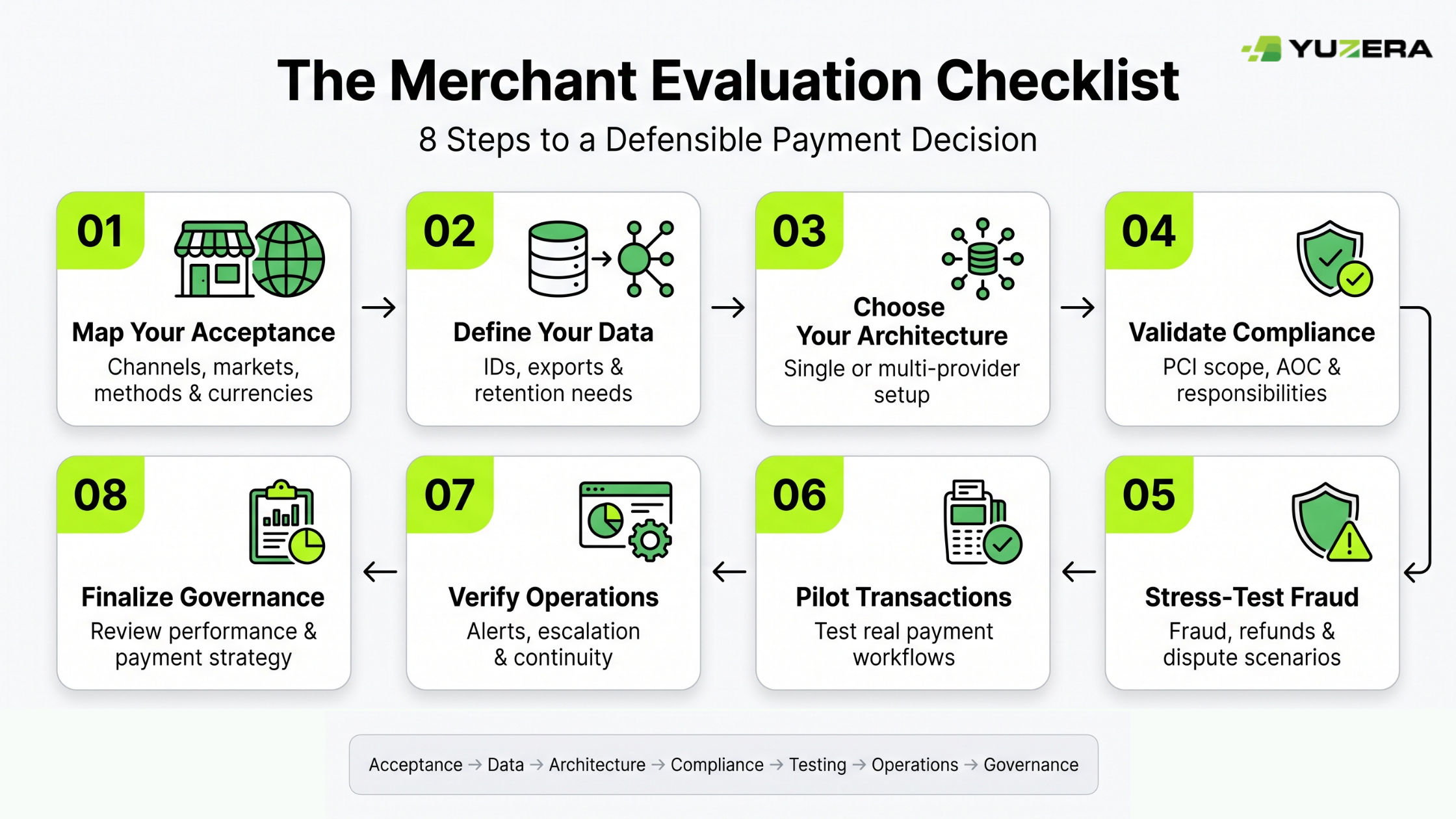
Use this numbered process for your payment gateway comparison to move from a shortlist to a confident choice.
- Map your acceptance surface area. Document channels, geographies, methods, currencies, average order value, and refund and dispute profile.
- Define your must-own data model. Identify the IDs needed to unify POS, online, and back-office systems, the required exports, and retention needs.
- Choose your target architecture. Decide between a single provider and a multi-provider setup with orchestration, and be explicit about who owns the orchestration logic.
- Validate compliance posture early. Confirm PCI scope, request the AOC and responsibility matrix, and resolve embedded-versus-redirect implications before development starts.
- Run a fraud and dispute tabletop exercise. Simulate a fraud spike, refund abuse, and a dispute wave, then test the workflows and support response.
- Pilot with real transactions. Test reconciliation, refunds, partial captures, offline and online edge cases, and device lifecycle management.
- Pass an operational readiness gate. Verify monitoring, alerts, escalation paths, incident communications, and business continuity plans.
- Finalize governance. Set quarterly reviews of authorization and approval health, disputes, refund abuse, and the payment method roadmap.
This checklist reflects how a turnkey, omni-solutions approach, like that offered by Yuzera, is typically structured: proprietary POS software and hardware cover face-to-face flows, e-commerce gateway solutions handle non-face-to-face flows, and payment orchestration ties multiple providers into a single operational view. The goal for any merchant making this decision, from growing SMBs to enterprise-level operators, is to have an educational payment processor guide that clearly lays out these steps.
FAQ
Q1) How do I compare payment processors in Canada?
Evaluate Canadian providers the same way as anywhere else: coverage across channels, integration and extensibility, unified reporting, fraud and dispute tooling, PCI artifacts, and funds-flow policy. Canadian merchants operate in a market where e-commerce reached 6.1% of total retail trade in December 2025 (Statistics Canada), so omnichannel consistency matters. Also confirm each candidate’s role, since an acquirer that provides settlement is distinct from a processor that does not.
Q2) Which payment processor should I use in Canada?
The right payment processor depends on acceptance surface area, data-ownership requirements, and how fraud, disputes, and reserves are handled, not on a single headline number. Given that 62% of merchants in 2025 preferred multiple providers (451 Research), many Canadian operators are evaluating whether orchestration across providers is a better fit than a single connection. Run the eight-step checklist above before committing.
Q3) How do I choose payment processor partners without getting locked in?
When choosing processor platforms without getting locked in, define the must-own data model first and confirm token portability, export granularity, and API versioning policy. Visa describes network tokens as non-processor-specific and interoperable across the ecosystem (Visa on tokenization), which is one anchor of portability. Ask for a written change-management policy and sample data exports to ensure a future migration remains feasible.
Q4) What belongs in a payment gateway comparison guide?
A useful payment processor guide details coverage and omnichannel capabilities, integration and extensibility, reporting and reconciliation, fraud and dispute operations, security and compliance, and funds flow policy. Each dimension should come with specific evidence to request, such as an AOC, a responsibility matrix, sample exports, and a dispute workflow demo. That evidence turns a sales conversation into a defensible decision.
Q5) What are the most overlooked processor pros and cons?
The most overlooked processor pros and cons live in post-transaction operations: how disputes are handled as chargeback volume climbs toward 324 million by 2028 (Mastercard), and under what conditions funds can be held or reserved (OCC). A strong provider makes these policies transparent and offers remediation support. A weak fit leaves merchants to discover them after a problem hits.
Works Cited
- 451 Research. 451 Research Pathfinder Paper.
- EMVCo. 3-D Secure Specification v2.3.1.
- EMVCo. EMV Payment Tokenisation.
- Mastercard. 2025 State of Chargebacks Report.
- Mastercard. What Is First-Party Fraud, and Why Is It So Hard to Tackle?
- Office of the Comptroller of the Currency. Comptroller’s Handbook: Merchant Processing.
- PCI Security Standards Council. FAQ 1576: What Evidence Is a TPSP Expected to Provide.
- PCI Security Standards Council. FAQ 1588: How Does an E-Commerce Merchant Meet the SAQ A Eligibility Criteria for Scripts?
- PCI Security Standards Council. PCI DSS v3.2.1 to v4.0 Summary of Changes.
- Statistics Canada. The Daily: Annual Retail Trade, 2024.
- Statistics Canada. The Daily: Retail Trade, December 2025.