
Payment processor onboarding is the end-to-end process of applying to accept card payments, passing a risk-based review, signing a merchant agreement, and completing payment gateway setup so a transaction can move from a customer’s tap or click to an authorization. It is not a single form and a switch being flipped. Behind the scenes, a provider confirms your business is real, lawful, and operating where you say it is, while your team decides how cards will actually be accepted at the counter, on the phone, and online.
The good news for merchants switching systems or navigating a new payment processing setup: almost every delay is predictable. Knowing what gets checked, which payment processor documents to provide, and what gets tested turns a vague waiting period into a short, manageable project.
TL;DR
- During the payment approval process, Visa’s rules require an acquirer or payment facilitator to confirm a prospective merchant is financially responsible, operating lawfully, in an allowed jurisdiction, and not misrepresenting outlet locations before a merchant agreement is signed.
- Approval and technical readiness are separate milestones in payment processor onboarding; Visa says transactions may only be submitted for sellers with a valid, executed contract in place.
- PCI SSC defines different validation paths by channel, including SAQ A for fully outsourced e-commerce, SAQ A-EP where your site affects transaction security, and SAQ B-IP for standalone IP terminals.
- Payments Canada reported 26.7 billion retail payment transactions worth $12.9 trillion in 2025, with cards at 68% of volume and contactless volume up 9% year over year.
What are the payment gateway setup requirements before you apply?
These requirements fall into three buckets: business identity, operating model, and technical configuration. You need an accurate legal entity record, verifiable business and outlet locations, a clear description of what you sell and how you fulfill it, and a decision about which acceptance channels you are turning on.
Visa’s public payment rules, updated April 2026, state that before entering a merchant agreement an acquirer or payment facilitator must ensure the prospective merchant is financially responsible, is not engaged in activity that could harm the Visa system or brand, operates in an allowed jurisdiction, and does not misrepresent merchant outlet locations. That is why mismatched addresses and vague business descriptions stall applications more often than anything else.
On the technical side, the requirements depend on how money actually reaches you. A hosted checkout, an embedded field inside your own page, a countertop terminal, and a virtual terminal for phone orders are four different configurations with four different security profiles. Yuzera is a tech-forward fintech and omni-solutions provider serving diversified merchants across Canada and the United States, delivering proprietary POS software and hardware, payment orchestration, and value-added services, backed by parent company Digitech’s track record. Our e-commerce work runs in phases that can include website development, shopping-cart integration, and gateway implementation, so the payment gateway setup is completed against a checkout that already exists rather than bolted onto one mid-launch.
Decide the channel mix first. Everything else in your payment processing setup follows from it.
How to set up payment processing, step by step
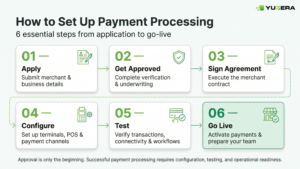
To set up payment processing, you submit an application, pass underwriting, execute a merchant agreement, configure your acceptance channels, test in a controlled environment, then go live. Each stage has an owner and a gate, and skipping ahead is what creates the “approved but not transacting” limbo merchants complain about.
Visa’s merchant risk guide describes the sequence plainly: a payment facilitator or marketplace collects prospective-merchant information through an application, validates it, authenticates the merchant to prevent fraudulent applications, and then makes an underwriting decision to approve, conditionally approve, or decline. That same guide notes transactions may only be submitted for sellers or retailers with a valid, executed contract containing terms on illegal transactions and compliance with applicable rules and laws. Approved is not the same event as contracted, and contracted is not the same event as configured.
Configuration is its own workstream. EMVCo’s contactless chip overview explains that EMV Contactless Chip specifications define how the chip and acceptance terminal communicate and process contact and contactless transactions. Additionally, EMVCo facilitates testing, approval, and evaluation of contactless acceptance devices. A terminal rollout therefore includes device selection, configuration, connectivity, acceptance testing, and staff readiness. Yuzera’s terminal lineup spans countertop, portable, mobile, and all-in-one formats, and our POS environment ties checkout to orders, inventory, reports, and customer records so the go-live covers the whole operation, not just the card read.
What does the payment processor onboarding process actually check?
This onboarding review checks whether your business is legitimate, lawful, locatable, and operationally consistent with what you described in the application. The payment approval process is a due-diligence decision informed by multiple signals, not a single pass/fail lookup.
Visa’s merchant risk guide puts the rationale directly: “Payment facilitators and marketplaces act as ‘gatekeepers’ to the payment system and must ensure that only qualified and responsible sellers are provided access.” In practice, that means reviewers look beyond the entity record. The guide says a payment facilitator must determine whether there is significant negative background information about merchant principals, as legally permitted, and that facilitators must query the Visa Merchant Screening Service, or a comparable terminated-merchant file where unavailable, to identify applicants previously terminated for cause. Importantly, Visa says that screening results should be weighed alongside other due-diligence information and should not be the sole basis for declining acceptance privileges.
Applications flagged as higher brand risk get a deeper operational look. Enhanced due diligence can include a review of specific payment processor documents detailing the goods or services offered, how they are marketed and sold, validation of the merchant location, and consumer-complaint-board checks.
The practical takeaway for a prepared merchant: be ready to explain, in one page, what you sell, where you operate, how customers place orders, and how you deliver or fulfill them. Requirements vary by provider program and jurisdiction, so confirm specifics with the organization administering yours.
The process of getting approved for payment processing: what helps and what holds things up
Getting approved for payment processing is faster when the payment processor documents you submit are internally consistent, verifiable, and match your public-facing presence. Mismatches between your legal name, registered address, website content, and stated fulfillment model are the most common cause of back-and-forth, because reviewers are required to validate location accuracy and operating legitimacy.
During the payment approval process, conditional approval is a normal, workable outcome, not a rejection. Visa’s framework allows for approve, conditionally approve, or decline, and a condition usually means the provider wants one more piece of clarity before full acceptance privileges open. No provider can promise an approval or a specific timeline; the review is risk-based and depends on your facts and the program’s requirements.
What you can control is readiness. A smooth payment processing setup requires having your business description, channel mix, fulfillment process, and refund and delivery practices written down before you apply. If your model has changed recently, say so in the application rather than letting a reviewer discover it.
Channel context matters too. Payments Canada’s payment trends release reported 26.7 billion retail payment transactions in Canada in 2025 valued at $12.9 trillion, with credit and debit combined at 68% of payment volume and contactless volume up 9% year over year. Most merchants now onboard for several channels at once, which means the payment approval process and the technical setup should be scoped together rather than sequentially. Our teams combine digital capability with human support, so questions during review reach a person who already knows your file.
What documents and security responsibilities does go-live require?
The documents needed for payment processor applications typically include business registration, ownership details, the executed merchant agreement, and payment processor documents outlining your acceptance channels and security responsibilities. The last category is the one merchants underestimate, because outsourcing technology does not outsource oversight.
The PCI Security Standards Council’s third-party compliance FAQ states: “In all scenarios where a TPSP is used, the customer must manage and oversee all their TPSP relationships and monitor the PCI DSS compliance status of their TPSPs in accordance with Requirement 12.8.” That includes performing due diligence, maintaining appropriate agreements, identifying which requirements apply to each party, and monitoring compliance status at least annually.
Validation paths differ by channel. PCI SSC’s self-assessment guidance describes SAQ A for card-not-present merchants that fully outsource all cardholder-data functions, SAQ A-EP where an e-commerce merchant outsources payment functions but its own website can affect transaction security, SAQ B-IP for standalone PTS-approved IP-connected terminals, and SAQ C-VT for manually keyed transactions through a hosted virtual terminal. Confirm your actual category with your acquirer or compliance-program administrator; it is not a self-classification shortcut.
For online checkout, PCI SSC’s e-skimming guidance notes that PCI DSS v4.x Requirements 6.4.3 and 11.6.1 focus on ensuring payment-page scripts are authorized, integrity-checked, and monitored for tampering, and on managing security-impacting HTTP headers. That guidance applies to pages affecting payment security through embedded iframes too. Inventory every team that can touch checkout scripts before launch.
FAQ
Q1) What is required before starting your payment gateway setup as a new merchant?
You need accurate legal entity and ownership information, verified business and outlet locations, a clear description of goods or services and fulfillment, and a defined acceptance channel mix. Visa’s rules require confirmation that a merchant is financially responsible, operating lawfully in an allowed jurisdiction, and not misrepresenting outlet locations. Technical requirements then follow from whether you are accepting in person, online, or both.
Q2) How is payment processing set up from scratch?
Apply, pass underwriting, execute the merchant agreement, finalize your payment gateway setup and terminal configuration, test, then go live. Visa’s merchant risk guide describes application collection, validation, merchant authentication, and an underwriting decision to approve, conditionally approve, or decline. Configuration includes terminal selection, connectivity, acceptance testing, and staff training. Payment processing setup moves fastest when channel decisions are made before the application is submitted.
Q3) How long does payment processor onboarding take?
No provider can promise a specific timeline, because review is risk-based and depends on your business facts and the program’s requirements. Straightforward applications with consistent documentation and a clearly described sales model move through the payment processing setup with the fewest follow-up requests. Higher-risk applications can require enhanced due diligence, including review of marketing, location validation, and prior acceptance history.
Q4) What improves a merchant’s chances of getting approved for payment processing?
Consistency and clarity. Make sure your legal name, address, website, and stated fulfillment model all match, and describe exactly what you sell and how customers order and receive it. Conditional approval during the payment approval process is common and usually means one clarification is outstanding. Visa also notes that a screening-file match should be considered alongside other due-diligence information and should not be the sole basis for a decline.
Q5) What documents are needed during payment processor onboarding?
Expect business registration and ownership details, an executed merchant agreement, and documentation describing your acceptance channels and security responsibilities. PCI SSC requires customers to perform due diligence on third-party service providers, maintain agreements, allocate requirements between parties, and monitor compliance status at least annually. Your acquirer or compliance-program administrator confirms which validation path and payment processor documents apply to your setup.
Works Cited
- EMVCo. “EMV Contactless Chip.”
- Payments Canada. “Canadian Payment Transactions Total More Than $12 Trillion in 2025.”
- PCI Security Standards Council. “Completing Self-Assessment.”
- PCI Security Standards Council. “FAQ 1312: Third-Party Service Providers and PCI DSS Compliance.”
- PCI Security Standards Council. “New Information Supplement: Payment Page Security and Preventing E-Skimming.”
- Visa. Payment Facilitator and Marketplace Risk Guide.
- Visa. Visa Core Rules and Visa Product and Service Rules.