
A high-risk payment processor is a provider that supports merchants whose category, sales channel, or transaction model calls for enhanced underwriting, monitoring, and security controls before and after they start accepting cards. The label reflects a risk-management decision made by card networks and acquiring institutions. It is not a ruling on whether your business is legitimate or whether it can scale. Classification can differ by network, acquirer, jurisdiction, merchant category code, channel, and historical performance, which is why two companies selling similar products are sometimes treated very differently. What follows is a plain explanation of what drives the designation, which operational signals matter most, and what a specialized payment solution built around your actual model should include.
TL;DR
- “High-risk” is risk-based segmentation, not a blacklist. Visa’s acceptance standards cite future-sales activity, high-integrity categories, enterprise entities, and pay-by-link merchants as examples requiring closer review.
- Visa’s excessive-merchant VAMP threshold for Canada and the U.S. dropped from 220 basis points to 150 basis points on April 1, 2026, with a 1,500 monthly fraud-and-dispute minimum.
- Payment fraud equalled 3.2% of global e-commerce revenue in the Merchant Risk Council’s 2025 survey of 1,082 professionals across 38 countries; 62% reported rising first-party misuse disputes.
- Monitoring of high-integrity-risk merchants starts on the 31st calendar day after first deposit, with daily comparison against normal activity and weekly baseline reviews.
What is a high-risk payment processor, and why do merchants get the label?
A high-risk payment processor serves merchants that acquirers have placed in a higher-risk segment, which means stricter onboarding evidence, more documentation, and ongoing performance oversight. The classification comes from a formal segmentation process, not from a universal industry blacklist.
Visa’s acceptance risk standards require acquirers to segment merchants using a risk-based onboarding policy, and the examples given include future-sales activity, Visa Integrity Risk Program high-integrity categories, enterprise entities, and pay-by-link merchants. Risk can therefore come from how and when you take payment, not only from what you sell. Underwriting for restricted category payments confirms creditworthiness, alignment between the business model and the acquirer’s risk tolerance, controls against activity that could harm the payment system, operation in permitted jurisdictions, regulatory compliance, and accurate representation of merchant outlet locations.
Being in a closely watched category does not make commerce illegal. Visa’s network integrity guidance states plainly: “We do not discriminate against legal commerce.” Legal adult-content and gambling businesses are described there as carrying a higher risk of illegal activity, so the institutions supporting them must put enhanced safeguards in place.
Accurate classification starts with you. Visa requires acquirers to assign the merchant category code that most accurately describes a merchant outlet’s business, with separate codes available for distinct lines of business that meet stated conditions. Describing your products, channels, and fulfillment model loosely is not a shortcut; it is a liability.
What should a high-risk payment gateway in Canada be able to prove?
A high-risk payment gateway used in Canada should be able to demonstrate configurable authentication, granular transaction data capture, and reporting that tracks the same metrics acquirers and networks track. Canadian merchants also need to watch a tightening performance bar.
Visa’s monitoring program overview sets the VAMP ratio as fraud reports plus disputes divided by settled transactions for domestic and cross-border card-not-present activity. The excessive-merchant threshold for the Canada, U.S., AP, and EU regions was reduced from 220 basis points to 150 basis points effective April 1, 2026, with a minimum monthly fraud-and-dispute count of 1,500 attached to that program threshold. Fraud and disputes are measured together, so treating them as two separate back-office problems hides the number that actually matters.
Oversight intensity is defined too. Under Visa’s merchant monitoring standards, acquirers supporting high-integrity-risk merchants retain daily information including gross sales volume, average transaction amount, transaction receipt count, and dispute count. Monitoring begins on the 31st calendar day after the merchant’s first deposit, compares current behaviour against normal activity at least daily, and reviews what counts as normal at least weekly.
Visa may also impose security or authentication requirements on a high-integrity-risk merchant or sponsored merchant. That makes configurability the real test of a high-risk payment gateway: if authentication rules, descriptors, and risk thresholds cannot be tuned by channel and product line, you will be stuck adjusting your business to the software instead.
What does a payment solution for restricted categories need to handle?
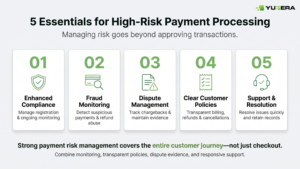
A specialized payment solution has to manage the full dispute lifecycle, not just approvals: refunds, cancellations, chargeback evidence, and customer-support outcomes all feed the same risk picture. Restricted category payments are governed by enhanced registration and closer performance monitoring rather than exclusion.
Visa’s network integrity position is that legal adult-content and gambling merchants go through an enhanced registration process and closer performance monitoring so safeguards for restricted category payments stay in place. In practice, that means your infrastructure must produce evidence on demand: authentication records, fulfillment confirmations, policy acceptance, and dispute responses.
The threat mix has also shifted away from classic stolen-card fraud. The Merchant Risk Council’s global fraud report found payment fraud represented 3.2% of total annual global e-commerce revenue among respondents, with 47% naming refund abuse as the top fraud attack and 45% pointing to real-time payment fraud as the next biggest. Sixty-two percent saw increasing rates of first-party misuse disputes. The survey was fielded in October and November 2024 among 1,082 payment and fraud professionals across 38 countries, so treat it as a benchmark for direction rather than a number to apply to your own volume.
The operational conclusion is useful for any merchant using a high-risk payment processor. If most dispute pressure is coming from refund abuse and customers who do not recognize or do not honour their own purchase, the fixes live outside the fraud screen: clear billing descriptors, specific delivery timelines, straightforward cancellation terms, fast support resolution, and records that prove what was promised and when it arrived.
What technology separates an advanced payment processor from a generic checkout?
A specialized payment processor Canadian merchants trust is defined by its security architecture for unique industry payments: validated encryption at the point of sale, script integrity controls on the payment page, and authentication layered by transaction risk. A specialized payment solution assembles those pieces around one operating model instead of applying a single default checkout to everyone.
Start with scope. The PCI Security Standards Council states that “payment security is paramount for every merchant, financial institution or other entity that stores, processes or transmits cardholder data.” Its guidance notes that approved point-to-point encryption can render stolen cardholder data unreadable to unauthorized parties and may reduce the scope of a merchant’s cardholder data environment, which matters for in-person acceptance across multiple locations.
Online, the attack surface is the page itself. PCI DSS v4.x Requirements 6.4.3 and 11.6.1 focus on authorizing payment-page scripts, integrity-checking them, monitoring for tampering, and managing security-impacting HTTP headers, according to the council’s e-skimming guidance. Using an embedded form does not transfer the problem. The council’s script security FAQ says a merchant using a third-party embedded payment page must confirm its own site is not susceptible to script attacks, either through its own controls or through confirmation from the compliant provider.
Two further layers belong in the conversation. EMVCo describes 3-D Secure as an authentication protocol that exchanges transaction, payment-method, and device data so issuers can request extra authentication on higher-risk purchases. Mastercard’s payment tokenization overview says tokens can be unique to the cardholder, merchant, and transaction, lowering fraud risk while simplifying checkout.
How do you choose a payment gateway for unique industries?
Evaluating platforms for unique industry payments comes down to three checks: what each vendor touches, who owns each security function, and what daily visibility you get into your own numbers. Unique industry payments succeed or fail on documentation and oversight, not on category labels.
Ask about registration first. Visa’s security and compliance resources state that third-party agents deploying POS or kiosk acceptance devices, managing encryption keys, or storing, processing, transmitting, or accessing Visa cardholder data must be registered in the Third Party Agent Registration Program before issuers, acquirers, or merchants use them. Map every vendor in your stack against that list and know which party is accountable for each control.
History counts as well. Visa’s risk standards require acquirers to check internal declined and terminated profiles plus external terminated-merchant resources during onboarding, and Mastercard’s chargeback guide describes MATCH as a system used to record terminated merchants in applicable circumstances. A record is a serious due-diligence signal, not an automatic permanent bar, so prepare context rather than hoping it goes unnoticed.
Then build the daily view into your high-risk payment gateway. Since acquirers compare high-integrity-risk merchants against a normal baseline every day, business owners should see the same shape of data: volume, average transaction size, transaction counts, disputes, refunds, and exceptions by channel. Yuzera builds POS reporting and analytics for the owner rather than only the clerk, with connected reporting, customer management, and invoicing in one operating environment. Our team, backed by the track record of our separate parent company Digitech Payments in Montreal, can help you scope that setup for unique industry payments at yuzera.com.
FAQ
Q1) Do I need a payment processor for a high-risk business if my category is only sometimes flagged?
Possibly, because flagging depends on more than category. Visa’s acceptance risk standards cite future-sales activity, pay-by-link merchants, enterprise entities, and high-integrity-risk categories as examples of situations requiring risk-based segmentation. If you take payment before full delivery, bill on a recurring schedule, or send payment links, your transaction model alone can move you into closer review regardless of what you sell.
Q2) What makes a high risk payment gateway in Canada different from a standard one?
Configurability and data depth. A high-risk payment gateway built for Canadian merchants must support adjustable authentication rules, accurate descriptors, and reporting that mirrors network monitoring metrics. It matters more now that Visa’s excessive-merchant VAMP threshold for the Canada and U.S. regions fell to 150 basis points on April 1, 2026, with a 1,500 monthly fraud-and-dispute minimum attached to that threshold.
Q3) What should infrastructure for restricted category payments include?
Enhanced registration support, evidence capture, and dispute tooling that extends past checkout. Visa applies closer performance monitoring to legal restricted categories rather than excluding them. Because 47% of merchants in the Merchant Risk Council’s 2025 survey named refund abuse as their top fraud attack, workflows handling restricted category payments need the same design attention as the payment page.
Q4) How do I evaluate a specialized payment solution?
Check registration, security ownership, and reporting. Confirm that any third party deploying devices, managing encryption keys, or accessing cardholder data is registered under Visa’s Third Party Agent Registration Program. Confirm who handles payment-page script integrity under PCI DSS v4.x. Then confirm you receive daily visibility into volume, average ticket, disputes, and refunds by channel.
Q5) Can I get a specialized payment solution if my model does not fit standard templates?
Yes. Unique industry payments are handled through accurate classification and proportionate controls, not through workarounds. Document your real operating model, assign the merchant category code that most accurately describes each line of business, assemble your jurisdiction and licensing file, and match authentication, tokenization, and encryption to your actual transaction profile.
Works Cited
- “Visa Acceptance Risk Standards.” Visa.
- “Visa Network Integrity.” Visa.
- “Visa Core Rules and Visa Product and Service Rules.” Visa.
- “Visa Acquirer Monitoring Program Fact Sheet.” Visa.
- “2025 Global Payments and Fraud Report.” Merchant Risk Council.
- “Merchants: Payment Security.” PCI Security Standards Council.
- “New Information Supplement: Payment Page Security and Preventing E-Skimming.” PCI Security Standards Council.
- “FAQ 1588.” PCI Security Standards Council.
- “EMV 3-D Secure.” EMVCo.
- “Network Tokenization.” Mastercard.
- “Security and Compliance.” Visa.
- “Chargeback Guide.” Mastercard.