
Why Fast and Reliable Payouts Matter as Much as Fraud Protection
Fraud prevention gets the budget, the committee time, and the vendor demos. Payout reliability usually gets a footnote in an onboarding document. That imbalance is worth correcting, because fast payment deposits and predictable funds availability are how a business actually uses the revenue its fraud controls just protected. A trustworthy payment gateway can tell you, with precision, when money moves, when it becomes usable, and what happens when something needs a second look.
For merchants operating across the US and Canada, this is not a theoretical concern. Cutoff times, settlement calendars, rail eligibility, receiving-institution participation, and compliance review all shape when funds land. Two providers can describe the same timing model and deliver very different operational experiences. The difference shows up in the details: status data quality, exception handling, documented recovery objectives, and whether a merchant is told why something is under review.
This piece breaks down the vocabulary, the rail mechanics in both countries, the regulatory expectations now shaping funds safeguarding, and a concrete evaluation process. It is written for teams who already know what an authorization is and want the operational layer underneath.
TL;DR
- More than half of US employer firms (56%) named paying operating expenses as a financial challenge in the prior 12 months, and 51% cited uneven cash flows, according to Federal Reserve survey data.
- In Statistics Canada’s Q4 2024 survey, 73.8% of businesses said they had cash to operate for three months, while 12.0% said they did not and 14.2% were unsure.
- Nacha’s three Same Day ACH windows settle at 1:00 p.m., 5:00 p.m., and 6:00 p.m. ET, with submission deadlines as early as 10:30 a.m. ET for the first window.
- From September 18, 2026, non-same-day ACH credits must be available for withdrawal by 9:00 a.m. local time on the settlement date under a published Nacha rule.
- The Canadian Anti-Fraud Centre logged over 112,000 fraud reports and more than $704 million in reported losses in 2025, yet only 5% to 10% of frauds are reported at all.
Why is fraud protection incomplete without payout reliability?
Fraud protection and payout reliability are two halves of the same operating capability: one keeps bad money out, the other makes good money usable on a schedule you can plan around. A merchant who blocks every fraudulent transaction but cannot predict when legitimate revenue becomes available has solved half the problem. Treating these as separate procurement checkboxes is a common structural mistake in payment technology evaluations.
The fraud numbers justify serious controls. The Canadian Anti-Fraud Centre’s fraud prevention month page reports more than 112,000 fraud reports in 2025, with more than $704 million in reported losses. In the United States, the Federal Trade Commission’s fraud testimony release reported 3 million consumer fraud reports and $15.9 billion in losses during 2025. Those are floors, not ceilings. Canadian government partners note in a joint fraud prevention release that only 5% to 10% of frauds are reported, meaning the observed figures represent a fraction of the actual harm.
So the controls are necessary. The question is how they are designed. A screening model that produces unexplained holds transfers risk from the platform to the merchant’s treasury function. A screening model that produces a documented review path, a clear reason code, and an expected resolution window keeps the merchant operating while the review runs.
The PCI Security Standards Council frames this well in its PCI resource hub, describing PCI DSS as a global standard with a baseline of technical and operational requirements designed to protect account data. Protection is the baseline, not the finish line. What merchants need on top of it is operational certainty: accurate timing data, visible status, and a defined process when a transaction falls outside the normal path. A reliable payment processor should be able to describe both capabilities in the same conversation without treating one as a concession to the other.
What does the cash-flow data say about payout timing?
Payout timing is an operating variable, not a convenience feature, because most businesses in both countries already report friction in meeting routine obligations. The Federal Reserve Banks’ employer firms report found that 56% of surveyed US employer firms identified paying operating expenses as a financial challenge in the prior 12 months. The same survey found 51% cited uneven cash flows, a category the report describes as including the collection of receivables.
Those two figures describe the same underlying condition from different angles. Operating expenses arrive on a fixed calendar. Inflows do not. When the gap between a completed sale and usable funds widens or becomes unpredictable, the business absorbs the variance through buffers, delayed supplier payments, or short-term credit, highlighting why fast payment deposits are essential.
Canadian data tells a parallel story with a useful nuance. Statistics Canada’s business financing analysis for Q4 2024 found that 73.8% of businesses said they had the cash or liquid assets needed to operate over the following three months. That sounds comfortable until you read the remainder: 12.0% said they did not, and 14.2% were unsure. More than a quarter of respondents either lacked confidence or lacked visibility. The “unsure” category is arguably the more interesting one, because uncertainty about liquidity is often a data problem as much as a funding problem.
The same Statistics Canada analysis found that among businesses that did not plan to apply for new debt financing and also said they could not take on more debt, 34.7% cited cash flow as the reason. Cash flow was not just a symptom here; it was the constraint that closed off a financing option entirely.
For merchants evaluating next-day deposits or a same-day payout option, the practical exercise is to map material outflows against inflow timing. Payroll, inventory replenishment, rent, supplier terms, and refund volume all have their own rhythms. If payroll clears on a Friday and card volume peaks on the preceding weekend, the timing model matters concretely. If outflows are smooth and reserves are deep, predictable next-day timing may be entirely sufficient. The answer is merchant-specific, and any platform conversation that skips this mapping step is starting in the wrong place.
Accepted, settled, available: what do these terms actually mean?
“Funds available” and “payment initiated” describe different moments, and conflating them is a common source of payout confusion. Payments Canada’s funds availability glossary defines funds availability as the point when a payee can withdraw and use funds. It notes that this may occur before participating financial institutions actually settle. Availability and settlement are related, but they are not the same event, and they do not always happen in the order merchants assume.
A workable mental model has four distinct stages:
Authorization or acceptance. The transaction is approved at the point of interaction. This is the moment the POS shows a green checkmark and the customer walks out. No money has moved.
Clearing and settlement. The transaction is exchanged between financial institutions, and the obligation between them is discharged. This runs on the schedule of whichever system is carrying the payment, ultimately dictating how quickly your funds arrive.
Funds availability. The payee can actually withdraw or spend the money. This is the stage merchants care about and the one most often described imprecisely.
Reconciliation and reporting. The merchant’s finance team matches funds movement back to sales records, refunds, adjustments, and fees at the ledger level.
The scale of the systems underneath matters here. Payments Canada’s retail batch system page notes that Canada’s retail batch payment system, comprising the Automated Clearing Settlement System and the U.S. Bulk Exchange application, supports 99% of daily transaction volume and 13% of daily transaction value cleared across Payments Canada systems. Nearly all transactions by count run through batch infrastructure. That directly affects timing.
The fourth stage is where data quality becomes a payout issue rather than an accounting one. Payments Canada’s ISO messaging overview explains that enhanced remittance data in ISO 20022 can support automated reconciliation and straight-through processing. Richer structured data on the payment message means fewer manual matches downstream.
One more definitional point worth carrying into vendor conversations: the same Payments Canada glossary identifies automated funds transfer credits as direct deposits and notes they are commonly used for payroll. When a provider describes a deposit, ask which of the four stages the description refers to. A trustworthy payment gateway will answer that question without hedging.
Why do cutoff times create payout surprises?
Cutoff times are the reason a same-day payout can behave like a next-day one, and they are almost always the gap between what a merchant expected and what actually happened. Same-day availability is not an all-day promise. It is a set of windows, each with a submission deadline, and a transaction submitted one minute late does not get faster treatment; it gets the next window.
Nacha’s ACH schedules chart lays out the structure precisely. The first Same Day ACH window carries a 10:30 a.m. ET originating financial institution deadline, a 1:00 p.m. ET settlement time, and a 1:30 p.m. local time funds-availability requirement. The second window has a 2:45 p.m. ET deadline, a 5:00 p.m. ET settlement time, and a 5:00 p.m. local time availability requirement. The third window has a 4:45 p.m. ET deadline, a 6:00 p.m. ET settlement time, and requires funds to be available by the receiving institution’s end of processing day.
Read those three rows carefully, and a pattern emerges. The last same-day submission deadline is 4:45 p.m. Eastern. For a West Coast merchant, that is 1:45 p.m. local. A retail location doing meaningful volume between 2:00 p.m. and close has no same-day path for that day’s transactions, regardless of what the marketing page says.
A second layer of variability exists. Nacha’s same-day expansion page states that each ACH Operator determines Same Day ACH schedules and exact file-processing timing, even though the rules establish the relevant framework and requirements. The rulebook sets the floor. Operational implementation sets the experience.
Canadian merchants face an analogous structure. Payments Canada’s batch funds availability material explains that qualifying Canadian-dollar automated funds transfer credit transactions can be available to payees no later than two hours after the relevant exchange deadlines, subject to exceptions and to participation by financial institutions offering faster funds availability. That sentence embeds two conditions: the transaction must qualify, and the receiving institution must participate.
Calendar effects compound the issue. Payments Canada notes that cheques deposited on Saturday do not clear until the following Monday evening. Weekend volume behaves differently from weekday volume across most batch-based paths.
The practical takeaway: ask for cutoff times expressed in your operating time zone, and ask specifically what happens to a transaction submitted after the final window.
Are same-day, next-day, and instant timing models interchangeable?
They are not interchangeable, and treating them as a simple speed ranking leads to poor architecture decisions. Each model has a different availability standard, a different sensitivity to the calendar, and a different set of eligibility conditions. The right choice depends on your cash cycle and whether your business genuinely requires accelerated funding, not on which option sounds fastest.
Scheduled ACH credits are getting a meaningful upgrade in predictability. Nacha’s ACH availability rule takes effect September 18, 2026. It will require receiving financial institutions to make all non-same-day ACH credit entries available for withdrawal by 9:00 a.m. local time on the settlement date. That is a substantive change for anyone relying on next-day deposits. A morning availability floor makes the model plannable in a way that “sometime on settlement date” never was.
Same Day ACH sits between scheduled and instant, often serving as the primary rail for a same-day payout. It is faster when the transaction qualifies and hits a window, and it is also getting a capacity expansion. Nacha announced in April 2026, via its ACH limit announcement, that the Same Day ACH per-payment limit will increase from $1 million to $10 million on September 17, 2027. For larger merchants moving substantial single-payment amounts, that ceiling change matters.
Instant payment infrastructure operates on different assumptions entirely. The Federal Reserve’s FedNow participants overview states that the FedNow Service enables participating banks and credit unions to send and receive transactions within seconds, 24 hours a day, 7 days a week. The Fed’s FedNow service overview adds that businesses and individuals can send and receive instant payments in real time around the clock through participating financial institutions, with recipients having full access to funds immediately.
The operational detail underneath is where the engineering discipline shows. The FedNow operating procedures state that the service processes messages continuously, every day of the year, and that its accounting cycle rolls over at approximately 7:00 p.m. ET without interrupting real-time message processing. The same procedures say participants and service providers should make funds available as soon as practicable and no later than a few seconds, including weekends and Federal Reserve holidays. That planned downtime should not exceed two consecutive hours or 24 total hours per quarter.
Canada’s Real-Time Rail describes a comparable target. Payments Canada’s real-time framework consultation material describes a model in which payment exchange, clearing, and settlement occur within 10 seconds, with payee funds available within 60 seconds after settlement, subject to specified exceptions.
How do fraud, sanctions, and exception reviews affect timing?
Compliance and risk review are legitimate sources of payout delay, and a reliable payment processor makes them explainable rather than invisible. The goal is not zero holds. The goal is for every hold to have a reason, an owner, and a resolution path the merchant can see.
Sanctions screening illustrates why one-size-fits-all timing promises break down.
The Office of Foreign Assets Control’s instant payment guidance says financial institutions using instant payment systems should base sanctions-compliance controls, including decisions about whether and how to screen transactions, on their own risk assessment, and explicitly states there is no one-size-fits-all approach. The same guidance notes that US banks are expected to perform risk-based customer due diligence at onboarding and at regular intervals thereafter, including screening customers for a potential sanctions nexus.
False positives are an expected part of that system, not a malfunction. OFAC’s false hit guidance recognizes that organizations may need to eliminate a transaction hold or trigger further manual review after a screening match has been identified and evaluated as a false hit. Two outcomes, both normal. What distinguishes a good platform is how quickly and clearly it communicates which applies to your transaction.
Reversals are another timing factor with defined rules. Payments Canada’s pre-authorized debit guide explains that pre-authorized debits can be dishonored for reasons including insufficient funds, stop payment, or a closed account no later than the next business day. For merchants running recurring billing, that window belongs in the cash-flow model, not in the surprise column.
Auditability underpins all of this. PCI DSS self-assessment materials, specifically the PCI assessment questionnaire, require audit logs to support anomaly and suspicious-activity detection, as well as forensic analysis of events. Logs designed for detection and forensics are also the raw material for explaining a hold to a merchant.
The evaluation question to bring into a vendor conversation is not “do you ever hold funds?” Every serious platform does. The question is: when a transaction is under review, what will I be told, how quickly, through which interface, and what do I need to provide to resolve it? A trustworthy payment gateway answers that with specifics.
What regulatory expectations now govern reliable access to funds in Canada?
In Canada, reliable access to funds is now a supervised expectation rather than a service courtesy, and merchants evaluating providers should understand the framework. The Bank of Canada’s retail payments supervision materials state that payment service providers subject to the Retail Payment Activities Act must mitigate operational risk, respond to incidents, and safeguard end-user funds. The requirements for operational-risk frameworks and funds-safeguarding frameworks took effect on September 8, 2025.
The safeguarding requirements are specific. For payment service providers that hold end-user funds, the Bank of Canada says funds must be held either in trust in a trust account, or in a segregated account with insurance or a guarantee. That is a structural requirement about where money sits, not a best-practice suggestion.
The documentation requirement goes further and is directly relevant to merchant due diligence. A payment service provider holding end-user funds must have a written safeguarding framework explaining how it will ensure end users have reliable and timely access to funds, including how funds would be paid if the provider became insolvent. The phrase “reliable and timely access” appears in a regulatory context, which tells you the regulator views payout reliability as a supervisory matter, not a marketing differentiator.
Operational risk carries parallel expectations. The Bank of Canada says payment service providers’ operational-risk and incident-response frameworks should aim to preserve the integrity, confidentiality, and availability of payment activities and related systems, data, and information. Availability sits alongside integrity and confidentiality as a first-class objective. That framing is useful for merchants because it validates what finance teams already know intuitively: a system that is secure but unavailable has not met its obligation.
Two important boundaries for merchants to keep in mind. First, these are regulatory requirements applicable to entities within the scope of the Act, and they describe what a supervised provider must do, not a guarantee about any specific provider’s performance. Second, delayed funds do not automatically signal poor service, even for expected next-day deposits. Reviews and delays can arise from legitimate risk, compliance, account, network, or calendar conditions.
For anyone assessing a reliable payment processor Canada-side, the productive approach is to use this framework as a question set. Ask whether the provider holds end-user funds, how it safeguards them if it does, and what the operational-risk framework covers. Those questions are answerable, and the quality of the answer tells you a great deal.
What operational signals separate real reliability from a surface-level promise?
Genuine reliability is measurable, documented, and tested. A surface-level promise is a sentence on a webpage. The Bank of Canada’s operational risk guideline provides an unusually concrete vocabulary for telling the two apart, and it works as a buyer-education framework regardless of which side of the border you operate on.
Start with targets. The guideline recommends that relatively more ubiquitous or interconnected payment service providers establish reliability targets, including system-availability targets, recovery-time objectives, maximum tolerable downtime, and recovery-point objectives. It defines a recovery-time objective as the maximum time a disrupted system, service, process, or function should take to resume operations, and maximum tolerable downtime as the maximum time it can be unavailable. Those are numbers. A provider either has them or does not.
Then testing. The same guideline says providers should document testing methodology, including testing scope, frequency, stakeholder involvement, reporting of results, and remediation of gaps or vulnerabilities. It adds that scenario-based testing should assess whether the framework and incident-management planning preserve the integrity, confidentiality, and availability of payment activities and the systems and data supporting them. Untested continuity planning is a hypothesis.
Incident response is the third pillar. The guideline states that after an incident is detected, a provider should immediately investigate and contain it, and that its incident-response plan should include predetermined mitigation measures such as manual processes or alternative solutions. Predetermined is the operative word. Deciding on a workaround during an outage is not a plan.
Third-party dependencies deserve particular attention, because almost no merchant payout experience runs on a single party’s infrastructure. The guideline says providers must manage third-party service providers in a way that supports integrity, confidentiality, and availability objectives, including assessing operational performance and monitoring it after engagement. It specifies that providers must assess third parties related to payment functions before entering into, renewing, extending, or substantially amending a contract, and at least annually thereafter.
Most pointedly, the guideline says contractual arrangements alone are not sufficient controls for third-party risk, and that providers may need compensating controls such as broader monitoring, ongoing security testing, and termination plans. A contract allocates liability. It does not keep a system running.
This is the framework we encourage merchants to apply to any payment technology evaluation. The point is documented answers to questions.
How do POS and orchestration layers affect payout visibility?
The POS and orchestration layer determines whether payout timing becomes visible or stays opaque, and it is the part of the stack merchants control most directly. Rails determine when money can move. The software layer, especially when powered by a trustworthy payment gateway, determines whether you can see it happening, match it to sales, and act when something deviates.
Reconciliation is the clearest example. Payments Canada’s ISO messaging overview explains that enhanced remittance data in ISO 20022 can support automated reconciliation and straight-through processing. Structured, richer payment data means a finance team can match deposits to orders programmatically instead of by hand. The same Payments Canada funds availability glossary distinction between availability and settlement only becomes operationally useful if your dashboard actually surfaces both states as separate fields.
This is why a POS should be designed for the business owner, not only the clerk. The clerk needs a fast, accurate transaction flow. The owner needs deposit status by batch, exception flags with reasons, refund and chargeback impact on expected deposits, and a view that holds up across multiple locations and time zones. Those are different information needs served by the same system.
Orchestration adds another dimension. When a merchant runs in-person, e-commerce, invoicing, recurring billing, and marketplace flows, each channel can have different timing behavior, eligibility conditions, and exception patterns. An orchestration layer that normalizes status reporting across those flows turns a fragmented picture into one operational view. Without it, finance teams reconcile several systems, each differently.
Audit trails connect this back to risk. The PCI DSS self-assessment materials in the PCI assessment questionnaire require audit logs that support anomaly and suspicious-activity detection, plus forensic analysis of events. The same log infrastructure that satisfies a security requirement can power merchant-facing exception visibility, if the platform is designed to expose it.
Yuzera builds proprietary POS software and hardware alongside payment orchestration and value-added services, and the visibility layer is a deliberate part of that design, not an afterthought bolted onto a gateway.
The practical test for any setup: can your finance team, without opening a support ticket, answer where a specific batch is, when it is expected to be available, and why any portion of it is not?
Comparing payout timing models across US and Canadian rails
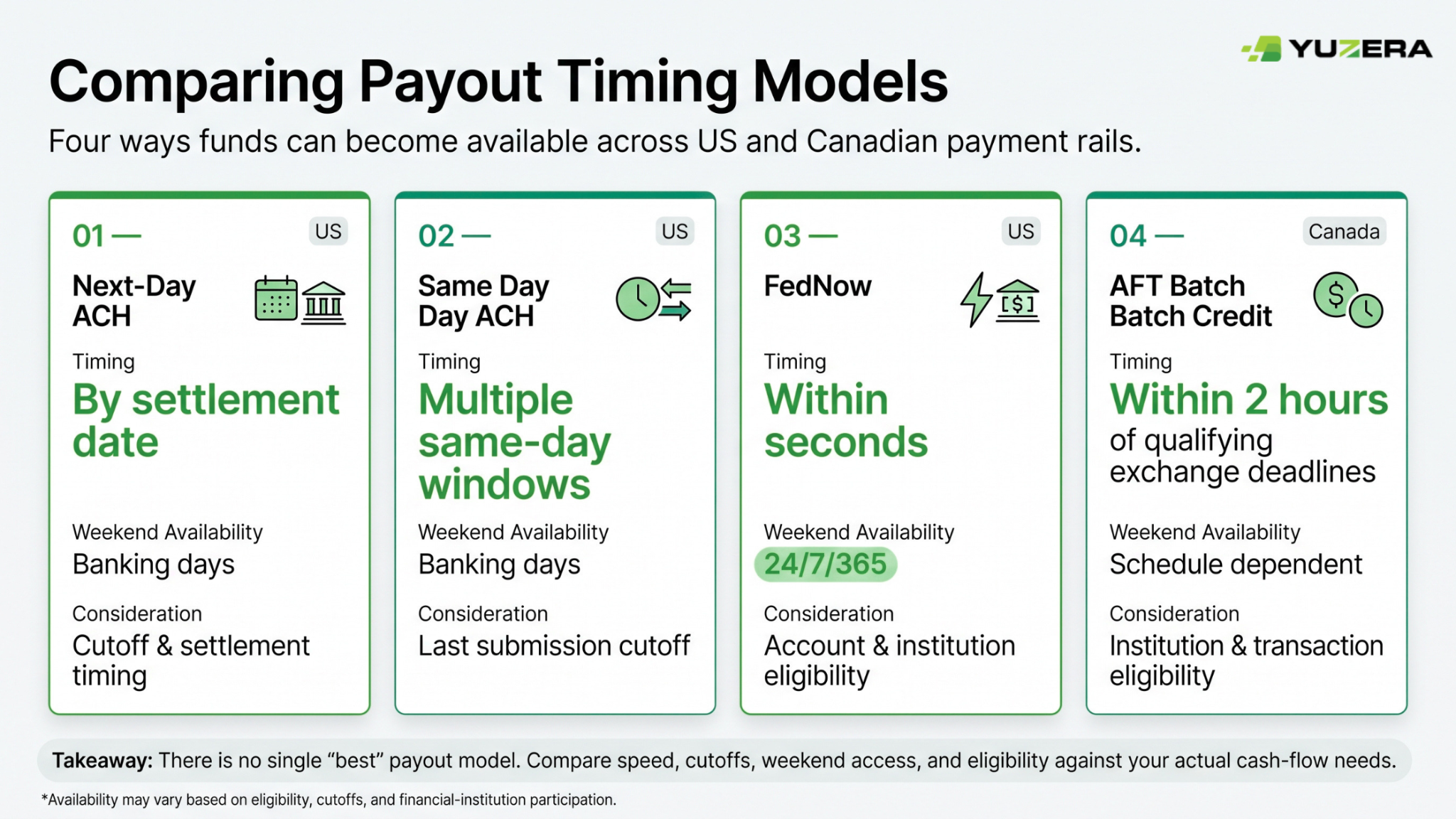
No timing model is universally best. The right one depends on your cash-cycle needs, geographic footprint, transaction pattern, operating calendar, account eligibility, and your platform’s ability to give real-time status and exception visibility. Predictable next-day deposits may perfectly serve a high-volume e-commerce operation with smooth outflows and deep reserves with a documented morning availability floor. A multi-location operator with weekend peaks and Monday payroll has a different calculus entirely, and may find instant-payment participation worth the eligibility work.
The table below compares four availability paths across the dimensions that actually drive merchant experience. Read the “reliability questions to ask” row as the practical output. Timing models do not fail because a merchant chose wrong on paper. They fail because eligibility conditions, cutoff sensitivity, or weekend treatment were never surfaced during evaluation.
Availability may depend on eligibility, cutoffs, and financial-institution participation in every one of these columns.
| Dimension | Scheduled or next-day ACH credit (US) | Same Day ACH credit (US) | FedNow instant payment (US) | Canadian AFT batch credit |
|---|---|---|---|---|
| Timing model | Settlement-date availability; from September 18, 2026, non-same-day ACH credits must be available by 9:00 a.m. local time on the settlement date | Three processing windows settling at 1:00 p.m., 5:00 p.m., and 6:00 p.m. ET | Messages processed continuously, every day of the year | Qualifying Canadian-dollar credits available no later than two hours after applicable exchange deadlines |
| Cutoff sensitivity | Yes; timing depends on the relevant settlement date | Yes; latest published submission deadline is 4:45 p.m. ET for the third window | Not governed by weekday-only windows, but participation and service availability still matter | Yes; tied to exchange deadlines and participating institutions |
| Availability standard | 9:00 a.m. local time on settlement date under the 2026 rule | 1:30 p.m., 5:00 p.m., or end of processing day depending on window | As soon as practicable and no later than a few seconds | No later than two hours after qualifying exchange deadlines, subject to exceptions |
| Weekends and holidays | Based on banking and settlement operations | Based on banking and settlement operations | Operates around the clock, including weekends and Federal Reserve holidays | Depends on the applicable institution and system schedule |
| Questions to ask | What is the deposit cutoff? What does next day mean in my local time? | Which transactions qualify? What happens after the last cutoff? | Which accounts are eligible? What protects continuous availability? | Which transactions and institutions qualify? What exceptions apply? |
A 12-step checklist for evaluating payout reliability and fraud resilience
-
Map your cash cycle first. Identify when payroll, inventory, supplier obligations, refunds, and rent occur relative to sales inflows. This determines whether next-day timing is sufficient, whether a same-day payout path is operationally meaningful, or if you need to prioritize rapid deposits across all channels.
-
Separate payment accepted from funds usable. Require a clear explanation of when a transaction is accepted, when it clears or settles, and when funds can actually be withdrawn. Payments Canada defines availability as the point a payee can withdraw and use funds.
-
Document required timing by channel. Assess in-person, e-commerce, invoicing, recurring billing, marketplace, and multi-location flows separately. Different business flows often need different timing models and different reconciliation views, and averaging them hides the constraint.
-
Request cutoff times in your operating time zone. Confirm what happens to transactions submitted before and after each same-day cutoff. The final Same Day ACH submission deadline is 4:45 p.m. ET, which lands mid-afternoon on the West Coast.
-
Confirm weekend and holiday treatment explicitly. Determine whether the relevant option follows business-day schedules or runs on instant-payment infrastructure. FedNow operating procedures cover weekends and Federal Reserve holidays; batch paths generally do not.
-
Identify eligibility and exception conditions before launch. Ask which transaction types, bank accounts, financial institutions, and use cases qualify for a given availability path. Canadian two-hour availability applies to qualifying transactions and participating institutions, with exceptions.
-
Evaluate fraud controls alongside payout communication. Ask how the platform handles suspicious activity and, specifically, what information a merchant receives when a transaction requires review. A reliable gateway should provide full transparency by default. A hold without a reason code is a process gap, not a security feature.
-
Assess the audit trail depth. Confirm that transaction, administrative, and exception events can be traced through logs and reporting. PCI DSS materials require audit logs supporting anomaly detection and forensic analysis, and that same data should surface operationally.
-
Review reconciliation capabilities concretely. Determine whether the POS and orchestration environment delivers remittance and status data that lets finance match funds movement to sales records. Enhanced ISO 20022 remittance data supports automated reconciliation and straight-through processing.
-
Ask for reliability and recovery metrics in writing. Request documented system-availability targets, recovery-time objectives, maximum tolerable downtime, and recovery-point objectives. The Bank of Canada recommends these specific measures for interconnected payment service providers.
-
Ask how incidents are tested, not just planned. Confirm documented incident-response procedures, scenario-based testing, and predetermined mitigation measures, such as manual processes or alternative solutions, to continue critical operations during a disruption.
-
Review third-party dependency management. Ask how the provider assesses and monitors the technology and financial-service parties behind your experience. Contractual arrangements alone are not sufficient controls; compensating controls and termination plans matter.
FAQ
Q1) What should I look for in a processor to ensure fast fund deposits?
Look for precise timing definitions rather than speed adjectives. A fast funds deposit payment processor should tell you the cutoff time in your local time zone, which transaction types and receiving accounts qualify, how weekends and holidays are treated, and what the availability standard is for each path. Ask whether the described timing refers to settlement or to funds you can actually withdraw, since Payments Canada notes availability can occur before participating institutions settle. Documented answers beat marketing language every time.
Q2) How does a payment gateway handle same-day payouts after the cutoff?
Transactions submitted after the final window move to the next available processing cycle. In the US, Nacha’s published schedule shows the third Same Day ACH window carries a 4:45 p.m. ET submission deadline, so anything after that does not qualify for same-day treatment that day. A provider offering a same-day payout should make this behavior visible in the dashboard rather than leaving merchants to infer it. Ask specifically what status a post-cutoff transaction displays and when it is expected to become available.
Q3) Are next-day deposits available on weekends and holidays?
It depends entirely on the underlying rail. ACH-based next-day deposits follow banking and settlement operations, so weekend and holiday behavior differs from weekdays. Instant-payment infrastructure works differently: FedNow operating procedures state the service processes messages continuously, every day of the year, including weekends and Federal Reserve holidays. Payments Canada similarly notes cheques deposited on a Saturday are not cleared until the following Monday evening. Confirm which path your volume actually travels before assuming calendar coverage.
Q4) What should I ask a processor about next-day deposit guarantees?
Ask for the availability standard, not an estimate. From September 18, 2026, a Nacha rule requires receiving financial institutions to make all non-same-day ACH credit entries available for withdrawal by 9:00 a.m. local time on the settlement date. That gives you a concrete benchmark to test against. A next-day deposit payment processor should also explain what conditions could push a deposit outside the normal path, including risk review, compliance screening, or a dishonored pre-authorized debit.
Q5) How do I evaluate a reliable payment processor in Canada?
Use the supervisory framework as your question set. The Bank of Canada requires payment service providers subject to the Retail Payment Activities Act to mitigate operational risk, respond to incidents, and safeguard end-user funds; these requirements have been in force since September 8, 2025. Ask whether the provider holds end-user funds and, if so, how it structures safeguarding. For evaluating a reliable payment processor Canada-wide, also request availability targets, recovery-time objectives, and evidence of scenario-based testing.
Works Cited
- Bank of Canada. “Operational Risk and Incident Response.”
- Bank of Canada. “Supervisory Framework: Retail Payments.”
- Canadian Anti-Fraud Centre. “Fraud Prevention Month.”
- Canadian Anti-Fraud Centre, Competition Bureau, and RCMP. “Fraud Prevention News Release.”
- Federal Reserve Banks. “2025 Report on Employer Firms.” Small Business Credit Survey.
- Federal Reserve Financial Services. “FedNow Service Operating Procedures.”
- Federal Reserve Financial Services. “About the FedNow Service.”
- Federal Reserve Financial Services. “FedNow Service Participants and Organizations.”
- Federal Trade Commission. “FTC Testifies Before Joint Economic Committee on Agency’s Efforts to Combat Fraud.”
- Nacha. “Expanding Same Day ACH.”
- Nacha. “Funds Availability Requirements for Non-Same-Day Credit Entries.”
- Nacha. “Same Day ACH Payment Limit Increase to $10 Million.”
- Nacha. “Same Day ACH Schedules and Funds Availability.”
- Office of Foreign Assets Control. “Instant Payment Systems Compliance Guidance.”
- Office of Foreign Assets Control. “Guidance on Potential Name Matches.”
- Payments Canada. “Glossary.”
- Payments Canada. “ISO 20022.”
- Payments Canada. “Modernizing Batch Payments: Two-Hour Funds Availability.”
- Payments Canada. “Pre-Authorized Debit.”
- Payments Canada. “Public Consultation: Real-Time Rail Legal Framework.”
- Payments Canada. “Retail Batch Payment System.”
- PCI Security Standards Council. “PCI DSS v4.0 Resource Hub.”
- PCI Security Standards Council. “PCI DSS v4.0 SAQ C.”
- Statistics Canada. “Business Financing Analysis.”