
Retail payment processing stopped being a single-channel problem years ago. It is the set of technology and workflows a merchant uses to accept, record, and reconcile sales across every place a customer buys, and most merchants now run at least three of those places at once: a store, a website, and a marketplace listing, with wholesale orders arriving on the side. In the United States, seasonally adjusted retail e-commerce sales reached $340.2 billion in Q2 2026, up 12.2% year over year and representing 17.1% of total retail sales, according to the U.S. Census Bureau’s quarterly e-commerce report. That share is too large to run on a second, disconnected stack. Here is what unification actually requires.
TL;DR
- Retail e-commerce hit $340.2 billion in Q2 2026, 17.1% of total U.S. retail sales, which makes online a primary channel rather than an add-on to the store system.
- GS1 confirms the same GTIN identifies a product in-store and online, so shared identifiers, not duplicated catalogs, are the foundation of a unified system.
- NRF estimates 19.3% of online sales were returned in 2025, and 71% of consumers say a poor returns experience makes them less likely to return.
- PCI DSS v4.0.1 e-commerce requirements took effect March 31, 2025, and outsourcing checkout components does not remove merchant responsibility for oversight.
How Retail Payment Processing Works When In-Store and Online Run as One System
Payment processing for retail stores works as one system when in-person and online sales share the same product identities, order records, customer records, and transaction references, while keeping channel-specific rules intact. It is not one database that erases the differences between a store aisle and a marketplace listing; it is one authoritative record per object, with rules about who may write to it.
Start by inventorying every channel and operational system you run: physical POS, online storefront, marketplaces, wholesale ordering, inventory, fulfillment, returns, accounting exports, fraud tools, and support tools. Then assign a system of record for each object. Products, prices, inventory, customers, orders, returns, and payment references each need one authoritative owner. Most integration failures trace back to two tools quietly overwriting the same field.
Product identity comes next, and it comes before any connector is switched on. GS1’s barcode identification guide states that every product sold online or in stores needs a unique identification number, and defines the Global Trade Item Number as an identifier for a trade item that can be priced, ordered, or invoiced anywhere in the supply chain.
Yuzera is a tech-forward fintech and omni-solutions brand focused on POS technology, payment orchestration, e-commerce scalability, and value-added merchant tools. Our point-of-sale solutions cover in-person, online, and mobile business models, with inventory management and customer-relationship tools built into the same retail stack.
What Should an In-Store Processing Setup Include Once That Business Also Sells Online?
A payment solution for brick and mortar business that also sells online needs two separate security paths designed deliberately, not one path stretched to cover both. Card-present acceptance and online checkout have genuinely different attack surfaces, and treating them as interchangeable is how merchants end up with gaps in brick and mortar payments.
On the counter side, evaluate whether a PCI-listed point-to-point encryption solution suits your brick and mortar payments. The PCI Security Standards Council’s P2PE security standard describes P2PE as protecting account data from the point of capture in the merchant device until it reaches the secure decryption environment, making the data unreadable in between and potentially reducing applicable PCI DSS requirements, though not removing all of them.
Document who owns, deploys, replaces, and supports each terminal while you are at it.
On the web side, the obligations are active and ongoing. PCI SSC’s 2025 e-skimming security guidance points to requirements 6.4.3 and 11.6.1, which cover authorizing payment-page scripts, verifying their integrity, maintaining a script inventory, and monitoring for tampering with payment pages and security-impacting HTTP headers. The current PCI DSS v4.0.1 e-commerce requirements became effective on March 31, 2025, per the council’s SAQ update guidance.
Tie your e-commerce and brick and mortar payments together with tokens rather than card data. PCI SSC’s tokenization security guidelines define tokenization as replacing a primary account number with a surrogate value, and note the guidance does not replace PCI DSS requirements. Build refunds, exchanges, and support workflows around those references.
How Does Omnichannel Payment Processing Handle Returns and Post-Purchase Work?
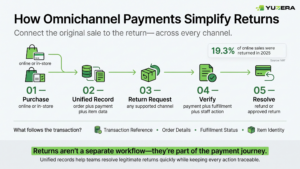
This unified approach handles returns by carrying transaction references, order details, fulfillment status, item identity, and staff actions across channels so a store associate can resolve an online purchase at the counter. Returns are not an edge case you connect after the sales channels work. They are a core workflow, and omnichannel payments that skip them fail in the first week of live use.
The volume settles the argument. The National Retail Federation’s retail returns landscape estimates that 19.3% of online sales were returned in 2025. Retailers expect 15.8% of annual sales to be returned across the industry, totaling $849.9 billion, according to the NRF’s retail returns release. As Katherine Cullen, NRF Vice President of Industry and Consumer Insights, puts it: “Returns are no longer the end point of a transaction.”
The stakes run in both directions. NRF reports that 71% of consumers say they are less likely to shop with a retailer again after a poor returns experience, while 9% of all returns in 2025 were estimated to be fraudulent. A unified return process has to be fast for the honest customer and auditable for everyone else, which means the record the associate sees must include the original channel, the payment reference, and the fulfillment state.
Risk controls belong in the same design. NIST’s National Cybersecurity Center of Excellence, in its e-commerce authentication guide, describes work with retail stakeholders on risk-based scenarios that trigger multifactor authentication to reduce fraudulent online purchases, noting the rise in fraudulent card-not-present transactions as chip-based point-of-sale controls spread.
What Does a Marketplace Payment Gateway Need to Connect Safely?
A payment gateway for marketplace sellers needs shared product identifiers, governed APIs, and a documented third-party responsibility model, because every marketplace connection is another endpoint with its own credentials and its own failure modes. A marketplace payment gateway that simply pushes listings without record-level authorization controls expands your risk surface faster than it expands your revenue.
Identifiers come first. GS1’s GTIN channel guidance states plainly: “Yes, the same GS1 GTIN™ uniquely and clearly identify your product whether you sell it online or in-store.” What does change identity is a real product difference. GS1 Canada’s omnichannel identification guide says a separate GTIN is required whenever a trade item differs in a way relevant to the trading process, including name, brand, type, variety, quantity, style, colour, or size. Marketplace merchandising copy is not a new product; a new colourway is.
Then govern the connections. OWASP’s API inventory guidance lists Improper Inventory Management as API9:2023 and warns that old API versions or endpoints left running without patches can enable unauthorized access or data leakage. OWASP’s object authorization guidance adds that every endpoint receiving an object ID must enforce object-level authorization checks rather than inferring permission from a login.
Third parties need oversight too. PCI SSC’s third-party oversight FAQ says organizations must conduct due diligence, identify which PCI DSS responsibilities apply to each party, and monitor relevant providers at least annually. Our Full-Stack e-commerce setup, covering website design and development, shopping-cart integration, and a custom marketplace payment gateway, is built so those connection points stay documented rather than improvised.
How Does a Wholesale Payment Solution Fit Alongside Retail and E-Commerce Channels?
A seller’s payment solution for wholesale businesses fits alongside retail and online channels by mapping business-to-business document flows into the same operational view as direct retail sales, without forcing purchase orders through a consumer checkout. A wholesale payment solution runs on agreed terms, structured documents, and delayed settlement, so the integration work is about document mapping rather than cart design.
X12’s supply chain flow sets out the sequence. The 850 Purchase Order establishes the legal purchase agreement, the 856 Ship Notice/Manifest connects the order to delivery, the 810 Invoice covers goods and services, and the 820 Payment Order/Remittance Advice carries payment and remittance information. X12 describes the 856 as “a critical transaction that ties the order to the delivery process,” which is exactly the link a merchant needs when a wholesale shipment draws down the same inventory pool the store sells from.
Shared identifiers pay off again here. X12 notes that when trading partners have already exchanged item and party information and use unique identifiers, the 850 Purchase Order can require limited or no descriptive text, which reduces transaction-set complexity and increases throughput. The SKU and GTIN discipline you apply for retail payment processing directly shortens your B2B onboarding.
A common product-data model supports all of it, serving as the foundation for scalable omnichannel payments. GS1’s global data model defines foundational product attributes needed to “list, order, store, move and sell products,” and is intended to improve product-data accuracy for omnichannel payments. Our virtual-terminal option handles transactions and invoices through a digital interface, complementing your core retail payment processing without bending the checkout experience out of shape.
Before rolling anything out, pilot the exceptions: split fulfillment, inventory adjustments, online-to-store returns, partial shipments, your wholesale payment solution, and outage fallback.
FAQ
Q1) What is the best checkout setup for merchants that sell in more than one place?
Transaction processing across multiple channels works best when one authoritative record exists per product, order, customer, and return, shared by every platform. Inventory each system first, then assign owners before connecting anything. Standardize SKUs and GTINs so the same item is recognizable across online carts, brick and mortar payments, and partner channels. Test exception flows before migration, not after.
Q2) What should I look for in a physical point-of-sale integration?
An effective in-person system should cover card-present acceptance, an online path, and the reconciliation between them. Consider PCI-listed P2PE for brick and mortar payments, since PCI SSC says it protects account data from the merchant device to the secure decryption environment. Document terminal ownership, deployment, and support. Confirm your validation obligations with the organizations managing your compliance program.
Q3) How do omnichannel payments work?
Omnichannel payments require the coordination of in-store, online, mobile, marketplace, and wholesale transactions through shared product identities, order records, and payment references. This setup lets a store associate resolve an online order and keeps inventory accurate across locations. Returns are the real test: NRF estimated 19.3% of online sales were returned in 2025, so cross-channel return visibility is essential.
Q4) Do sellers need a dedicated marketplace payment gateway?
A reliable marketplace payment gateway connects to listing platforms through governed, inventoried APIs with record-level authorization. Use the same GTIN across store, site, and marketplace listings, and create a new identifier only when the product itself differs. OWASP warns that unretired API versions can leak sensitive data. Keep written responsibility agreements with every connected provider.
Q5) How is a wholesale payment solution different from retail checkout?
A wholesale payment solution processes structured B2B documents rather than consumer carts. X12 defines the 850 Purchase Order, 856 Ship Notice/Manifest, 810 Invoice, and 820 Payment Order/Remittance Advice as the core sequence. Those flows should draw on the same inventory and product master as retail sales while preserving their own terms, approvals, and settlement timing.
One More Responsibility You Cannot Outsource
Whatever architecture you choose, the obligation stays partly with you. The PCI Security Standards Council states in its outsourced payment responsibilities FAQ: “PCI DSS is intended for any entity that stores, processes, or transmits cardholder data, regardless of whether these activities are conducted directly or by a third-party service provider.” Merchants who outsource may have fewer directly applicable requirements, but they remain responsible for provider due diligence, written responsibility agreements, and annual monitoring. Confirm your validation obligations with your acquirer or payment brand, and give data-sharing and cross-border contracts a legal review.
Works Cited
- GS1. “Get Barcodes.”
- GS1. “GS1 Global Data Model.”
- GS1. “I Started Selling in Physical Stores and Now I Plan to Sell Online. Can I Use the Same GS1 GTIN?” GS1 Support.
- GS1 Canada. Canadian Omni-Channel Implementation Guidelines.
- National Institute of Standards and Technology. “Multifactor Authentication for E-Commerce.” National Cybersecurity Center of Excellence.
- National Retail Federation. “2025 Retail Returns Landscape.”
- National Retail Federation. “Consumers Expected to Return Nearly $850 Billion in Merchandise in 2025.”
- OWASP Foundation. “API1:2023 Broken Object Level Authorization.” OWASP API Security Top 10.
- OWASP Foundation. “API9:2023 Improper Inventory Management.” OWASP API Security Top 10.
- PCI Security Standards Council. “Does PCI DSS Apply to Merchants Who Outsource All Payment Processing Operations?“
- PCI Security Standards Council. “FAQ 1312: Third-Party Service Provider Oversight.”
- PCI Security Standards Council. “Important Updates Announced for Merchants Validating to Self-Assessment Questionnaire A.”
- PCI Security Standards Council. “New Information Supplement: Payment Page Security and Preventing E-Skimming.”
- PCI Security Standards Council. “Point-to-Point Encryption (P2PE).”
- PCI Security Standards Council. Tokenization Product Security Guidelines.
- U.S. Census Bureau. “Quarterly Retail E-Commerce Sales.”
- X12. “Supply Chain Flow.”