
PCI compliance is the set of technical and operational practices that apply to every business that stores, processes, or transmits cardholder data, and it is the foundation of any secure payment gateway. It is not a one-time form you file and forget. It defines how your payment environment is built, monitored, and validated, and it directly affects whether buyers trust you enough to complete checkout. For merchants running both in-store and online, understanding payment compliance is the difference between a setup that holds up under pressure and one that becomes a liability. This guide breaks down what the standard covers, who it applies to, and what a compliant setup looks like in practice.
TL;DR
- PCI DSS applies to all entities that store, process, or transmit cardholder data, according to the PCI Security Standards Council. There is no size exemption.
- PCI DSS v4.0 retired on December 31, 2024, leaving v4.0.1 as the only active version, and 51 future-dated requirements that were “best practices” became mandatory after March 31, 2025, per the PCI SSC.
- 19% of shoppers abandoned checkout in the last three months because they did not trust the site with their card information, based on Baymard’s 2025 survey of 1,026 respondents.
- The global average cost of a data breach hit USD 4.44M in 2025, and the U.S. average reached USD 10.22M, according to the IBM Cost of a Data Breach Report 2025.
- Breaches involving a third party now account for 48% of all breaches, per the Verizon 2026 DBIR, which makes vendor selection part of your security posture.
What Is PCI Compliance, and Who Does It Apply To?
PCI compliance means meeting the Payment Card Industry Data Security Standard (PCI DSS), a framework that applies to all entities that store, process, and/or transmit cardholder data. The PCI Security Standards Council states that the standard covers technical and operational practices for system components included in or connected to environments that handle cardholder data. In plain terms, if card data enters, moves through, or is stored on your systems, or if your systems touch systems that handle card data, PCI DSS applies to you.
This is broader than most merchants assume. Visa confirms that PCI DSS compliance is required of all entities that store, process, or transmit cardholder data, including financial institutions, merchants, and service providers. There is no carve-out for small businesses or for companies that only take a few cards online.
It also helps to know who does what. The PCI SSC owns, maintains, and manages the standard and all its supporting documents, while the card brands manage compliance enforcement and validation, according to Visa. The Council itself notes that it does not enforce compliance; instead, you work with the organizations managing your compliance program, typically your acquirer and the payment brands, for validation and reporting responsibilities, as described in PCI SSC guidance. Understanding this split matters, because your specific obligations are ultimately set by your acquirer and the brands, not by a generic checklist.
What Version of PCI DSS Is Active Right Now?
PCI DSS v4.0.1 is the only active version of the standard. The PCI SSC published v4.0.1 as a limited revision to v4.0, adding clarifications with no additional or deleted requirements. PCI DSS v4.0, first published in March 2022, retired on December 31, 2024. A program that still references v4.0 documentation, or v3.2.1 which retired on March 31, 2024, is working with a standard that is no longer supported.
The bigger operational shift is the future-dated requirements. PCI DSS v4.x introduced 64 new requirements, 51 of which were future-dated. According to the PCI SSC, those requirements were treated as best practices only until March 31, 2025. After that date, they must be fully considered in a DSS assessment. Merchants who treated the transition as optional now have real obligations to meet.
What Does PCI DSS Actually Cover?
PCI DSS covers twelve high-level requirement groups spanning network security, data protection, access control, monitoring, and governance. Rather than a single technical rule, managing payment gateway regulatory requirements involves a layered program. The requirement headings in the current SAQ D for Service Providers give a clear map of the domains:
- Install and Maintain Network Security Controls
- Apply Secure Configurations
- Protect Stored Account Data
- Protect Cardholder Data with Strong Cryptography During Transmission
- Protect All Systems and Networks from Malicious Software
- Develop and Maintain Secure Systems and Software
- Restrict Access to System Components and Cardholder Data
- Identify Users and Authenticate Access
- Restrict Physical Access to Cardholder Data
- Log and Monitor All Access
- Test Security Systems and Networks Regularly
- Support Information Security with Organizational Policies and Programs
Read together, these domains describe a payment environment that is segmented, hardened, encrypted, monitored, and governed by written policy. Meeting the regulatory requirements payments merchants face is less about any single control and more about proving that all of these layers work together and keep working.
How Do You Define the Scope of a Secure Payment Environment?
Scope is the set of systems that fall under PCI DSS, and the correct starting assumption is that everything is in scope until you prove otherwise. The PCI SSC scoping guidance is explicit on this point: begin by assuming that every system is in scope, then verify what can be safely excluded. Getting scope wrong is one of the most common and expensive mistakes because an under-scoped assessment leaves gaps that attackers can exploit.
Does Network Segmentation Reduce Scope?
Segmentation can reduce the number of system components in scope, but it is not a silver bullet. The same PCI SSC guidance warns that attackers frequently pivot from systems assumed to be out of scope into the cardholder data environment (CDE). Segmentation only helps if it is implemented correctly and validated to confirm it actually isolates the CDE. Without proper segmentation, PCI SSC FAQ 1115 states that the entire network is in scope for PCI DSS.
Does Encrypting Cardholder Data Remove It From Scope?
Encryption alone does not remove your environment from PCI scope. The PCI SSC explains that using encryption does not eliminate the need for PCI DSS because the environment can remain in scope depending on how cardholder data is stored or handled. The Council lists specific in-scope examples even when encryption is used: systems that perform encryption, decryption, or key management; encrypted data co-located with decryption keys; and encrypted data accessible to an entity that also has key access. The takeaway is straightforward: encryption is a control, not an exit strategy from compliance.
Why Is E-Commerce Script Integrity Now a Core Requirement?
Payment page and script integrity became a mandatory focus because e-skimming attacks have increased significantly. The PCI SSC reports that breaches during e-commerce transactions have increased and that scripts running in the consumer’s browser are a significant target for attackers seeking to steal card data. This is the threat model behind two requirements every online merchant should understand.
Requirements 6.4.3 and 11.6.1 focus on making sure payment page scripts are authorized, checked for integrity, and monitored for tampering, and on preventing unauthorized changes to web pages, according to the PCI SSC. The guidance is intended for any entity processing payment card transactions through e-commerce via embedded iframes or with a web page that can impact the security of e-commerce payments. Analytics or marketing scripts running on a checkout page are part of the attack surface, and these requirements are how that risk gets managed. Merchants building an online checkout stack can review how this fits into a broader secure payment gateway strategy on the Yuzera e-commerce gateways page.
What Does a Compliant Setup Look Like in Practice?
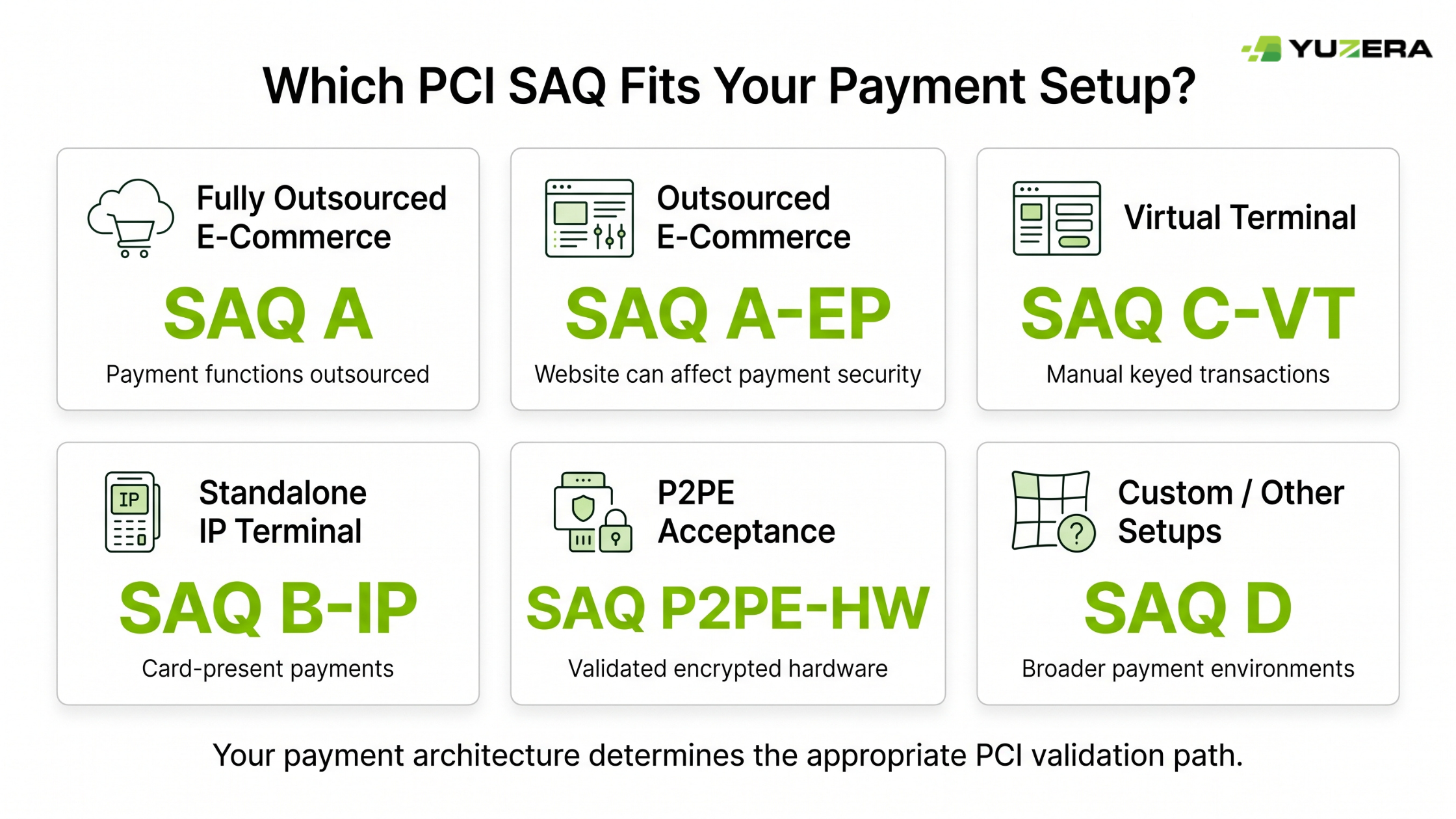
In the context of payment compliance, a compliant setup depends on how a business processes card payments. PCI DSS uses Self-Assessment Questionnaires (SAQs) to match the validation path to the acceptance architecture. According to the PCI SSC, SAQs are self-validation tools consisting of yes/no questions for each applicable requirement; if an answer is “no,” a business may need to document a remediation date and the planned actions. The Council published v4.0.1 SAQs on October 15, 2024, aligning them to v4.0.1 and clarifying eligibility for SAQs A, A-EP, and C-VT, per the PCI SSC bulletin.
The table below maps common acceptance models to their SAQ path. Every row reflects the official PCI SSC SAQ descriptions.
| Setup | SAQ Path | Best Fit | Key Condition |
|---|---|---|---|
| Fully outsourced e-commerce | SAQ A | Card-not-present merchants | All cardholder data functions outsourced to a compliant payment processor and third parties; no electronic storage, processing, or transmission on merchant systems |
| Outsourced processing, site affects transaction security | SAQ A-EP | E-commerce only | Website does not directly receive card data but can impact payment transaction security; processing outsourced to a compliant payment processor |
| Internet virtual terminal, keyed entry | SAQ C-VT | Manual, one transaction at a time | Merchant keys transactions into a virtual terminal hosted by a validated third-party service provider; no electronic card data storage |
| Standalone IP terminals | SAQ B-IP | Card-present only | Only PTS-approved standalone terminals over IP; no electronic card data storage |
| P2PE-managed acceptance | SAQ P2PE-HW | Card-present only | Only hardware terminals within a validated, PCI SSC-listed P2PE solution; no electronic card data storage |
| Everything else | SAQ D | Custom integrations, broader exposure | Applies to all merchants not covered by the narrower SAQ definitions |
What Changed for SAQ A?
SAQ A eligibility tightened because of the script-integrity requirements. The PCI SSC removed Requirements 6.4.3 and 11.6.1 from SAQ A, along with the 12.3.1 targeted risk analysis that supported 11.6.1. In their place, the Council added a new eligibility criterion: SAQ A merchants must confirm their site is not susceptible to script attacks that could affect their e-commerce systems. This can be satisfied either by deploying the relevant techniques directly or by obtaining confirmation from a PCI compliant payment processor, or using a PCI DSS-compliant embedded iframe, implemented per that provider’s instructions. In practice, this means fully outsourced no longer means hands-off. Merchants weighing in-store options can review the Yuzera face-to-face solutions page and the terminals overview to see how acceptance hardware maps to these paths.
Who Decides How You Validate, and How Often?
The acquirer and the payment brands decide the validation and reporting method, not the PCI SSC. According to PCI SSC FAQ 1473, the payment brands and acquirers, described as compliance-accepting entities, determine the validation and reporting methods, such as whether a business completes an SAQ or a Report on Compliance (ROC). Visa adds that issuers and acquirers are responsible for ensuring their merchants and service providers comply, and that they must ensure their service providers demonstrate PCI DSS compliance at least every 12 months.
Merchant levels drive the specifics. The Visa PCI DSS Validation Best Practice Review outlines validation minimums by level:
| Visa Merchant Level | Transaction Volume | Typical Validation |
|---|---|---|
| Level 1 | 6M+ Visa transactions | ROC + AOC |
| Level 2 | 1M–6M | SAQ + AOC |
| Level 3 | 20k–999,999 e-commerce | SAQ + AOC |
| Level 4 | Less than 20k e-commerce, other less than 1M total | SAQ or alternative defined by acquirer |
Mastercard similarly outlines merchant levels and notes that Level 4 merchants must comply with PCI DSS. However, Mastercard leaves formal validation reporting to the acquirer’s discretion except as required by law or regulation. Because these obligations, including specific regulatory requirements payments networks enforce, are contractual and vary by program, geography, and level, merchants should confirm exact requirements with their acquirer before assuming a path.
Why PCI Compliance Is Not Checkbox Security
Treating compliance as a paperwork exercise ignores the economics of a breach and the way modern attacks actually happen. The IBM Cost of a Data Breach Report 2025 puts the global average breach cost at USD 4.44M, with the U.S. average at USD 10.22M. Those figures dwarf the cost of building the program correctly the first time.
The attack patterns reinforce why the standard’s layered approach matters. The Verizon 2025 DBIR found that third-party involvement in breaches doubled to 30%, with credential abuse accounting for 22% of breaches and vulnerability exploitation for 20%. The Verizon 2026 DBIR went further: vulnerability exploitation became the top entry point at 31% of breaches, surpassing stolen credentials for the first time in the report’s history, and third-party-involved breaches climbed to 48% of all breaches. Every one of those vectors maps to a PCI DSS domain, from patching and secure development to access control and vendor governance. Compliance with payment regulations is a genuine risk-reduction program when it is treated as one.
A Practical Checklist for a Secure Payment Setup
Use this ordered checklist to move from ad hoc controls to a defensible program. Each step ties to a sourced PCI concept.
- Map every payment data flow. Trace where card data enters, moves, and rests, including logs, backups, and support tools. The PCI SSC scoping guidance says to assume everything is in scope until verified otherwise.
- Define the CDE and connected-to systems. Anything that can reach the CDE is in scope. Document it before attempting to reduce it.
- Decide whether to segment, then validate it. Segmentation can cut scope, but the PCI SSC stresses it is not a silver bullet. Test that isolation actually holds.
- Confirm encryption does not falsely narrow scope. Key management systems and co-located keys keep data in scope, per the PCI SSC.
- Select the right SAQ or ROC path. Match the acceptance model to an SAQ using the PCI SSC self-assessment page, then confirm with the acquirer, since PCI SSC FAQ 1473 makes clear the brands and acquirers set the method.
- Operationalize script and payment-page governance. For e-commerce, build inventory, authorization, integrity checks, and tamper monitoring consistent with the intent of 6.4.3 and 11.6.1, as described by the PCI SSC.
- Treat third parties as part of the risk surface. With third-party-involved breaches at 48% in the Verizon 2026 DBIR, vet vendors and require evidence of their compliance.
- Run PCI as an ongoing program, not an annual scramble. To meet evolving regulatory requirements, payments professionals track version changes and future-dated deadlines; the PCI SSC has confirmed that future-dated requirements are now mandatory.
- Re-scope whenever the environment changes. New payment channels, scripts, or integrations can bring systems back into scope.
- Align security with the checkout experience. Build controls for your secure payment gateway that reduce risk without adding needless friction, so trust and conversion move in the same direction.
Does PCI Compliance Actually Affect Buyer Trust at Checkout?
Yes, and the link is measurable. Baymard reports that 19% of users abandoned a checkout in the last three months specifically because they did not trust the site with their credit card information, based on a 2025 survey of 1,026 respondents representing the average U.S. adult internet population. That is roughly one in five lost sales tied directly to perceived security. Against a global average cart abandonment rate of 70.19%, per Baymard’s checkout usability research, trust is one of the few causes of abandonment fully within a merchant’s control.
A secure payment gateway and a visibly trustworthy checkout are two sides of the same investment. The controls that satisfy payment compliance, from strong cryptography in transit to script integrity monitoring, are the same ones that make a checkout feel safe. This is where a technology-forward setup pays off twice: it reduces breach risk and abandonment. Yuzera approaches payment technology as a solutions problem, pairing proprietary POS software and hardware with orchestration and value-added services so security and conversion are designed together rather than bolted on.
FAQ
Q1) What makes a payment processor a compliant payment processor?
A compliant payment processor is a service provider that meets PCI DSS across the systems it uses to store, process, or transmit cardholder data on a merchant’s behalf. Visa requires that acquirers ensure their service providers demonstrate compliance at least every 12 months. Outsourcing to a compliant provider narrows a merchant’s own scope. Still, the merchant remains responsible for validating their setup and, for e-commerce, confirming their site is not susceptible to script attacks under the updated SAQ A criteria.
Q2) What should merchants look for when evaluating a secure payment gateway in Canada?
Merchants should look for strong cryptography to protect cardholder data in transit, documented governance for payment-page scripts consistent with PCI DSS 6.4.3 and 11.6.1, and a provider that supports the correct SAQ path. Because the PCI SSC encourages awareness of nuances in local laws and regulations, handling payment solution compliance in Canada requires merchants to also confirm how privacy and breach-notification rules interact with PCI obligations, ideally with counsel for cross-border operations.
Q3) How should merchants approach payment compliance if operating in both Canada and the US?
Cross-border payment compliance starts with the same PCI DSS baseline that applies everywhere, then layers in local considerations. The PCI SSC notes that local laws and regulations can affect how the standards apply, and card brand rules can vary by program and geography. Cross-border merchants using a compliant payment processor should treat PCI DSS as the floor, then verify additional privacy, breach-notification, and contractual obligations with acquirers in each country before finalizing their architecture.
Q4) What are the main regulatory requirements payments processors demand for an online store?
The core regulatory requirements payments environments must follow come from PCI DSS, and the validation rules an acquirer and card brands enforce. In practice that means defining scope, protecting cardholder data with strong cryptography, controlling access, monitoring the environment, and, for e-commerce, meeting the script-integrity requirements the PCI SSC made mandatory after March 31, 2025. The specific validation method, whether SAQ or ROC, is set by the acquirer per PCI SSC FAQ 1473.
Q5) How does a merchant demonstrate ongoing adherence to PCI rules after the first assessment?
Demonstrating this ongoing adherence means running PCI DSS as a continuous program rather than an annual event. Revalidation should follow the cadence the acquirer requires, with re-scoping whenever channels, scripts, or integrations change, and close tracking of version and deadline changes, such as the future-dated requirements that became mandatory in 2025 per the PCI SSC. Given that third-party-involved breaches reached 48% in the Verizon 2026 DBIR, keeping vendor evidence up to date should be part of the recurring proof.
Works Cited
- PCI Security Standards Council. “Merchants.“
- Visa. “Security & Compliance.“
- PCI Security Standards Council. “FAQ 1473.“
- PCI Security Standards Council. “New Information Supplement: Payment Page Security and Preventing E-Skimming.“
- PCI Security Standards Council. “Just Published: PCI DSS v4.0.1.”
- Baymard Institute. “Checkout Usability Research & Statistics.“
- IBM. “Cost of a Data Breach Report 2025.“
- Verizon. “Data Breach Investigations Report (DBIR) 2025 & 2026.“