
A scalable payment solution is payment infrastructure that expands with order volume, sales channels, and geographies without forcing a disruptive rebuild. For growing online stores, that infrastructure has become core, not a back-office afterthought. Statistics Canada reported 2024 e-commerce revenue at $73.7 billion, which means the checkout and payment stack behind those orders is now load-bearing. The setup that comfortably handles today’s traffic can quietly turn into tomorrow’s bottleneck. This guide covers the warning signs, the architecture decisions that keep a store flexible, and how to treat scalability as a proactive choice rather than a reactive scramble.
TL;DR
- Canadian e-commerce revenue reached $73.7 billion in 2024, making payment infrastructure a growth-critical system rather than a utility. (Meanwhile, U.S. e-commerce hit $326.7 billion in Q1 2026, reinforcing this North American trend).
- 18% of U.S. online shoppers abandon orders because the checkout is too long or complicated, and the average checkout includes 23.48 form elements, compared with an ideal of 12 to 14.
- 83% of online shoppers have abandoned a cart, with 49% citing inconvenient friction points such as not having payment info handy.
- Visa reports that tokenization delivered an authorization lift of nearly 5% and more than $110 billion in incremental sales in 2024.
- The global payment orchestration platform market was $1,386.9 million in 2023 and is projected to reach $6,520.4 million by 2030 at a 24.7% CAGR, a signal that resilience and routing have become their own category.
Why is a scalable payment solution a now-problem, not a later one?
Scalable payments are now a problem because e-commerce volume keeps compounding, and checkout absorbs every bit of that growth. For merchants operating in Canada, the signals are clear. Payments Canada reported that Canada reached 22.5 billion retail payment transactions in 2024 totaling $12.2 trillion, with credit cards accounting for 32% of transactions and e-commerce representing 6% of total retail sales. Statistics Canada put 2024 retail spending at $865.2 billion, of which $73.7 billion was e-commerce revenue. E-commerce is still a minority of total retail in Canada, which is exactly why merchants building for it now are positioning ahead of the curve rather than behind it. A turnkey e-commerce setup planned around growth beats one patched together under pressure.
Growth at that pace does not stall to wait for infrastructure to catch up. Across the border, the U.S. Census Bureau put retail e-commerce at $326.7 billion for Q1 2026, up 2.7% over the prior quarter and 9.7% year over year.
The composition of payments is shifting too. The 2025 Federal Reserve Payments Study, covering calendar year 2024, found that credit cards grew the most in number among payment types, marking the first three-year period since 2000 in which credit card payments grew more than debit card payments. When the dominant payment type is also the fastest-growing, the systems that authorize, tokenize, and recover transactions carry more weight each quarter.
How do you know a store has outgrown its starter setup?
A store has outgrown its starter setup, signaling the need for a scalable payment solution, when revenue leaks show up in checkout data, decline handling, and operational load, all at once. The clearest early signal is checkout abandonment tied to friction that can be measured and fixed.
Baymard Institute found that 18% of U.S. online shoppers have abandoned an order due to a checkout that was too long or complicated. The same research benchmarks the average U.S. checkout flow at 23.48 form elements shown by default, or 14.88 counting only form fields, while an ideal checkout can be as short as 12 to 14 form elements, roughly 7 to 8 fields. If a checkout sits near the average and conversion is soft, that gap is a bottleneck hiding in plain sight that a modern turnkey e-commerce setup can fix.
Payment friction is distinct from UX friction, and it is measurable. Mastercard reported that 83% of online shoppers have abandoned a shopping cart, with 49% doing so because of inconvenient friction points including not having payment info handy, 40% because they were required to enter or save too much information, and 25% because checkout took too long. The same report notes that nearly three-quarters (72%) of shoppers always or often manually enter payment information at checkout. Every manual entry is a chance to abandon, mistype, or worry about compromise. Shopping is easy; paying is still hard without an all-in-one payment platform.
There is a second signal that has nothing to do with UX: reconciliation and failure handling. As order volume climbs, the manual work of matching transactions, chasing failed payments, and reporting across channels no longer scales linearly. When a team spends more time managing exceptions than growing the business, the setup has become the constraint, signaling it is time to upgrade to a robust SaaS payment gateway.
What should an all-in-one payment platform actually give a merchant as it scales?
An all-in-one payment platform should provide a merchant with flexibility at checkout, resilience behind it, and a credential strategy that scales with growth. The point of consolidation is not fewer logins. It is fewer places where scale breaks.
Yuzera approaches this as a turnkey e-commerce setup and omni-solutions provider with proprietary POS software and hardware, payment orchestration, and value-added services, built for the business owner and not only the clerk. That framing matters for larger, more stable merchants who need a single, coherent infrastructure across face-to-face and e-commerce, rather than a stack of disconnected tools. The pieces fit together across Yuzera’s e-commerce gateways and face-to-face solutions. Backed by parent company Digitech’s track record, Yuzera builds around education first: fraud prevention, secure transactions, and the orchestration know-how that keeps growth from turning into disruption.
The rest of this guide focuses on the four decisions that determine whether payment infrastructure scales gracefully: PCI scope and integration model, credential strategy, resilience architecture, and subscription payment processing.
Which integration model should a merchant choose, and how does it affect PCI scope?
An integration model directly determines PCI DSS scope, so it should be chosen deliberately rather than by default. The core trade-off is how much of the payment page originates from the merchant versus a validated third party.
PCI SSC states that to be eligible for SAQ A, all elements of the payment page delivered to the cardholder’s browser must originate only and directly from a PCI DSS validated third-party service provider, and when embedded in an iframe, all fields capturing payment card data must be contained within that iframe. If an implementation does not meet that fully outsourced bar, PCI SSC indicates that SAQ A versus SAQ A-EP eligibility becomes constrained by where elements originate and how the page is constructed. In practice, the more control a merchant has over the checkout, the greater the compliance responsibility it carries, which makes a fully hosted turnkey e-commerce setup appealing.
This is a scoping decision, not a checkbox. PCI interpretation depends on the specific environment and the acquirer or payment brand program involved, so the guidance here is educational; merchants should confirm the scope through a formal review.
What changed in PCI DSS v4.x for e-commerce payment pages?
PCI DSS v4.x sharpened its focus on scripts running on checkout pages and on detecting tampering, a direct response to e-skimming risk. PCI SSC published PCI DSS v4.0.1 as a limited revision to v4.0, and the future-dated requirements carried a March 31, 2025 adoption deadline, with a focus heavily on e-commerce.
Two requirements sit at the center of this shift, and PCI SSC published a dedicated information supplement, Payment Page Security and Preventing E-Skimming, covering Requirements 6.4.3 and 11.6.1, to help merchants and service providers implement controls that protect card data during e-commerce transactions. The full standard is available in the PCI DSS v4.0.1 document.
For starter setups that lean heavily on third parties, SAQ A itself changed. PCI SSC announced the removal of Requirements 6.4.3 and 11.6.1 from SAQ A reporting and the addition of an eligibility criterion confirming the merchant’s site is not susceptible to script-based attacks affecting its e-commerce systems, with the October 2024 SAQ A version retiring on March 31, 2025 and the January 2025 version taking effect that same day. The takeaway for scaling merchants is that third-party scripts on a checkout are now an explicit responsibility, even under the lightest validation path.
Why do network tokens matter when planning for growth?
Network tokens matter because they cut manual entry, lift authorization rates, and reduce fraud exposure at the same time, which is exactly the combination growth demands. A token replaces the raw card number with a credential that remains valid as cards are reissued, so the saved-customer experience does not degrade over time.
The metrics are hard, not aspirational. Visa announced that it issued its 10 billionth token, that Visa tokens have generated more than $40 billion in incremental e-commerce revenue globally and saved $650 million in fraud in the last year, and that 29% of all transactions Visa processed used tokens as of April 2024. Visa also reported that the share of manual-entry guest checkout fell from 44% in 2019 to 16% in 2025, powered by its tokenization technology. Visa also reported that tokenization delivered an authorization lift of nearly 5% for e-commerce sellers, resulting in more than $110 billion in incremental sales in 2024 for merchants utilizing an all-in-one payment platform.
Mastercard frames tokenization as both a checkout simplifier and a security control, stating that it reduces compliance burdens, lowers fraud risk, and simplifies checkout, and reports that it has more than doubled its tokenized e-commerce transactions in the past two years. For merchants choosing infrastructure now, a credential layer built on network tokens is the difference between a saved card that keeps working and one that silently fails.
How does payment orchestration change scalability?
Payment orchestration improves scalability by adding a routing and resilience layer between a store and its payment providers, so that a single point of failure no longer halts revenue. Citi defines payment orchestration as a software layer between a merchant’s sales process and its PSPs, facilitating optimal transaction routing.
The resilience benefit is concrete. Citi states that orchestration can provide contingency and failover so that if one provider experiences downtime, transactions automatically shift to the next-best option, minimizing disruption. The same article lists routing criteria, including reliability via failover, performance, where failure rates trigger rerouting, and payment options that provide access to region-specific methods.For merchants expanding into new storefronts or geographies, that last point matters: adding local payment methods becomes a routing decision instead of a checkout rewrite within a turnkey e-commerce setup.
Orchestration is maturing into its own category. Grand View Research estimates the global payment orchestration platform market at $1,386.9 million in 2023 and projects it to reach $6,520.4 million by 2030 at a 24.7% CAGR. The practical question for a scaling merchant is how to design for provider downtime without a full replatform, and orchestration is the answer that keeps resilience from requiring a rebuild.
What should authentication look like as a merchant expands across markets?
Authentication should be planned around EMV 3-D Secure because requirements vary by market, and retrofitting later is expensive. EMVCo states that it maintains the EMV 3-D Secure specifications and supporting approval processes, and collaborates with PCI SSC on the security evaluation of EMV 3-D Secure solutions. Public specification references, including the current version lineage and bulletins, live on the EMVCo 3-D Secure documentation page. Building a checkout to accommodate 3DS from the start means cross-border expansion is a configuration exercise, not a re-architecture, especially when using a modern SaaS payment gateway.
How big is involuntary churn, and why is decline recovery a scalability requirement?
Involuntary churn is the revenue lost when a payment fails, rather than when a customer chooses to leave, and, at scale, it becomes a core part of payment infrastructure. For merchants running subscriptions, memberships, replenishment, or invoice-based billing, decline recovery is not optional tuning. It is a critical part of subscription payment processing.
Recurly’s benchmarks make the size of the problem clear. The report puts the 2023 median sign-up decline rate at 10.7%, median churn at 4.1%, and median involuntary churn, meaning subscriptions canceled due to payment failure, at 1.0%. Those declines are not random. Recurly’s top decline reasons break down differently for sign-ups, where fraud at 37.3% and generic decline at 35.2% lead, versus renewals, where generic decline at 39.3% and insufficient funds at 32.2% lead. Monitoring them separately for new subscribers versus renewals indicates whether to invest in fraud tuning or in dunning.
Recovery works when it is built in. Recurly reports it saved 72.0% of at-risk subscribers in 2023 through recovery events, extending retention by a median of 141 additional days, and cites a median dunning recovery rate of 49.0%, with Recurly merchants recovering $254 million from dunning in 2023. Subscription payment processing without decline recovery leaves nearly half of recoverable revenue on the table. A SaaS payment gateway or subscription setup that ignores this is not built to scale.
Comparison: Starter setup versus scalability-first infrastructure
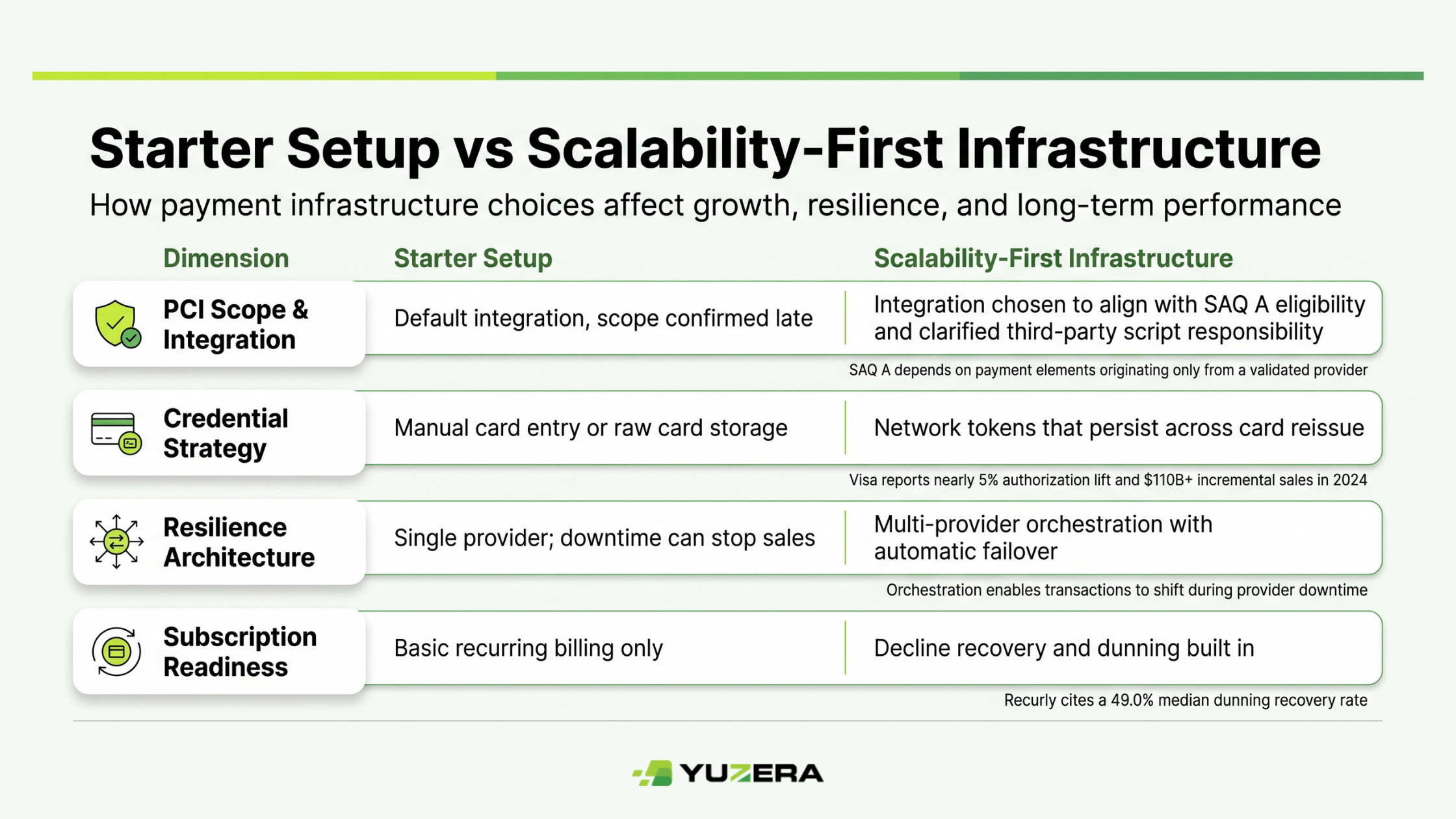
The table below compares common starter approaches against a scalable payment solution across the four decisions that govern growth. Each dimension is drawn from the sources cited throughout this guide.
| Dimension | Starter setup | Scalability-first infrastructure | Why it matters |
|---|---|---|---|
| PCI scope and integration | Default integration, scope confirmed late | Integration model chosen against SAQ A eligibility criteria, with third-party script responsibility understood | SAQ A eligibility hinges on all payment elements originating only from a validated provider |
| Credential strategy | Manual entry, raw card storage | Network tokens that persist across reissue | Visa reports nearly 5% authorization lift and $110B+ incremental sales in 2024 |
| Resilience architecture | Single provider, downtime equals lost sales | Orchestrated multi-provider routing with automatic failover | Citi describes transactions automatically shifting during provider downtime |
| Subscription payment processing readiness | Basic SaaS payment gateway with recurring billing | Decline recovery and dunning built in | Recurly cites a 49.0% median dunning recovery rate |
A scalability-first checklist for an online store
Use this ordered checklist to move from a reactive setup to a scalable payment solution designed for growth. Each step is an action with a reason behind it.
- Baseline checkout friction. Count form elements against the Baymard benchmark of 23.48 average versus an ideal 12 to 14 and reduce avoidable input burden.
- Design for shoppers who abandon over payment friction. Plan for missing card details, too much required information, and slow checkout, the top reasons Mastercard identifies.
- Choose an integration approach that matches PCI scope appetite. Decide between a fully outsourced SAQ A path and more in-scope models using PCI SSC’s eligibility criteria.
- Harden payment pages against script and tamper risk. Align with PCI DSS v4.0.1 and the e-skimming guidance, and make sure stakeholders understand the post-March 31, 2025 landscape.
- Future-proof saved credentials with network tokens. Reduce manual entry and capture the authorization and fraud improvements Visa reports.
- Treat decline recovery as a scalability requirement. For subscription payment processing, track sign-up declines, involuntary churn, and dunning recovery against Recurly’s benchmarks.
- Evaluate orchestration as channel and region complexity grows. An all-in-one payment platform uses routing and failover during provider downtime to stay online without a replatform.
- Plan authentication around EMV 3-D Secure. Build to the EMVCo specifications so new markets are a configuration change, not a rewrite.
- Confirm PCI scope through formal review. Validate SAQ eligibility for the exact environment with an acquirer or payment brand program before relying on it.
FAQ
Q1) What should an all-in-one payment solution for a small business in Canada include?
An all-in-one payment solution for a small business in Canada should cover face-to-face and e-commerce channels, a credential strategy built on network tokens, and decline recovery for recurring billing, all within a single coherent infrastructure. Payments Canada reported 22.5 billion retail transactions in 2024, with credit cards at 32% of the total, so credit card handling and tokenization matter from day one. Choosing a platform that spans both in-person and online now avoids the need to stitch separate systems together later.
Q2) How should a merchant plan a turnkey e-commerce payment setup that will not need rebuilding?
A turnkey e-commerce payment setup should be planned around the decisions that are expensive to reverse: the PCI integration model, the credential strategy, and the resilience architecture. Choosing network tokens and an orchestration-ready design early means adding payment methods or markets becomes a configuration change rather than a checkout rewrite, since Citi notes orchestration provides access to region-specific methods through routing. The goal is infrastructure that flexes with volume rather than breaking under it.
Q3) What does payment processing for new e-commerce stores need to get right first?
New e-commerce stores should get checkout friction and PCI scope right first, because both compound as volume grows. Baymard found that 18% of shoppers abandon at checkout due to a process that is too long or complicated, so a lean flow protects early conversion, while confirming SAQ A eligibility upfront prevents a compliance scramble later. Getting these two right early is cheaper than fixing them under load.
Q4) What should a payment gateway for SaaS companies in Canada prioritize?
A payment gateway for SaaS companies in Canada should prioritize network tokenization and decline recovery because subscription revenue depends on credentials that remain valid and payments that are retried intelligently. Recurly reports a 10.7% median sign-up decline rate and a 49.0% median dunning recovery rate, which means the gap between a SaaS payment gateway with recovery and one without is measured directly in retained revenue. Monitoring sign-up declines separately from renewal declines helps target the right fix.
Q5) How should payment processing for subscription services in Canada handle failed payments?
Payment processing for subscription services in Canada should handle failed payments with structured dunning and monitoring split by sign-up versus renewal. Recurly found that fraud and generic declines drive the majority of sign-up failures, while insufficient funds are the leading cause of renewal failures. A scalable system automatically applies intelligent dunning logic tailored to these specific failure codes, preventing involuntary churn from quietly eating into long-term growth.
Works Cited
- Baymard Institute. (2024). Checkout Optimization and Abandonment Rates.
- Citi. (2023). Payment Orchestration and Transaction Routing.
- EMVCo. (n.d.). 3-D Secure Specifications.
- Federal Reserve. (2025). 2025 Federal Reserve Payments Study (Covering 2024).
- Grand View Research. (2023). Global Payment Orchestration Platform Market Report.
- Mastercard. (2024). Digital Checkout Friction Report.
- Payments Canada. (2024). Retail Payment Transactions Report.
- PCI Security Standards Council. (2024). PCI DSS v4.0.1 and E-Skimming Guidance.
- Recurly. (2023). State of Subscriptions Benchmarks.
- Statistics Canada. (2024). Annual Retail Trade.
- U.S. Census Bureau. (2026). Quarterly Retail E-Commerce Sales (Q1 2026).
- Visa. (2024). Network Tokenization Metrics and Lift.